







Question: 7 . Consider the following payoffs from two countries ( Canada and the U . S . ) negotiating over reducing an air pollutant that
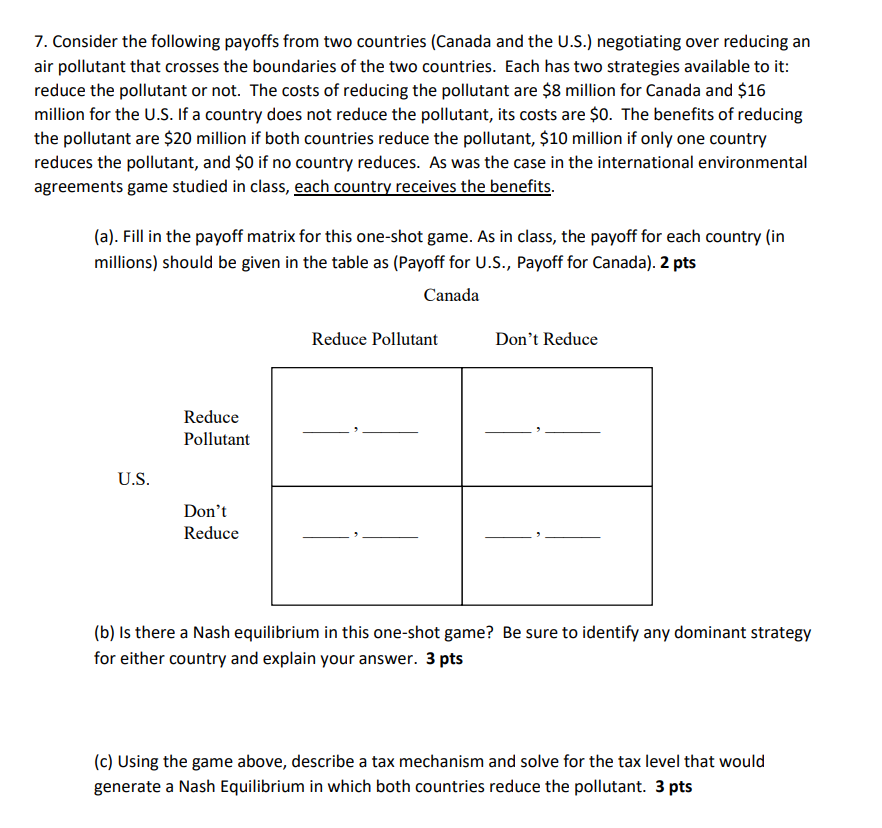
Consider the following payoffs from two countries Canada and the US negotiating over reducing an air pollutant that crosses the boundaries of the two countries. Each has two strategies available to it: reduce the pollutant or not. The costs of reducing the pollutant are $ million for Canada and $ million for the US If a country does not reduce the pollutant, its costs are $ The benefits of reducing the pollutant are $ million if both countries reduce the pollutant, $ million if only one country reduces the pollutant, and $ if no country reduces. As was the case in the international environmental agreements game studied in class, each country receives the benefits.
a Fill in the payoff matrix for this oneshot game. As in class, the payoff for each country in millions should be given in the table as Payoff for US Payoff for Canada pts
Canada
Reduce Pollutant
Don't Reduce
b Is there a Nash equilibrium in this oneshot game? Be sure to identify any dominant strategy for either country and explain your answer. pts
c Using the game above, describe a tax mechanism and solve for the tax level that would generate a Nash Equilibrium in which both countries reduce the pollutant. mathbf pts
Step by Step Solution
There are 3 Steps involved in it
1 Expert Approved Answer
Step: 1 Unlock

Question Has Been Solved by an Expert!
Get step-by-step solutions from verified subject matter experts
Step: 2 Unlock
Step: 3 Unlock
 Study Help