







Question: 7. Data were collected during an experiment that used two identical cars, car 1 and car 2, moving along a one- dimensional track. Car 1
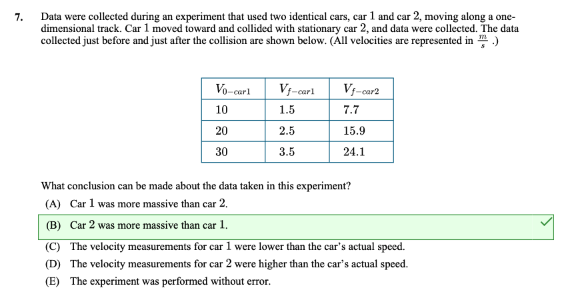
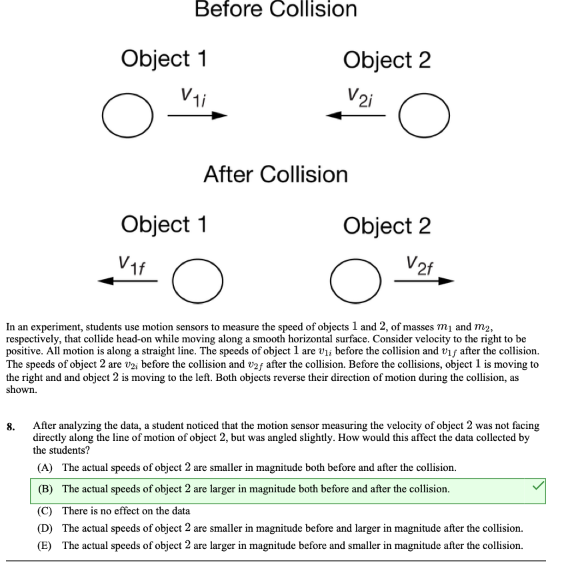
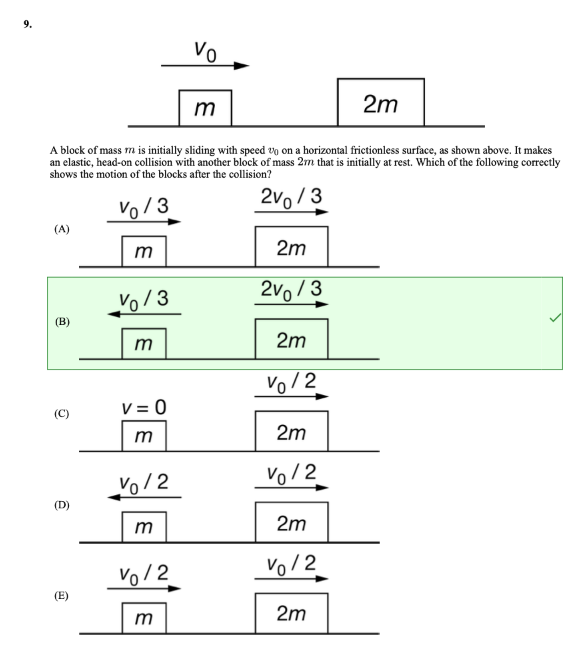
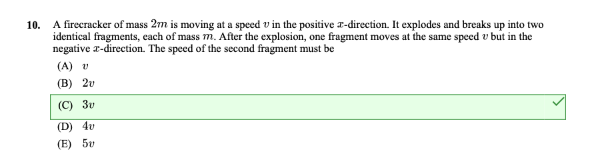
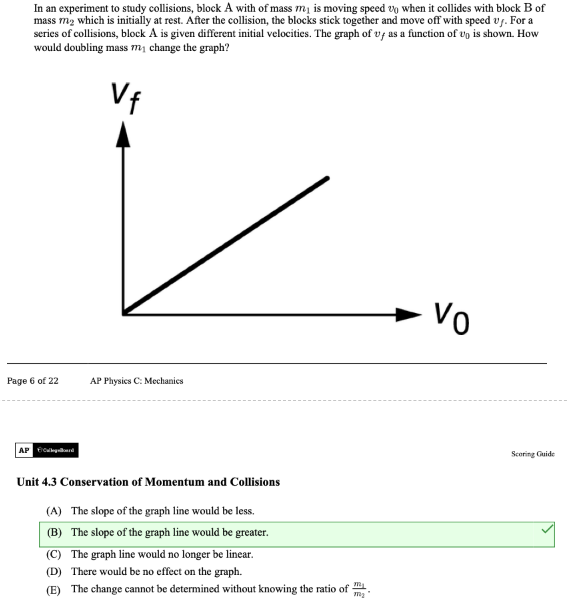
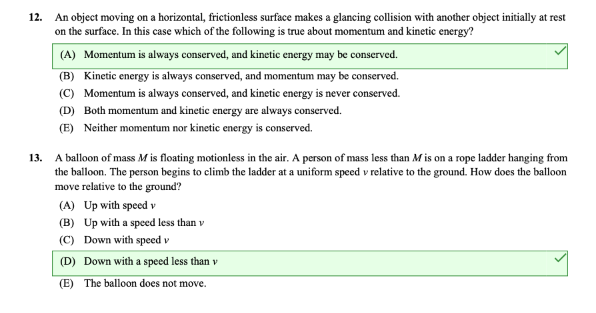
7. Data were collected during an experiment that used two identical cars, car 1 and car 2, moving along a one- dimensional track. Car 1 moved toward and collided with stationary car 2, and data were collected. The data collected just before and just after the collision are shown below. (All velocities are represented in .) Vo-carl Vf-carl Vf-car? 10 1.5 7.7 20 2.5 15.9 30 3.5 24.1 What conclusion can be made about the data taken in this experiment? (A) Car I was more massive than car 2. (B) Car 2 was more massive than car 1. (C) The velocity measurements for car I were lower than the car's actual speed. (D) The velocity measurements for car 2 were higher than the car's actual speed. (E) The experiment was performed without error.Before Collision Object 1 Object 2 O Vai V2i O After Collision Object 1 Object 2 Vif O O V 2f In an experiment, students use motion sensors to measure the speed of objects 1 and 2, of masses mj and me, respectively, that collide head-on while moving along a smooth horizontal surface. Consider velocity to the right to be positive. All motion is along a straight line. The speeds of object 1 are Vi, before the collision and thy after the collision. The speeds of object 2 are v2, before the collision and vay after the collision. Before the collisions, object 1 is moving to the right and and object 2 is moving to the left. Both objects reverse their direction of motion during the collision, as shown. 8. After analyzing the data, a student noticed that the motion sensor measuring the velocity of object 2 was not facing directly along the line of motion of object 2, but was angled slightly. How would this affect the data collected by the students? (A) The actual speeds of object 2 are smaller in magnitude both before and after the collision. "B) The actual speeds of object 2 are larger in magnitude both before and after the collision. (C) There is no effect on the data (D) The actual speeds of object 2 are smaller in magnitude before and larger in magnitude after the collision. (E) The actual speeds of object 2 are larger in magnitude before and smaller in magnitude after the collision.9. Vo m 2m A block of mass m is initially sliding with speed vo on a horizontal frictionless surface, as shown above. It makes an elastic, head-on collision with another block of mass 2m that is initially at rest. Which of the following correctly shows the motion of the blocks after the collision? Vo / 3 2vo / 3 (A) m 2m Vo / 3 2Vo / 3 (B) m 2m Vo / 2 V= 0 m 2m Vo / 2 Vo / 2 (D) m 2m Vo / 2 Vo / 2 (E) m 2m10. A firecracker of mass 27 is moving at a speed U in the positive T-direction. It explodes and breaks up into two identical fragments, each of mass m. After the explosion, one fragment moves at the same speed v but in the negative T-direction. The speed of the second fragment must be (A) U (B) 20 (C) 30 (D) 4u (E) 5uIn an experiment to study collisions, block A with of mass my is moving speed Up when it collides with block B of mass my which is initially at rest. After the collision, the blocks stick together and move off with speed vy. For a series of collisions, block A is given different initial velocities. The graph of vy as a function of up is shown. How would doubling mass my change the graph? Vf - VO Page 6 of 22 AP Physics C. Mechanics AP Fokkand Scoring Guide Unit 4.3 Conservation of Momentum and Collisions (A) The slope of the graph line would be less. (B) The slope of the graph line would be greater. (C) The graph line would no longer be linear. (D) There would be no effect on the graph. (E) The change cannot be determined without knowing the ratio of It.12. An object moving on a horizontal, frictionless surface makes a glancing collision with another object initially at rest on the surface. In this case which of the following is true about momentum and kinetic energy? (A) Momentum is always conserved, and kinetic energy may be conserved. (B) Kinetic energy is always conserved, and momentum may be conserved. (C) Momentum is always conserved, and kinetic energy is never conserved. (D) Both momentum and kinetic energy are always conserved. (E) Neither momentum nor kinetic energy is conserved. 13. A balloon of mass M is floating motionless in the air. A person of mass less than Mis on a rope ladder hanging from the balloon. The person begins to climb the ladder at a uniform speed v relative to the ground. How does the balloon move relative to the ground? (A) Up with speed v (B) Up with a speed less than v (C) Down with speed v (D) Down with a speed less than v (E) The balloon does not move
Step by Step Solution
There are 3 Steps involved in it

Get step-by-step solutions from verified subject matter experts
 Study Help