







Question: 7 ) Field Infiltration The initial infiltration rate is observed when a dry soil quickly absorbs water, meanwhile the basic infiltration rate occurs when the
Field Infiltration
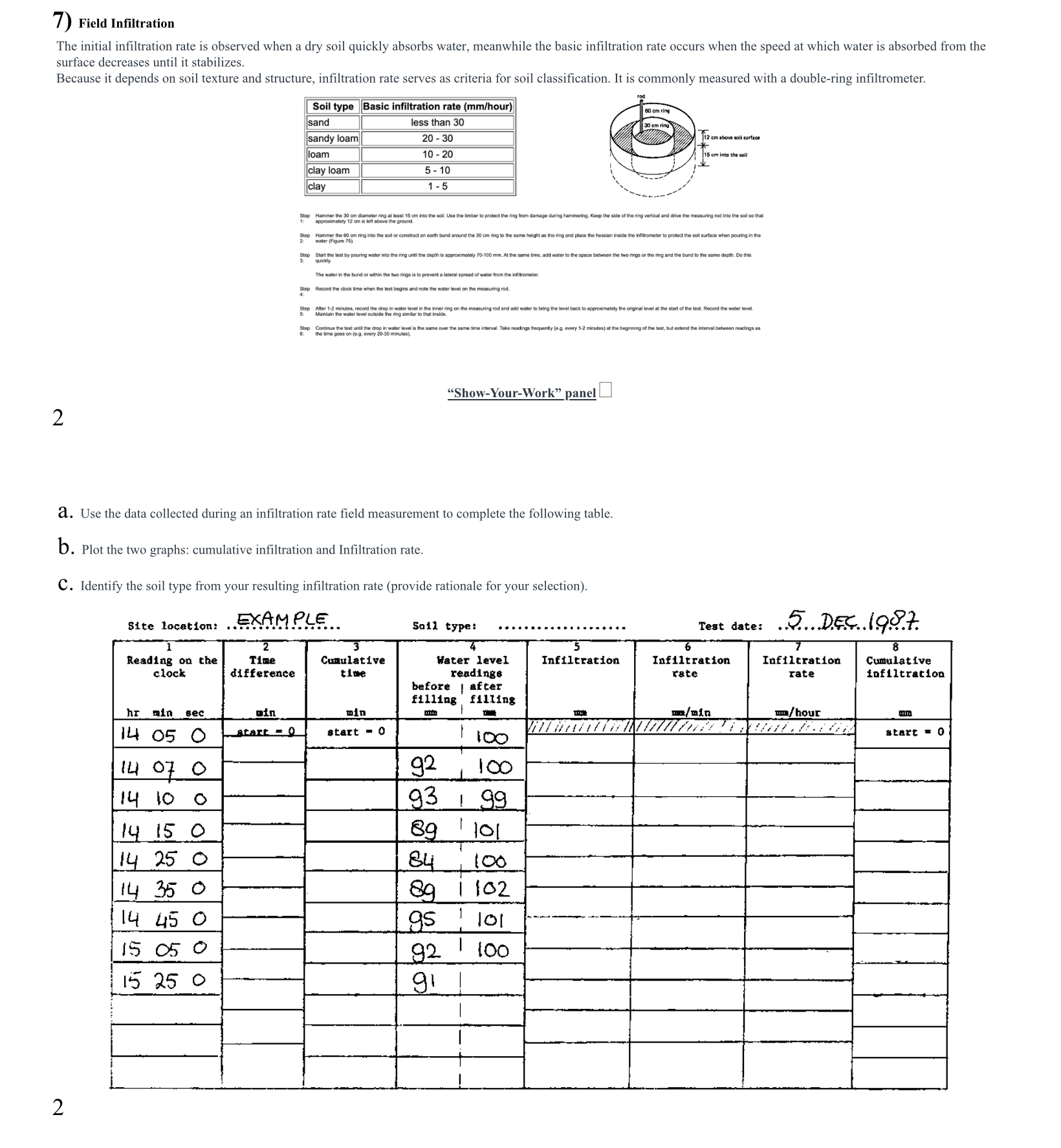
The initial infiltration rate is observed when a dry soil quickly absorbs water, meanwhile the basic infiltration rate occurs when the speed at which water is absorbed from the surface decreases until it stabilizes.
Because it depends on soil texture and structure, infiltration rate serves as criteria for soil classification. It is commonly measured with a doublering infiltrometer.
begintabularlc
hline Soil type & Basic infiltration rate mmhour
hline sand & less than
hline sandy loam &
hline loam &
hline Clay loam &
hline clay &
hline hline
endtabular
Step Hammer the cm diameter ring at least am into the soil. Use the timber to protect the ring from damage during hammering. Keep the side of the ring vertical and drive the measuring rod into the soil so that:
Step Hammer the cm ring info the soil or construct an earth bund around the cm ring to the same height as the ring and place the hessian inside the inflitrometer to protect the sol surface when pouring in the
Step Hammer the an
Step Start the test by pouring water into the ring until the depth is approximately mm At the same time, add water to the space between the two rings or the ring and the bund to the same dapth. Do this
The water in the bund or within the two rings is to prevent a lateral spread of water from the inflitrometer.
Step Reoord the clock time when the test begins and note the water level on the moasuring rod.
Step After minutes, record the drop in water level in the inner ring on the measuring rod and add water to bring the level back to approximately the original level at the start of the test. Record the water level.
Maintain the water level outside the ring similar to that inside.
"ShowYourWork" panel square
a Use the data collected during an infiltration rate field measurement to complete the following table.
b Plot the two graphs: cumulative infiltration and Infiltration rate.
C Identify the soil type from your resulting infiltration rate provide rationale for your selection
Step by Step Solution
There are 3 Steps involved in it
1 Expert Approved Answer
Step: 1 Unlock

Question Has Been Solved by an Expert!
Get step-by-step solutions from verified subject matter experts
Step: 2 Unlock
Step: 3 Unlock
 Study Help