


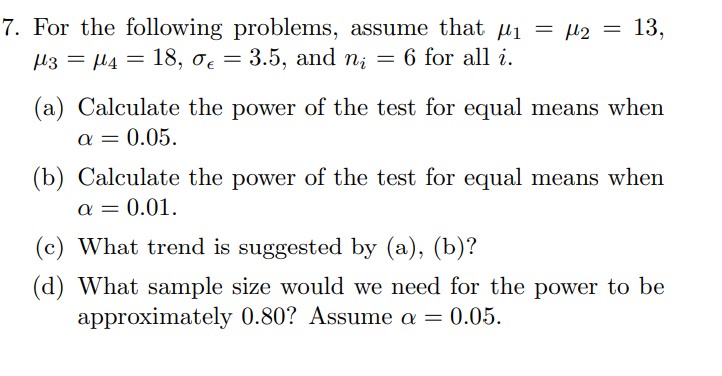
Question: 7. For the following problems, assume that p; = ps = 13, p3 = g = 18, 0. = 3.5, and n; = 6 for
7. For the following problems, assume that p; =7. For the following problems, assume that p; =7. For the following problems, assume that p; =
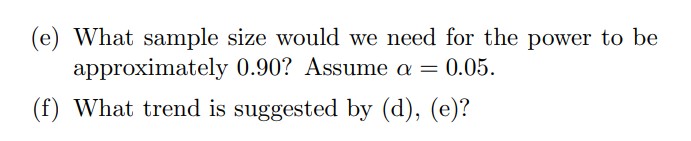
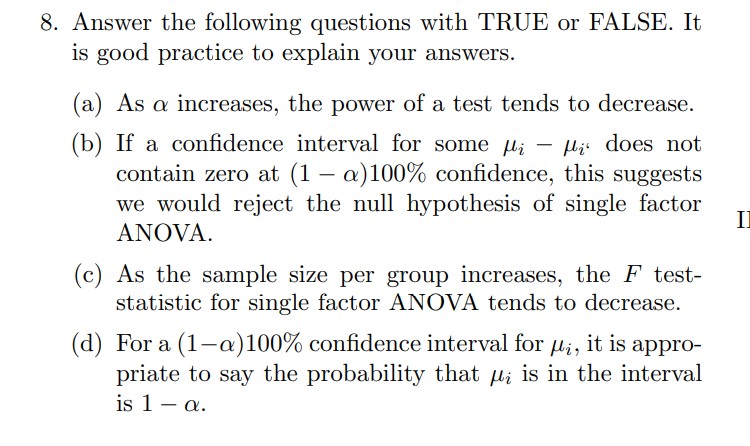
7. For the following problems, assume that p; = ps = 13, p3 = g = 18, 0. = 3.5, and n; = 6 for all 7. (a) Calculate the power of the test for equal means when a = 0.05. (b) Calculate the power of the test for equal means when a = 0.01. (c) What trend is suggested by (a), (b)? (d) What sample size would we need for the power to be approximately 0.807 Assume a = 0.05. (e) What sample size would we need for the power to be approximately 0.907 Assume o = 0.05. (f) What trend is suggested by (d), (e)? 8. Answer the following questions with TRUE or FALSE. It is good practice to explain your answers. (a) As a increases, the power of a test tends to decrease. (b) If a confidence interval for some pu; p; does not contain zero at (1 )100% confidence, this suggests we would reject the null hypothesis of single factor ANOVA. () As the sample size per group increases, the F test- statistic for single factor ANOVA tends to decrease. (d) Fora (1a)100% confidence interval for ji;, it is appro- priate to say the probability that pu; is in the interval is 1 a
Step by Step Solution

There are 3 Steps involved in it

1 Expert Approved Answer
Step: 1 Unlock blur-text-image
Question Has Been Solved by an Expert!

Get step-by-step solutions from verified subject matter experts

Step: 2 Unlock
Step: 3 Unlock

Students Have Also Explored These Related Mathematics Questions!