Question: 7. How can managers effectively plan when the external environment is continually changing? A. They should set general, but rigid plans. B. They should continue
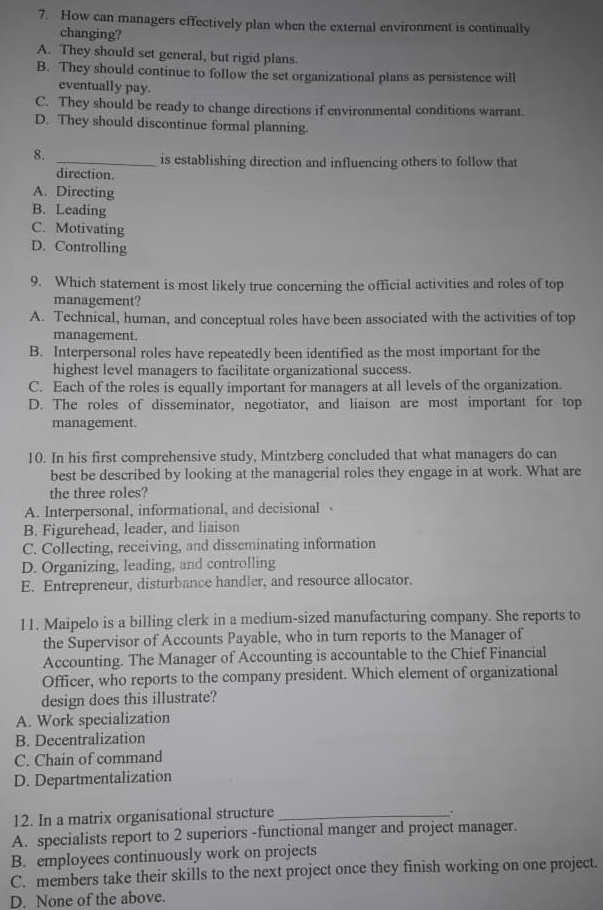
7. How can managers effectively plan when the external environment is continually changing? A. They should set general, but rigid plans. B. They should continue to follow the set organizational plans as persistence will eventually pay C. They should be ready to change directions if environmental conditions warrant D. They should discontinue formal planning. is establishing direction and influencing others to follow that 8. direction. A. Directing B. Leading C. Motivating D. Controlling 9. Which statement is most likely true concerning the official activities and roles of top management? A. Technical, human, and conceptual roles have been associated with the activities of top management. B. Interpersonal roles have repeatedly been identified as the most important for the highest level managers to facilitate organizational success. C. Each of the roles is equally important for managers at all levels of the organization. D. The roles of disseminator, negotiator, and liaison are most important for top management 10. In his first comprehensive study, Mintzberg concluded that what managers do can best be described by looking at the managerial roles they engage in at work. What are the three roles? A. Interpersonal, informational, and decisional B. Figurehead, leader, and liaison C. Collecting, receiving, and disseminating information D. Organizing, leading, and controlling E. Entrepreneur, disturbance handler, and resource allocator. 11. Maipelo is a billing clerk in a medium-sized manufacturing company. She reports to the Supervisor of Accounts Payable, who in turn reports to the Manager of Accounting. The Manager of Accounting is accountable to the Chief Financial Officer, who reports to the company president. Which element of organizational design does this illustrate? A. Work specialization B. Decentralization C. Chain of command D. Departmentalization 12. In a matrix organisational structure A. specialists report to 2 superiors -functional manger and project manager. B. employees continuously work on projects C. members take their skills to the next project once they finish working on one project D. None of the above









 Study Help