







Question: 7. In this problem we are going to analyze the difference in risk premium for a small village lender and a large formal banking institution
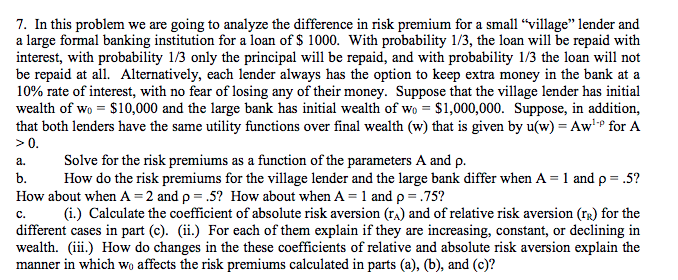
7. In this problem we are going to analyze the difference in risk premium for a small "village" lender and a large formal banking institution for a loan of S 1000. With probability l/3, the loan will be repaid with interest, with probability 1/3 only the principal will be repaid, and with probability 1/3 the loan will not be repaid at all. Alternatively, each lender always has the option to keep extra money in the bank at a 10% rate of interest, with no fear of losing any of their money. Suppose that the village lender has initial wealth of wo = $10,000 and the large bank has initial wealth of wo = $1,000,000. Suppose, in addition, that both lenders have the same utility functions over final wealth (w) that is given by u(w)-Aw"P for A 2 a. Solve for the risk premiums as a function of the parameters A and . How do the risk premiums for the village lender and the large bank differ when A-1 and ,5? How about when A 2 and p-.5? How about when A-1 and p-.75? c. (i.) Calculate the coefficient of absolute risk aversion (ra) and of relative risk aversion (rR) for the different cases in part (c). (ii.) For each of them explain if they are increasing, constant, or declining in wealth. (ii.) How do changes in the these coefficients of relative and absolute risk aversion explain the manner in which wo affects the risk premiums calculated in parts (a), (b), and (c)? 7. In this problem we are going to analyze the difference in risk premium for a small "village" lender and a large formal banking institution for a loan of S 1000. With probability l/3, the loan will be repaid with interest, with probability 1/3 only the principal will be repaid, and with probability 1/3 the loan will not be repaid at all. Alternatively, each lender always has the option to keep extra money in the bank at a 10% rate of interest, with no fear of losing any of their money. Suppose that the village lender has initial wealth of wo = $10,000 and the large bank has initial wealth of wo = $1,000,000. Suppose, in addition, that both lenders have the same utility functions over final wealth (w) that is given by u(w)-Aw"P for A 2 a. Solve for the risk premiums as a function of the parameters A and . How do the risk premiums for the village lender and the large bank differ when A-1 and ,5? How about when A 2 and p-.5? How about when A-1 and p-.75? c. (i.) Calculate the coefficient of absolute risk aversion (ra) and of relative risk aversion (rR) for the different cases in part (c). (ii.) For each of them explain if they are increasing, constant, or declining in wealth. (ii.) How do changes in the these coefficients of relative and absolute risk aversion explain the manner in which wo affects the risk premiums calculated in parts (a), (b), and (c)
Step by Step Solution
There are 3 Steps involved in it

Get step-by-step solutions from verified subject matter experts
 Study Help