







Question: (7 marks) Ito calculus. (a) (3 marks) Let X(t) and Y(t) be two stochastic processes, such that dXdY=X(X(t),t)dt+X(X(t),t)dZX=Y(Y(t),t)dt+Y(Y(t),t)dZY with dZX(t),dZY(t) being the increments for two
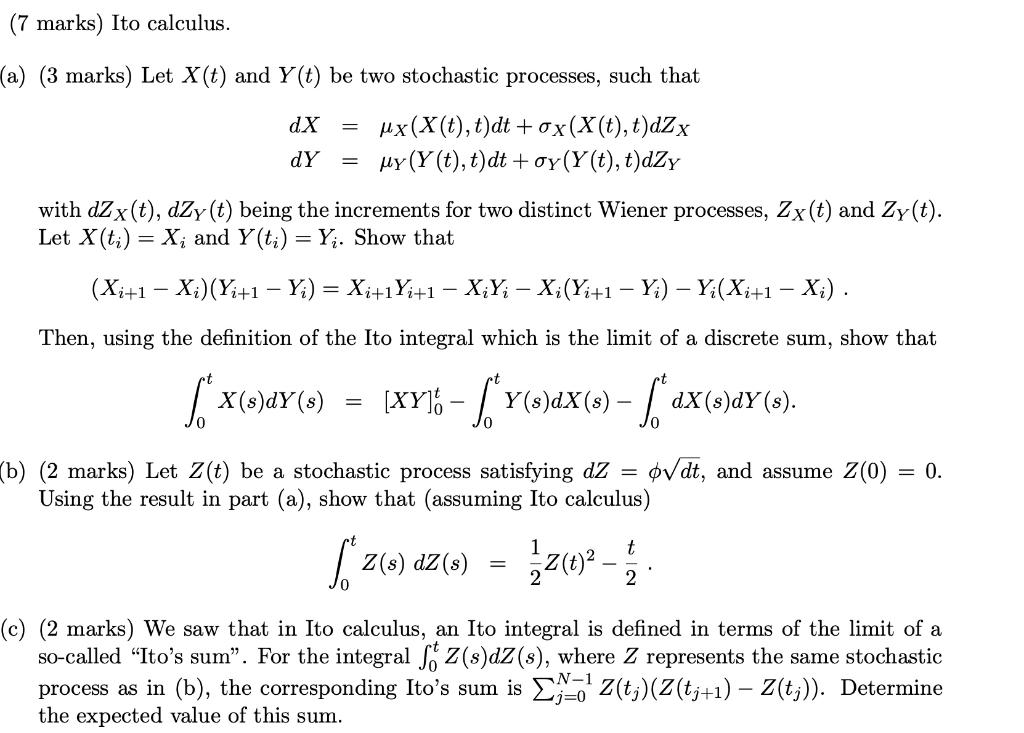
(7 marks) Ito calculus. (a) (3 marks) Let X(t) and Y(t) be two stochastic processes, such that dXdY=X(X(t),t)dt+X(X(t),t)dZX=Y(Y(t),t)dt+Y(Y(t),t)dZY with dZX(t),dZY(t) being the increments for two distinct Wiener processes, ZX(t) and ZY(t). Let X(ti)=Xi and Y(ti)=Yi. Show that (Xi+1Xi)(Yi+1Yi)=Xi+1Yi+1XiYiXi(Yi+1Yi)Yi(Xi+1Xi). Then, using the definition of the Ito integral which is the limit of a discrete sum, show that 0tX(s)dY(s)=[XY]0t0tY(s)dX(s)0tdX(s)dY(s) (b) (2 marks) Let Z(t) be a stochastic process satisfying dZ=dt, and assume Z(0)=0. Using the result in part (a), show that (assuming Ito calculus) 0tZ(s)dZ(s)=21Z(t)22t. (c) (2 marks) We saw that in Ito calculus, an Ito integral is defined in terms of the limit of a so-called "Ito's sum". For the integral 0tZ(s)dZ(s), where Z represents the same stochastic process as in (b), the corresponding Ito's sum is j=0N1Z(tj)(Z(tj+1)Z(tj)). Determine the expected value of this sum
Step by Step Solution
There are 3 Steps involved in it

Get step-by-step solutions from verified subject matter experts
 Study Help