







Question: 7. Multiple Choices. Select ALL that are correet (10 points, partially correct answers wi get credit). Which best describes the Ethernet protocol? ll NOT A.
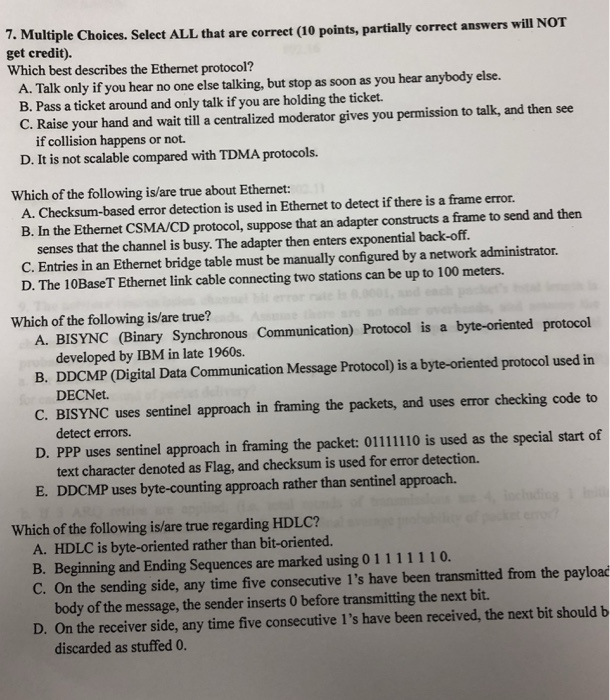
7. Multiple Choices. Select ALL that are correet (10 points, partially correct answers wi get credit). Which best describes the Ethernet protocol? ll NOT A. Talk only if you hear no one else talking, but stop as soon as you hear anybody else. B. Pass a ticket around and only talk if you are holding the ticket. C. Raise your hand and wait till a centralized moderator gives you permission to talk, and then see if collision happens or not. D. It is not scalable compared with TDMA protocols. Which of the following is/are true about Ethernet: A. Checksum-based error detection is used in Ethernet to detect if there is a frame error. B. In the Ethernet CSMA/CD protocol, suppose that an adapter constructs a frame to send and then senses that the channel is busy. The adapter then enters exponential back-off. C. Entries in an Ethernet bridge table must be manually configured by a network administrator. D. The 10BaseT Ethernet link cable connecting two stations can be up to 100 meters. Which of the following is/are true? A. BISYNC (Binary Synchronous Communication) Protocol is a byte-oriented protocol developed by IBM in late 1960s. DDCMP (Digital Data Communication Message Protocol) is a byte-oriented protocol used in DECNet. B. C. BISYNC uses sentinel approach in framing the packets, and uses error checking code to D. PPP uses sentinel approach in framing the packet: 01111110 is used as the special start of E. DDCMP uses byte-counting approach rather than sentinel approach. detect errors. text character denoted as Flag, and checksum is used for error detection. Which of the following is/are true regarding HDLC? A. HDLC is byte-oriented rather than bit-oriented. B. Beginning and Ending Sequences are marked using 0 1111110. C. On the sending side, any time five consecutive I's have been transmitted from the payload body of the message, the sender inserts 0 before transmitting the next bit. D. On the receiver side, any time five consecutive 1's have been received, the next bit should b discarded as stuffed 0
Step by Step Solution
There are 3 Steps involved in it

Get step-by-step solutions from verified subject matter experts
 Study Help