


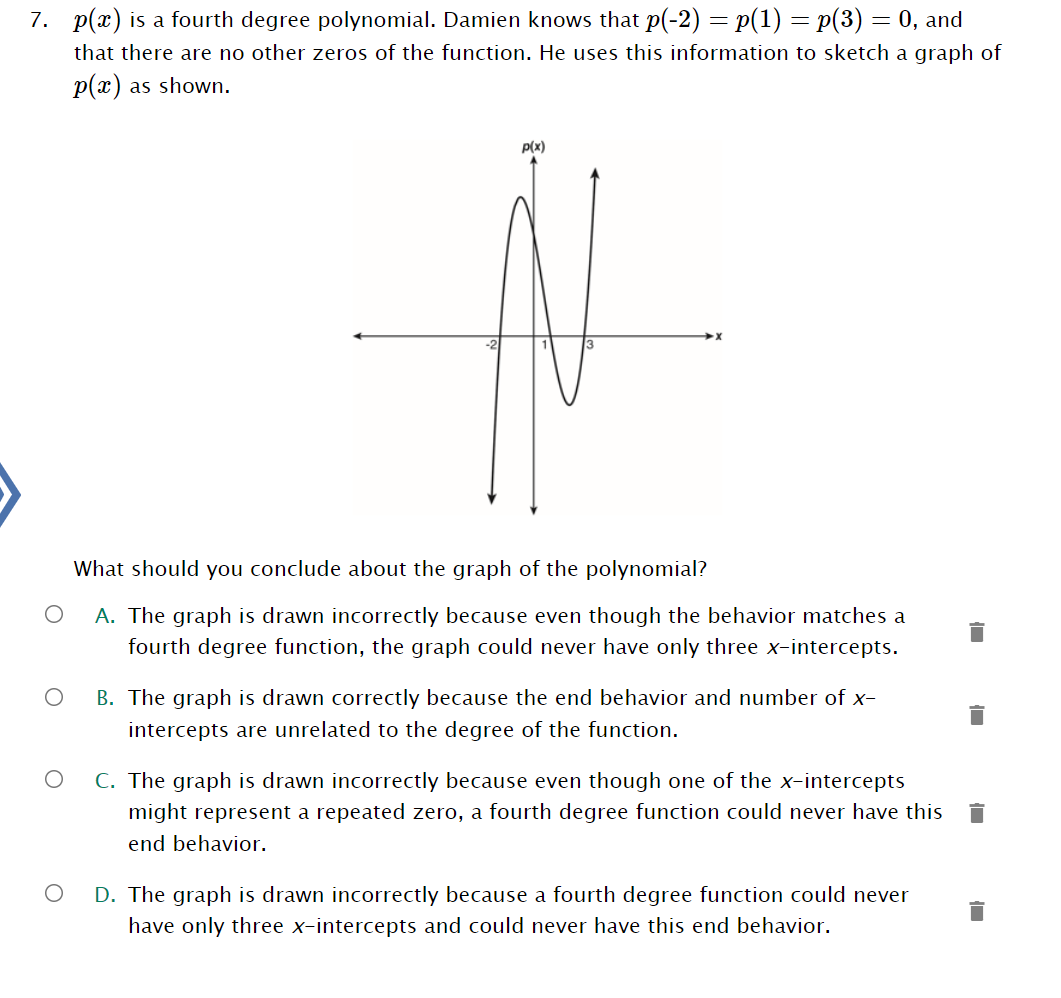
Question: 7. p(:r:) is a fourth degree polynomial. Damien knows that p(2) : 33(1) : 39(3) : 0, and that there are no other zeros of
7. p(:r:) is a fourth degree polynomial. Damien7. p(:r:) is a fourth degree polynomial. Damien7. p(:r:) is a fourth degree polynomial. Damien
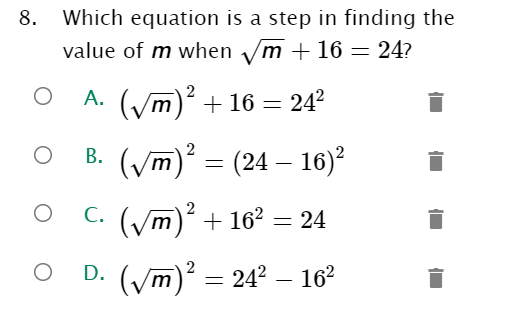
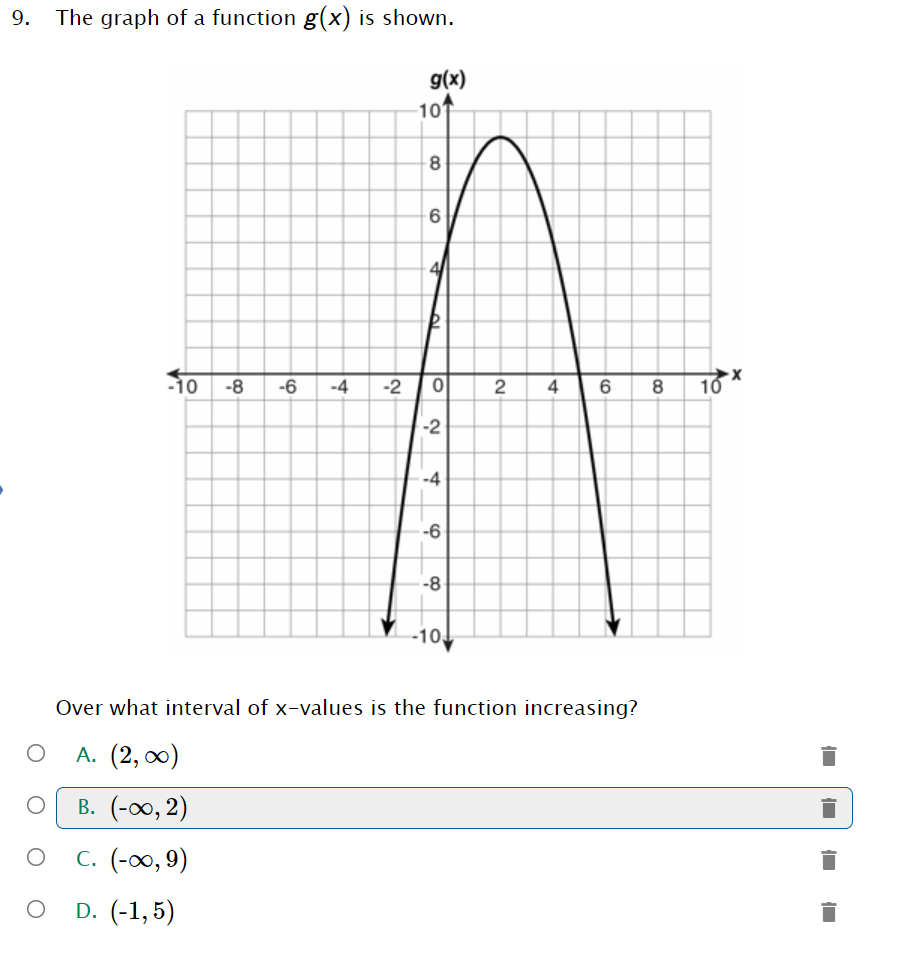
7. p(:r:) is a fourth degree polynomial. Damien knows that p(2) : 33(1) : 39(3) : 0, and that there are no other zeros of the function. He uses this information to sketch a graph of p(;t:) as shown. Hm What should you conclude about the graph of the polynomial? O A. The graph is drawn incorrectly because even though the behavior matches a __ fourth degree function, the graph could never have only three Xintercepts. O B. The graph is drawn correctly because the end behavior and number of X intercepts are unrelated to the degree of the function. 0 C. The graph is drawn incorrectly because even though one of the Xintercepts might represent a repeated zero, a fourth degree function could never have this | end behavior. 0 D. The graph is drawn incorrectly because a fourth degree function could never __ have only three xintercepts and could never have this end behavior. \f9. The graph of a function g(x) is shown. g(x) 101 8 6 TO -10 -8 -6 -4 -2 0 2 4 6 8 10 * -2 -4 -6 -8 Over what interval of x-values is the function increasing? O A. (2, 00 ) O B. (-00, 2) O C. (-00, 9) O D. (-1, 5)
Step by Step Solution

There are 3 Steps involved in it

1 Expert Approved Answer
Step: 1 Unlock blur-text-image

Question Has Been Solved by an Expert!

Get step-by-step solutions from verified subject matter experts

Step: 2 Unlock
Step: 3 Unlock

Students Have Also Explored These Related Mathematics Questions!