







Question: (7 pts.) A computer with 4 digit precision would recognize the given values as follows: 0.3142 x 101 12347.89 - 0.1235 x 10⁵ 0.0001231234 0.1231
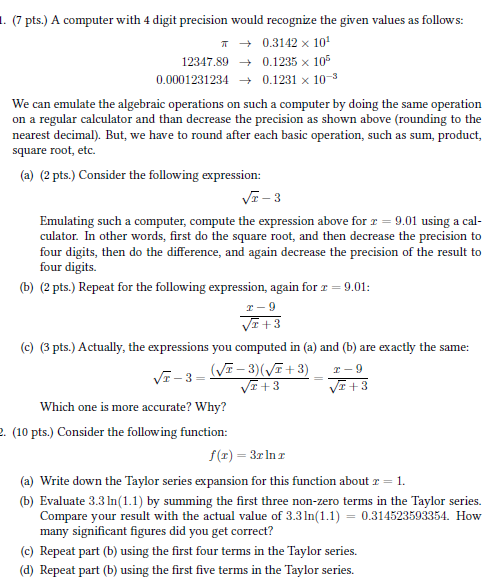
(7 pts.) A computer with 4 digit precision would recognize the given values as follows: 0.3142 x 101 12347.89 - 0.1235 x 10⁵ 0.0001231234 0.1231 x 10⁻³ We can emulate the algebraic operations on such a computer by doing the same operation on a regular calculator and than decrease the precision as shown above (rounding to the nearest decimal). But, we have to round after each basic operation, such as sum, product, square root, etc. (a) (2 pts.) Consider the following expression: Vr - 3 Emulating such a computer, compute the expression above for r = 9.01 using a cal- culator. In other words, first do the square root, and then decrease the precision to four digits, then do the difference, and again decrease the precision of the result to four digits. (b) (2 pts.) Repeat for the following expression, again for r = 9.01: r- 9 VI + 3 (c) (3 pts.) Actually, the expressions you computed in (a) and (b) are exactly the same: VI -3_ (VI-3)(vr+ 3) vr+ 3 VI + 3 Which one is more accurate? Why? (10 pts.) Consider the following function: f(x) = 3rlnr (a) Write down the Taylor series expansion for this function about r = 1. (b) Evaluate 3.3 In(1.1) by summing the first three non-zero terms in the Taylor series. Compare your result with the actual value of 3.3In(1.1) = 0.314523593354. How many significant figures did you get correct? (c) Repeat part (b) using the first four terms in the Taylor series. (d) Repeat part (b) using the first five terms in the Taylor series
Step by Step Solution
There are 3 Steps involved in it

Get step-by-step solutions from verified subject matter experts
 Study Help