







Question: 7. Silvaco simulation. LOCOS has been used to isolate individual devices on a chip. In this Silvaco simulation you will examine the narrow ends of
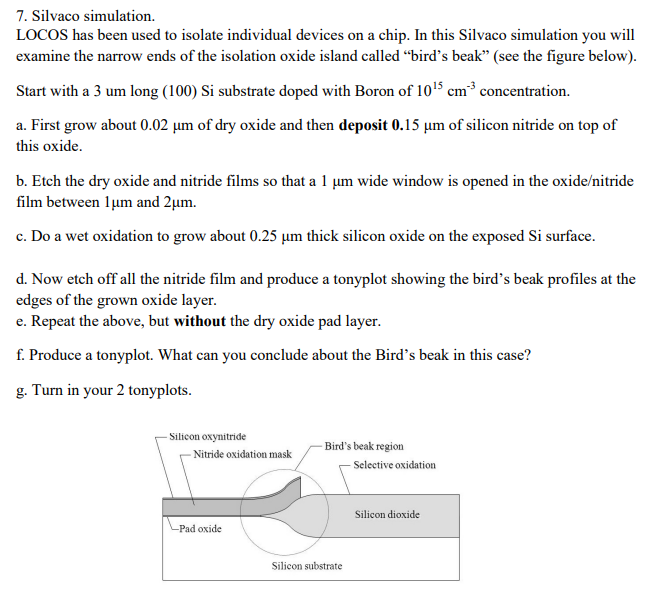
7. Silvaco simulation. LOCOS has been used to isolate individual devices on a chip. In this Silvaco simulation you will examine the narrow ends of the isolation oxide island called "bird's beak" (see the figure below). Start with a 3 um long (100) Si substrate doped with Boron of 10"> cm" concentration. a. First grow about 0.02 um of dry oxide and then deposit 0.15 um of silicon nitride on top of this oxide. b. Etch the dry oxide and nitride films so that a 1 um wide window is opened in the oxideitride film between 1 um and 2um. c. Do a wet oxidation to grow about 0.25 um thick silicon oxide on the exposed Si surface. d. Now etch off all the nitride film and produce a tonyplot showing the bird's beak profiles at the edges of the grown oxide layer. e. Repeat the above, but without the dry oxide pad layer. f. Produce a tonyplot. What can you conclude about the Bird's beak in this case? g. Turn in your 2 tonyplots. - Silicon oxynitride Bird's beak region - Nitride oxidation mask Selective oxidation Silicon dioxide -Pad oxide Silicon substrate
Step by Step Solution
There are 3 Steps involved in it

Get step-by-step solutions from verified subject matter experts
 Study Help