







Question: 7. The following backtracking algorithm is used to 3-color the graph shown below. Recall that in a proper k-coloring of a graph, nodes are each
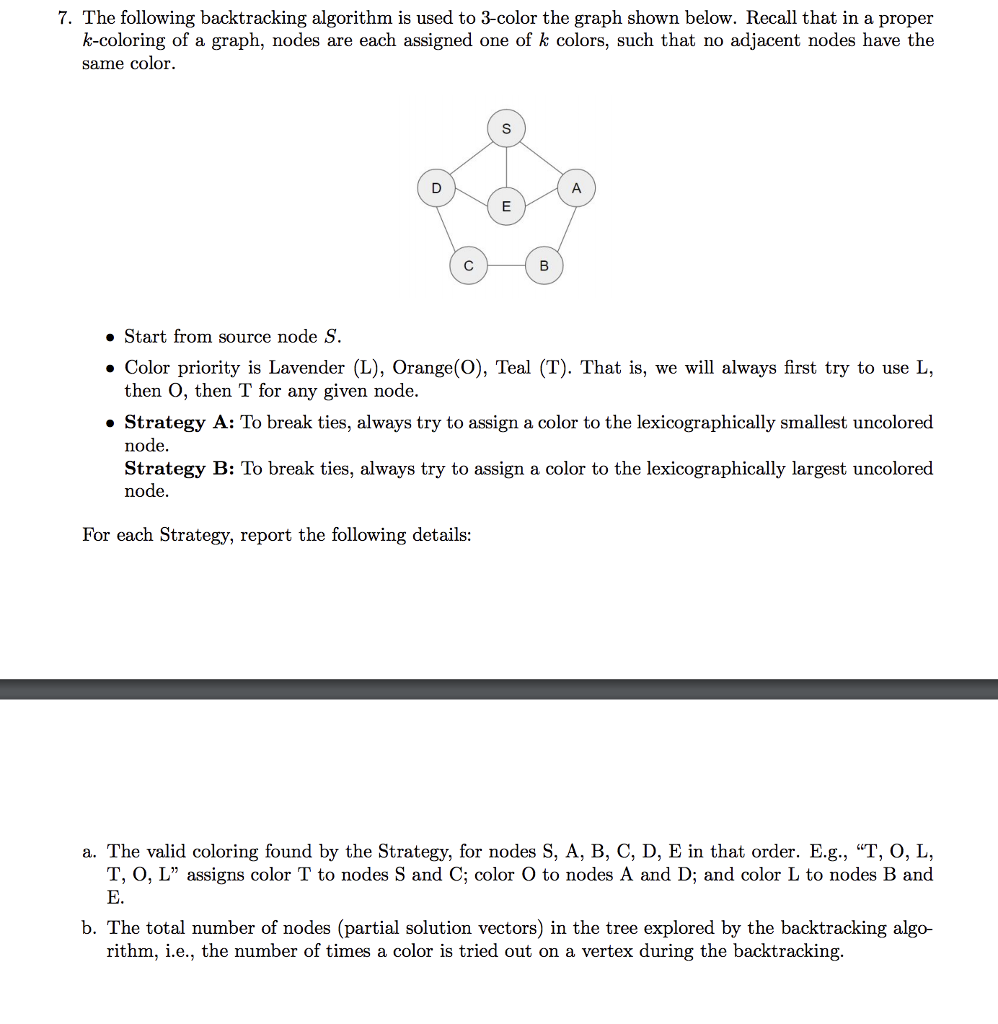
7. The following backtracking algorithm is used to 3-color the graph shown below. Recall that in a proper k-coloring of a graph, nodes are each assigned one of k colors, such that no adjacent nodes have the same color Start from source node S. Color priority is Lavender (L), Orange(O), Teal (T). That is, we will always first try to use L then O, then T for any given node Strategy A: To break ties, always try to assign a color to the lexicographically smallest uncolored node. Strategy B: To break ties, always try to assign a color to the lexicographically largest uncolored node. For each Strategy, report the following details: a. The valid coloring found by the Strategy, for nodes S, A, B, C, D, E in that order. E.g., "T, O, L, T, O, L" assigns color T to nodes S and C; color O to nodes A and D; and color L to nodes B and E. b. The total number of nodes (partial solution vectors) in the tree explored by the backtracking algo- rithm, i.e., the number of times a color is tried out on a vertex during the backtracking
Step by Step Solution
There are 3 Steps involved in it

Get step-by-step solutions from verified subject matter experts
 Study Help