







Question: 7. There are many ways for making a phosphate buffer. Depending on what is available in the lab, a phosphate buffer can be made from:
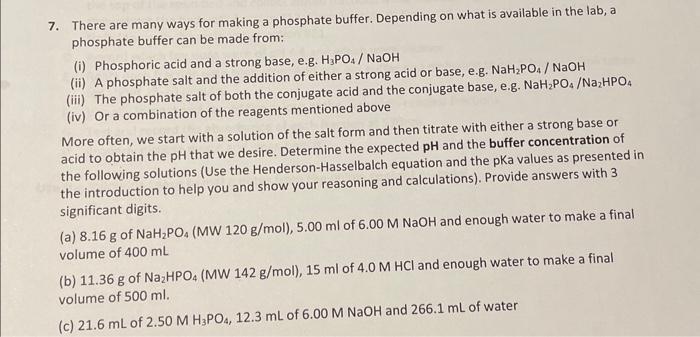
7. There are many ways for making a phosphate buffer. Depending on what is available in the lab, a phosphate buffer can be made from: (i) Phosphoric acid and a strong base, e.g. H3PO4/NaOH (ii) A phosphate salt and the addition of either a strong acid or base, e.g. NaH2PO4/NaOH (iii) The phosphate salt of both the conjugate acid and the conjugate base, e.g. NaH2PO4/Na2HPO4 (iv) Or a combination of the reagents mentioned above More often, we start with a solution of the salt form and then titrate with either a strong base or acid to obtain the pH that we desire. Determine the expected pH and the buffer concentration of the following solutions (Use the Henderson-Hasselbalch equation and the pKa values as presented in the introduction to help you and show your reasoning and calculations). Provide answers with 3 significant digits. (a) 8.16g of NaH2PO4 (MW 120g/mol ), 5.00ml of 6.00MNaOH and enough water to make a final volume of 400mL (b) 11.36g of Na2HPO4 (MW 142g/mol ), 15ml of 4.0MHCl and enough water to make a final volume of 500ml. (c) 21.6mL of 2.50MH3PO4,12.3mL of 6.00MNaOH and 266.1mL of water
Step by Step Solution
There are 3 Steps involved in it

Get step-by-step solutions from verified subject matter experts
 Study Help