







Question: #7: Use the Q7 dataframe. You want a 'good' model predicting Wins from all variables (without interactions). Perform the 'all possible' approach, which produces a
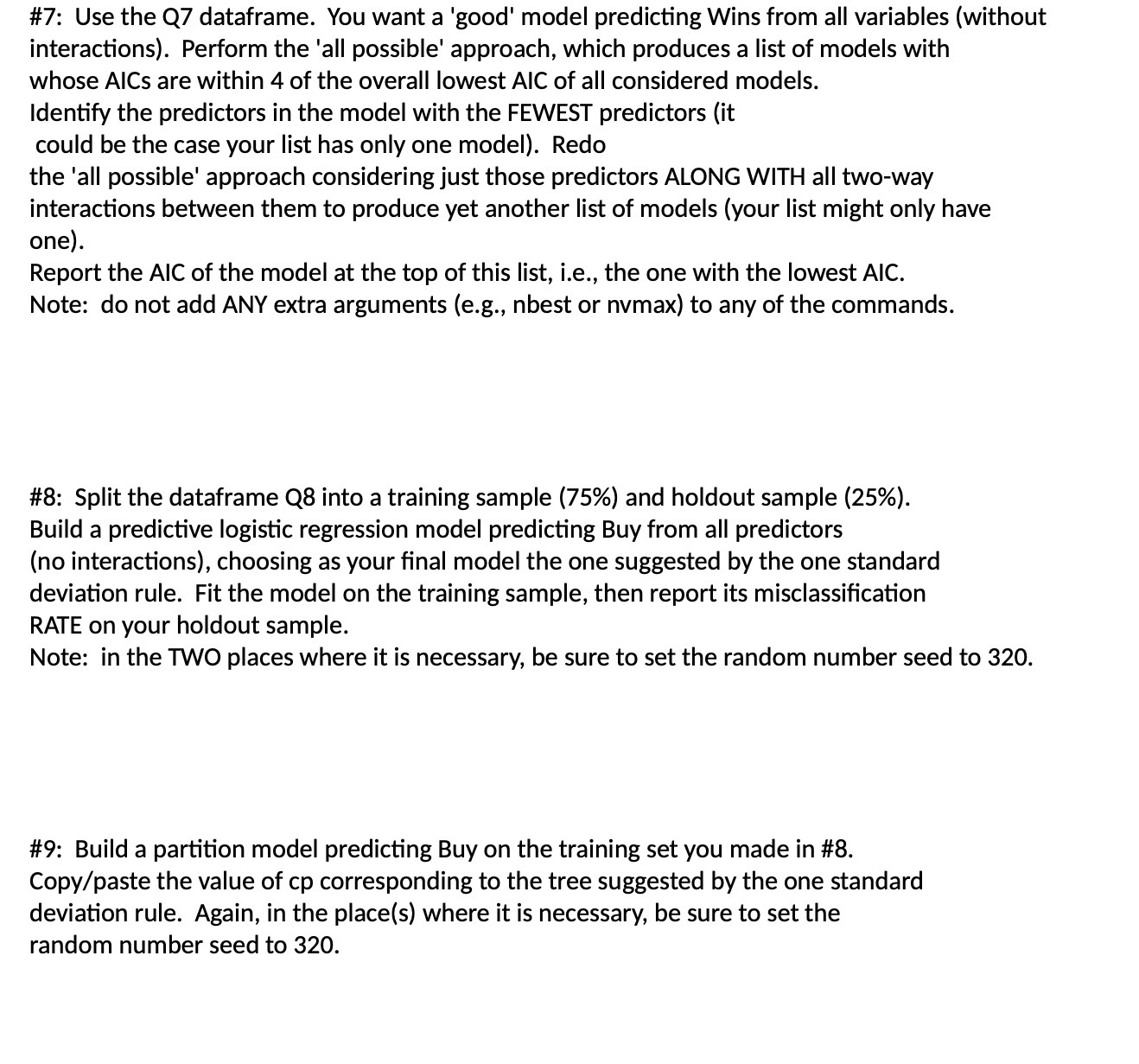
#7: Use the Q7 dataframe. You want a 'good' model predicting Wins from all variables (without interactions). Perform the 'all possible' approach, which produces a list of models with whose Ale are within 4 of the overall lowest AIC of all considered models. Identify the predictors in the model with the FEWEST predictors (it could be the case your list has only one model). Redo the 'all possible' approach considering just those predictors ALONG WITH all two-way interactions between them to produce yet another list of models (your list might only have one). Report the AIC of the model at the top of this list, i.e., the one with the lowest AIC. Note: do not add ANY extra arguments (e.g., nbest or nvmax) to any of the commands. #8: Split the dataframe Q8 into a training sample (75%) and holdout sample (25%). Build a predictive logistic regression model predicting Buy from all predictors (no interactions), choosing as your nal model the one suggested by the one standard deviation rule. Fit the model on the training sample, then report its misclassication RATE on your holdout sample. Note: in the TWO places where it is necessary, be sure to set the random number seed to 320. #9: Build a partition model predicting Buy on the training set you made in #8. Copy/paste the value of cp corresponding to the tree suggested by the one standard deviation rule. Again, in the place(s) where it is necessary, be sure to set the random number seed to 320
Step by Step Solution
There are 3 Steps involved in it

Get step-by-step solutions from verified subject matter experts
 Study Help