







Question: 7. When you conduct a t test, the calculated value of t can be positive or negative (T/F)? 8. Suppose you conducted a t test
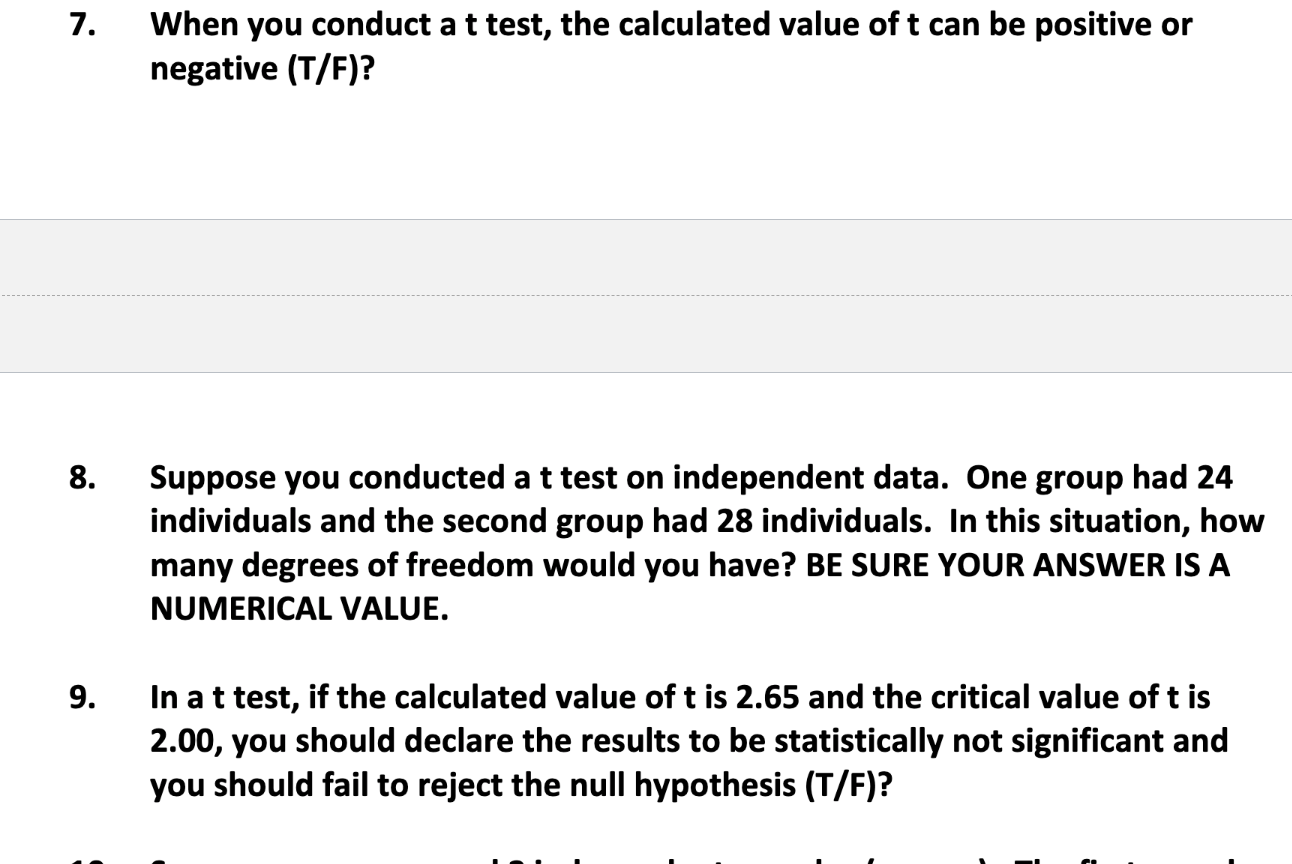
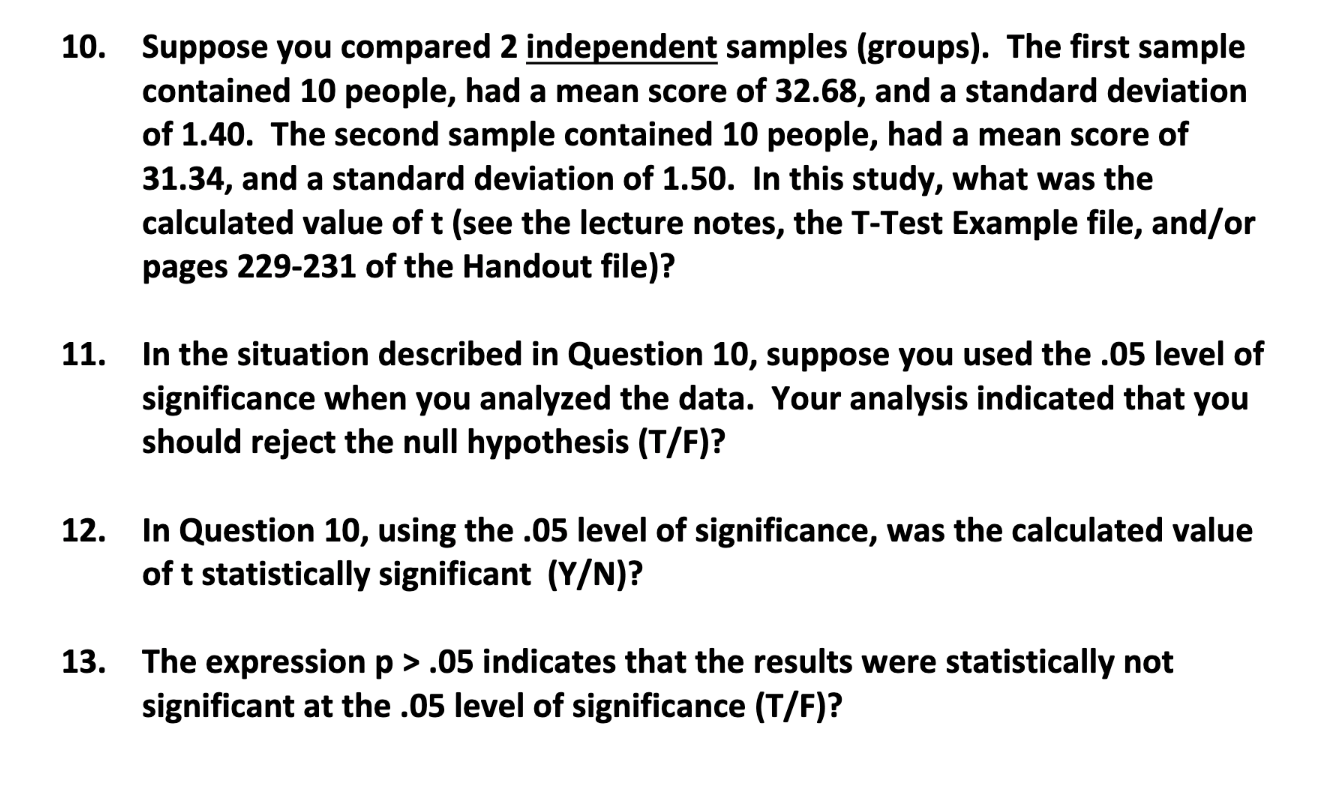
7. When you conduct a t test, the calculated value of t can be positive or negative (T/F)? 8. Suppose you conducted a t test on independent data. One group had 24 individuals and the second group had 28 individuals. In this situation, how many degrees of freedom would you have? BE SURE YOUR ANSWER IS A NUMERICAL VALUE. 9. In a t test, if the calculated value of t is 2.65 and the critical value of t is 2.00, you should declare the results to be statistically not significant and you should fail to reject the null hypothesis (T/F)? '- - I... I I _ n l I l .- 10. 11. 12. 13. Suppose you compared 2 independent samples (groups). The first sample contained 10 people, had a mean score of 32.68, and a standard deviation of 1.40. The second sample contained 10 people, had a mean score of 31.34, and a standard deviation of 1.50. In this study, what was the calculated value of t (see the lecture notes, the T-Test Example file, and/or pages 229-231 of the Handout file)? In the situation described in Question 10, suppose you used the .05 level of significance when you analyzed the data. Your analysis indicated that you should reject the null hypothesis (T/F)? In Question 10, using the .05 level of significance, was the calculated value of t statistically significant (YIN)? The expression p > .05 indicates that the results were statistically not significant at the .05 level of significance (T/F)
Step by Step Solution
There are 3 Steps involved in it

Get step-by-step solutions from verified subject matter experts
 Study Help