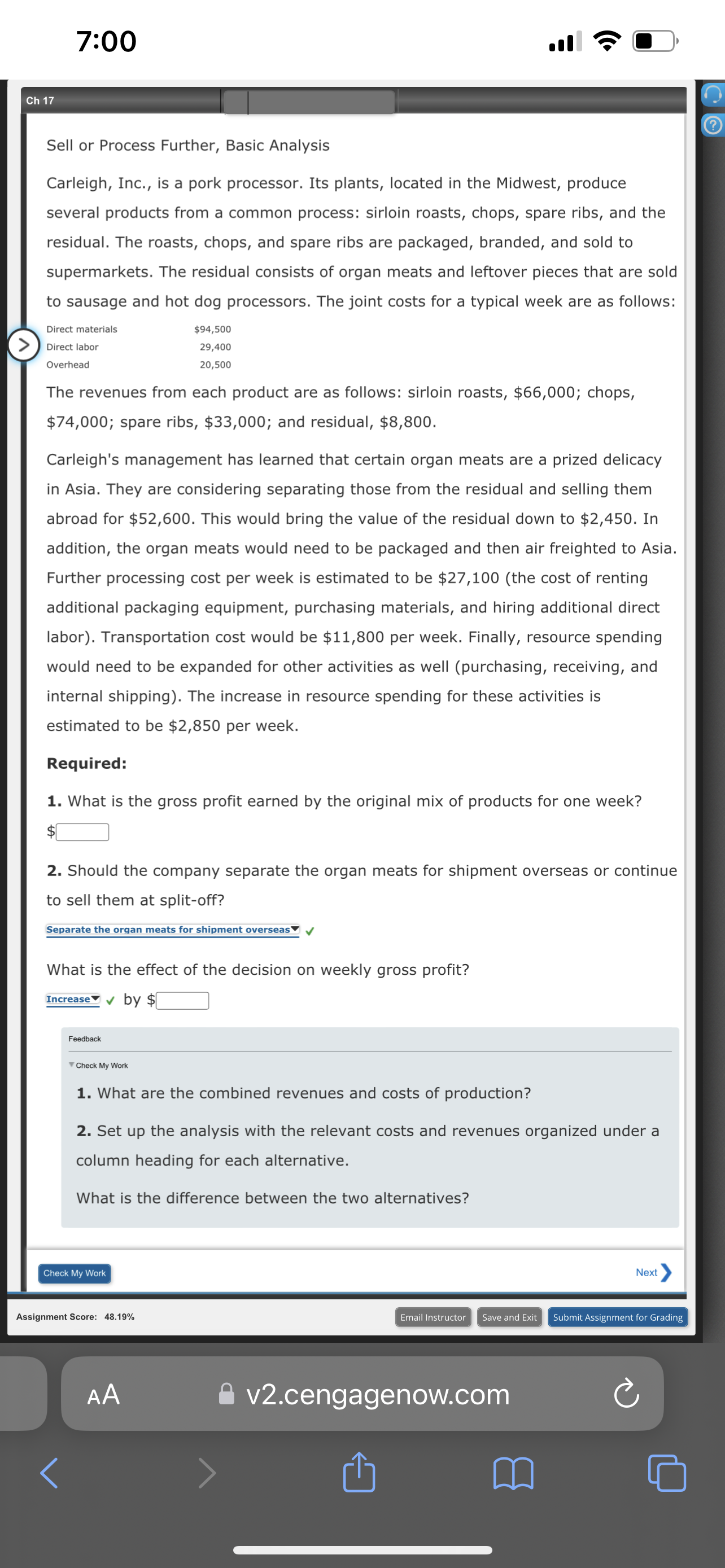
Question: 7:00 .II '2? C} Ch 17 (9-) Sell or Process Further, Basic Analysis Carleigh, Inc., is a pork processor. Its plants, located in the Midwest,
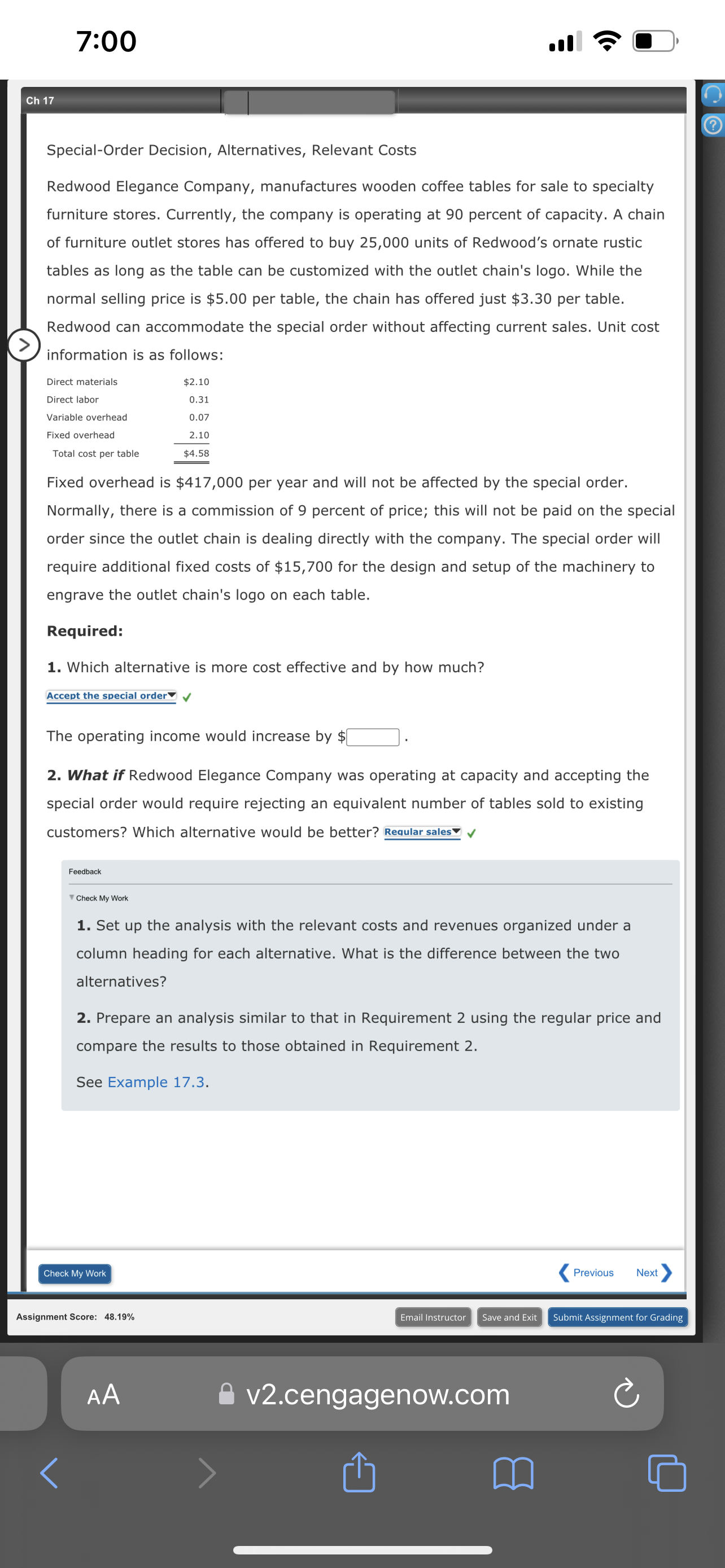
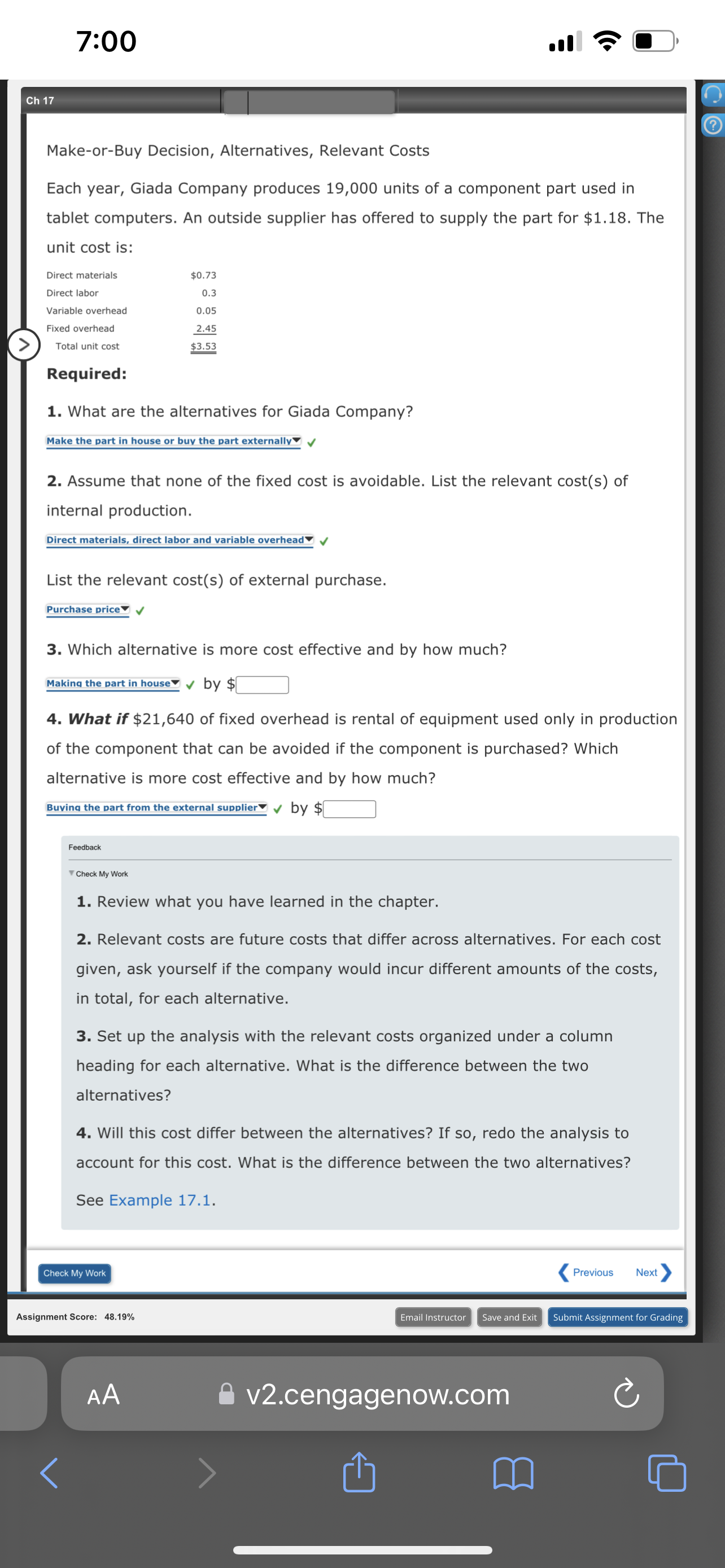
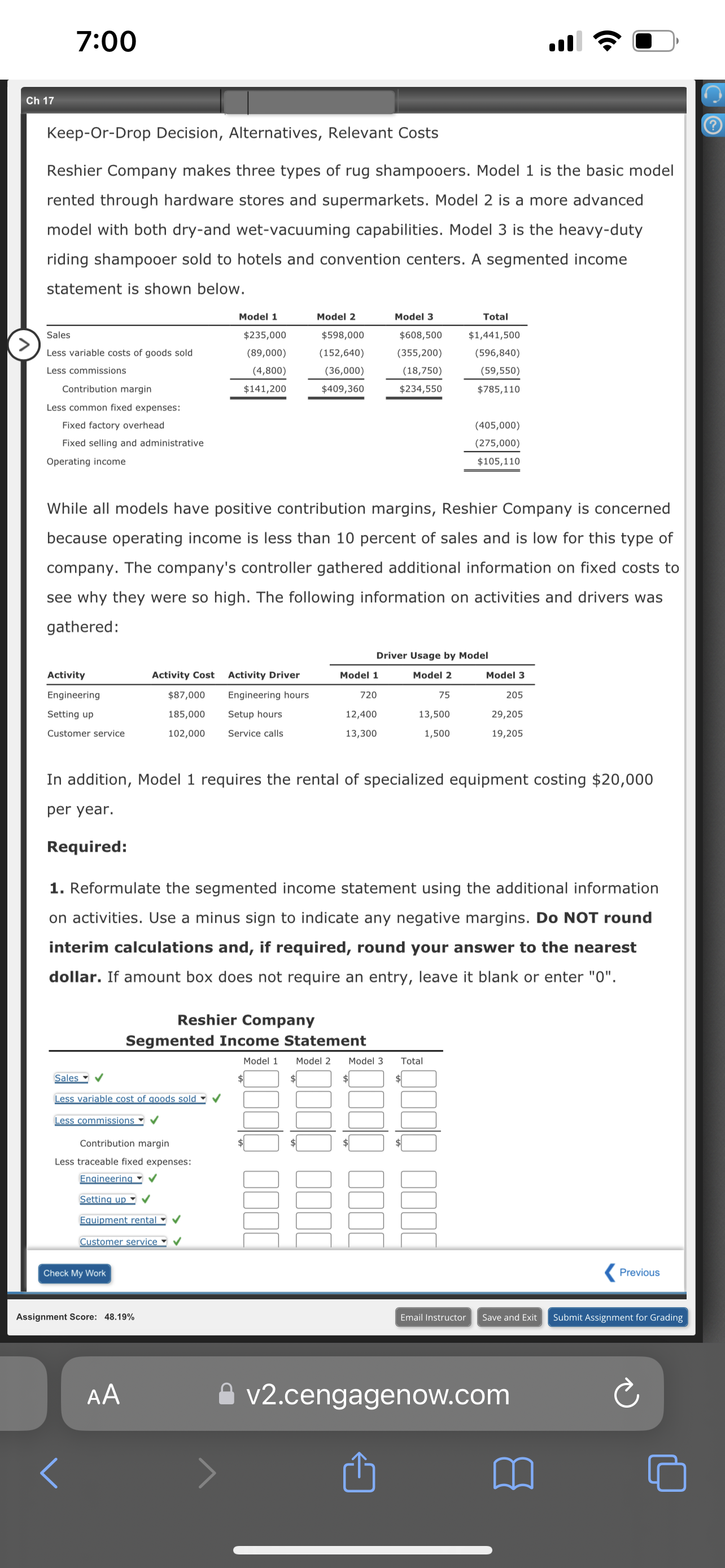
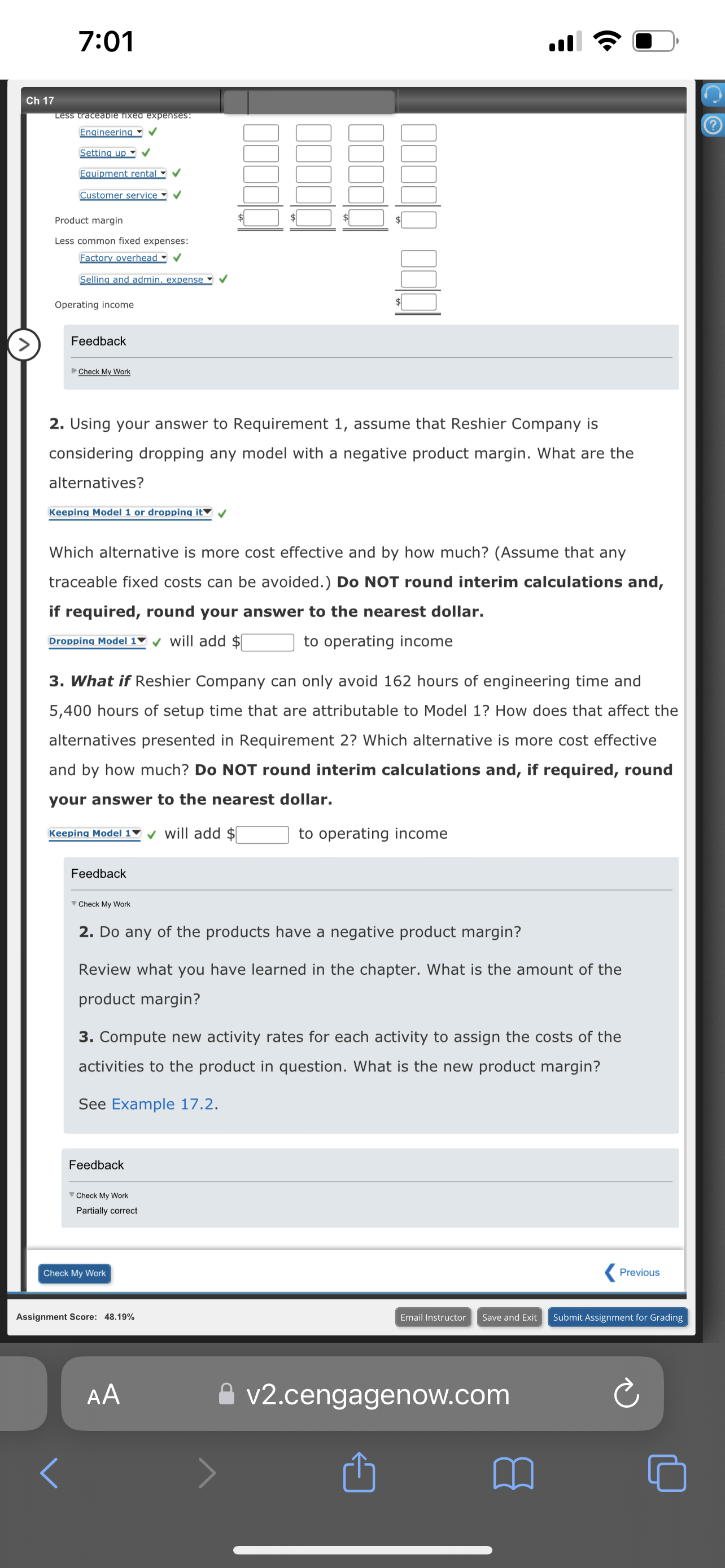
7:00 .II '2? C} Ch 17 (9-) Sell or Process Further, Basic Analysis Carleigh, Inc., is a pork processor. Its plants, located in the Midwest, produce several products from a common process: sirloin roasts, chops, spare ribs, and the residual. The roasts, chops, and spare ribs are packaged, branded, and sold to supermarkets. The residual consists of organ meats and leftover pieces that are sold to sausage and hot dog processors. The joint costs for a typical week are as follows: Direct materials 594,500 0 Direct labor 29,400 Overhead 20,500 The revenues from each product are as follows: sirloin roasts, $66,000; chops, $74,000; spare ribs, $33,000; and residual, $8,800. Carleigh's management has learned that certain organ meats are a prized delicacy in Asia. They are considering separating those from the residual and selling them abroad for $52,600. This would bring the value of the residual down to $2,450. In addition, the organ meats would need to be packaged and then air freighted to Asia. Further processing cost per week is estimated to be $27,100 (the cost of renting additional packaging equipment, purchasing materials, and hiring additional direct labor). Transportation cost would be $11,800 per week. Finally, resource spending would need to be expanded for other activities as well (purchasing, receiving, and internal shipping). The increase in resource spending for these activities is estimated to be $2,850 per week. Required: 1. What is the gross profit earned by the original mix of products for one week? $:] 2. Should the company separate the organ meats for shipment overseas or continue to sell them at splitoff? Separate the organ meets for shioment overseasv J What is the effect of the decision on weekly gross profit? Increase' V/ by $| Feedback 'cheexMywnrk 1. What are the combined revenues and costs of production? 2. Set up the analysis with the relevant costs and revenues organized under a column heading for each alternative. What is the difference between the two alternatives? Check My Work Next ) Assignment Score: 48.19% Email instructor Save and Exit Sulnriitksslgnment iorGrading AA 6 v2.0engagenow.com 7200 Ch 17 SpecialOrder Decision, Alternatives, Relevant Costs Redwood Elegance Company, manufactures wooden coffee tables for sale to specialty furniture stores. Currently, the company is operating at 90 percent of capacity. A chain of furniture outlet stores has offered to buy 25,000 units of Redwood's ornate rustic tables as long as the table can be customized with the outlet chain's logo. While the normal selling price is $5.00 per table, the chain has offered just $3.30 per table. Redwood can accommodate the special order without affecting current sales. Unit cost 9 information is as follows: Direct materials Direct labor Variable overhead Fixed overhead Total cost per table $2.10 0.31 0.07 2.10 $4.58 Fixed overhead is $417,000 per year and will not be affected by the special order. Normally, there is a commission of 9 percent of price; this will not be paid on the special order since the outlet chain is dealing directly with the company. The special order will require additional fixed costs of $15,700 for the design and setup of the machinery to engrave the outlet chain's logo on each table. Required: 1. Which alternative is more cost effective and by how much? Accept the special order' J The operating income would increase by $ . 2. What if Redwood Elegance Company was operating at capacity and accepting the special order would require rejecting an equivalent number of tables sold to existing customers? Which alternative would be better? Reuularsalesv ./ Feedbauk V Check My Work 1. Set up the analysis with the relevant costs and revenues organized under a column heading for each alternative. What is the difference between the two alternatives? 2. Prepare an analysis similar to that in Requirement 2 using the regular price and compare the results to those obtained in Requirement 2. See Example 17.3. Check My Work Assignment Score: 48.19% AA Email instructor Save and Exit 8 v2.0engagenow.com iii [1] v 10 0000 100000 100000 Customer service 100 0 0000 Product margin Less common fixed expenses: Factory overhead v Selling and admin. expense * v Operating income Feedback Check My Work 2. Using your answer to Requirement 1, assume that Reshier Company is considering dropping any model with a negative product margin. What are the alternatives? Keeping Model 1 or dropping it v Which alternative is more cost effective and by how much? (Assume that any traceable fixed costs can be avoided. ) Do NOT round interim calculations and, if required, round your answer to the nearest dollar. Dropping Model 10 v will add $ to operating income 3. What if Reshier Company can only avoid 162 hours of engineering time and 5,400 hours of setup time that are attributable to Model 1? How does that affect the alternatives presented in Requirement 2? Which alternative is more cost effective and by how much? Do NOT round interim calculations and, if required, round your answer to the nearest dollar. Keeping Model 10 v will add $ to operating income Feedback Check My Work 2. Do any of the products have a negative product margin? Review what you have learned in the chapter. What is the amount of the product margin? 3. Compute new activity rates for each activity to assign the costs of the activities to the product in question. What is the new product margin? See Example 17.2. Feedback Check My Work Partially correct Check My Work Previous Assignment Score: 48.19% Email Instructor Save and Exit Submit Assignment for Grading AA A v2.cengagenow.com C m
Step by Step Solution
There are 3 Steps involved in it
1 Expert Approved Answer
Step: 1 Unlock
Question Has Been Solved by an Expert!
Get step-by-step solutions from verified subject matter experts
Step: 2 Unlock
Step: 3 Unlock
Students Have Also Explored These Related Accounting Questions!









 Study Help