







Question: (7.3) A PV can be calculated by substituting known values of the and the into the basic PV equation as -. Or, we can rearrange
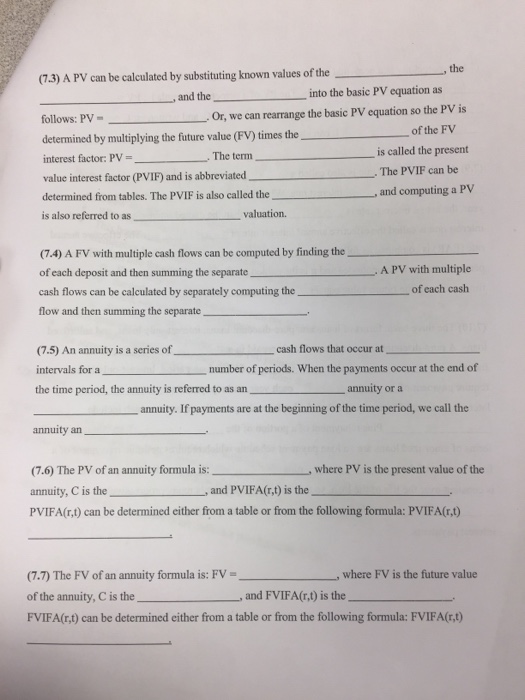
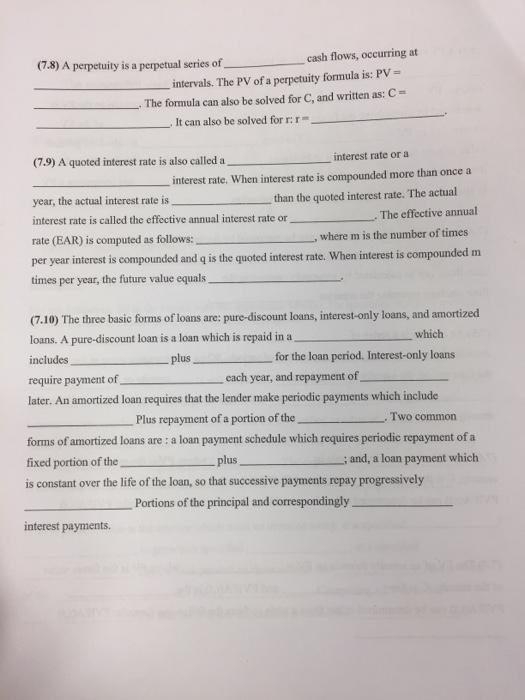
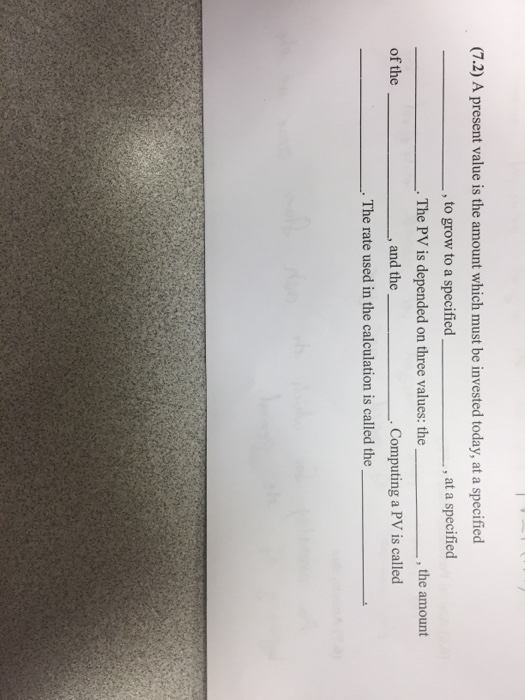
(7.3) A PV can be calculated by substituting known values of the and the into the basic PV equation as -. Or, we can rearrange the basic PV equation so the PV is follows: PV- determined by multiplying the future value (FV) times the interest factor: PV- . The term value interest factor (PVIF) and is abbreviated determined from tables. The PVIF is also called the is also referred to as of the FV is called the present The PVIF can be , and computing a PV valuation. (74) A FV with multiple cash flows can be computed by finding the of each deposit and then summing the separate cash flows can be calculated by separately computing the flow and then summing the separate A PV with multiple of each cash (7.5) An annuity is a series of intervals for a the time period, the annuity is referred to as an cash flows that occur at number of periods. When the payments occur at the end of annuity or a annuity. If payments are at the beginning of the time period, we call the annuity an (7.6) The PV of an annuity formula is: -where PV is the present value of the annuity, C is the PVIFA(r,t) can be determined either from a table or from the following formula: PVIFA(r,t) and PVIFA(r.t) is the (7.7) The FV of an annuity formula is: FV- of the annuity, C is the , and FVIFA(r,t) is the FVIFA(r,t) can be determined either from a table or from the following formula: FVIFA(rt) , where FV is the future value
Step by Step Solution
There are 3 Steps involved in it

Get step-by-step solutions from verified subject matter experts
 Study Help