







Question: [7.4.1] Use Stokes' theorem to evaluate .76 13 - d? where F = (3,42, 2oz, em?) and C is the circle :52 + y2 =
![[7.4.1] Use Stokes' theorem to evaluate .76 13" - d? where](https://s3.amazonaws.com/si.experts.images/answers/2024/06/6679b4aabb72b_1386679b4aa9437a.jpg)
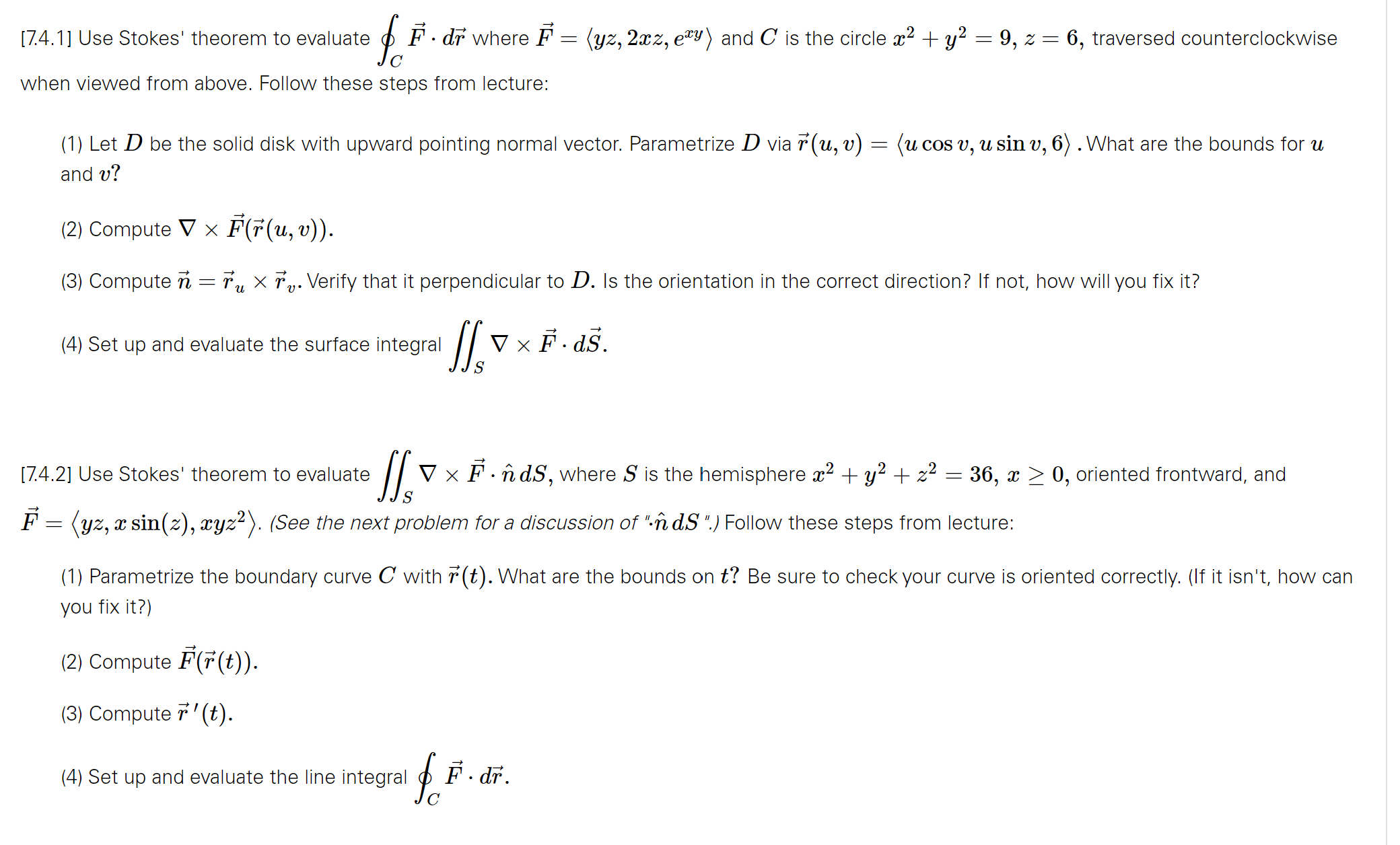
[7.4.1] Use Stokes' theorem to evaluate .76 13" - d? where F = (3,42, 2oz, em?) and C is the circle :52 + y2 = 9, z = 6, traversed counterclockwise 0 when viewed from above. Follow these steps from lecture: (1) Let D be the solid disk with upward pointing normal vector. Parametrize D via ?(u, v) : (u cos v,usi11 v, 6) .What are the bounds for u and v? (2) Compute V X (?(u, 12)) (3) Compute FL : at X F\". Verify that it perpendicular to D. Is the orientation in the correct direction? If not, how will you fix it? (4) Set up and evaluate the surface integral // V x 13- dg. S [7.4.2] Use Stokes' theorem to evaluate // V x 14:" - dS, where S is the hemisphere 1-2 l y2 + :52 : 36, :1: 2 0, oriented frontward, and s I3 = (312,23 sin(z), my?) (See the next problem fora discussion of "-dS ".) Follow these steps from lecture: (l) Parametrize the boundary curve C with Ht). What are the bounds on t? Be sure to check your curve is oriented correctly. (If it isn't, how can you fix it?) (2) Compute (?(t)). (3) Compute F'(t). ' (4) Set up and evaluate the line integral jg F - (1?. C
Step by Step Solution
There are 3 Steps involved in it

Get step-by-step solutions from verified subject matter experts
 Study Help