







Question: (b) (c) F2(A, B, C, D) - (each single unique digit of your student ID) [hints: if your ID is 170105199 then take 1,
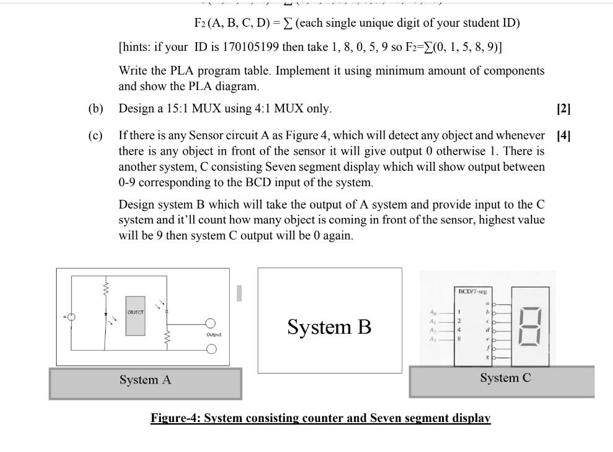
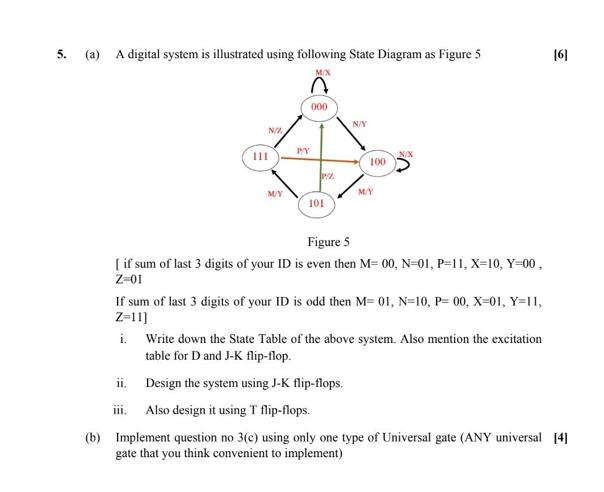
(b) (c) F2(A, B, C, D) - (each single unique digit of your student ID) [hints: if your ID is 170105199 then take 1, 8, 0, 5, 9 so F2-(0, 1, 5, 8, 9)] Write the PLA program table. Implement it using minimum amount of components and show the PLA diagram. Design a 15:1 MUX using 4:1 MUX only. [2] If there is any Sensor circuit A as Figure 4, which will detect any object and whenever [4] there is any object in front of the sensor it will give output 0 otherwise 1. There is another system, C consisting Seven segment display which will show output between 0-9 corresponding to the BCD input of the system. Design system B which will take the output of A system and provide input to the C system and it'll count how many object is coming in front of the sensor, highest value will be 9 then system C output will be 0 again. ORECT System A I System B BCDV-ME I 2 4 System C Figure-4: System consisting counter and Seven segment display 5. (a) A digital system is illustrated using following State Diagram as Figure 5 M/X N/Z M/Y 000 PY P/Z 101 N/Y 100 M/Y N/X Figure 5 [if sum of last 3 digits of your ID is even then M= 00, N-01, P-11, X-10, Y-00, Z-01 If sum of last 3 digits of your ID is odd then M= 01, N=10, P=00, X-01, Y=11, Z=11] i. Write down the State Table of the above system. Also mention the excitation table for D and J-K flip-flop. Design the system using J-K flip-flops. [6] ii. iii. Also design it using T flip-flops. (b) Implement question no 3(c) using only one type of Universal gate (ANY universal [4] gate that you think convenient to implement)
Step by Step Solution
3.57 Rating (154 Votes )
There are 3 Steps involved in it

Get step-by-step solutions from verified subject matter experts
 Study Help