







Question: 7.5 Aplia Assignment Back to Assignment Attempts: Do No Harm: /1 5. True or False? Use your knowledge of the conditional proof method to determine
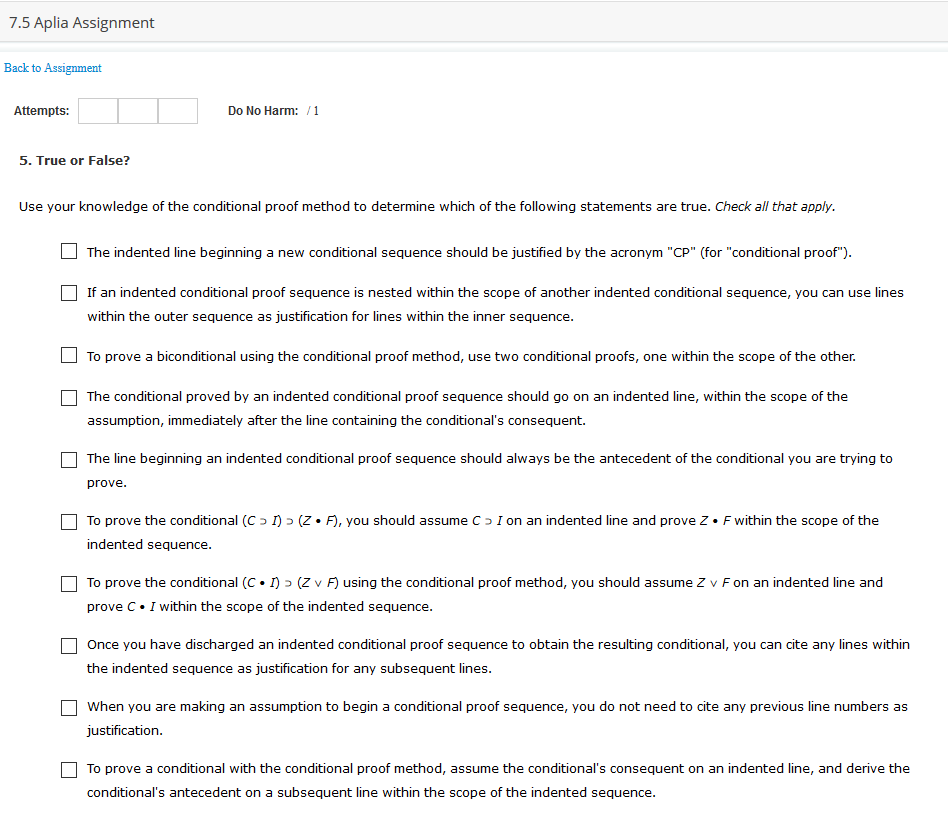
7.5 Aplia Assignment Back to Assignment Attempts: Do No Harm: /1 5. True or False? Use your knowledge of the conditional proof method to determine which of the following statements are true. Check all that apply. U The indented line beginning a new conditional sequence should be justified by the acronym "CP" (for "conditional proof"). If an indented conditional proof sequence is nested within the scope of another indented conditional sequence, you can use lines within the outer sequence as justification for lines within the inner sequence. To prove a biconditional using the conditional proof method, use two conditional proofs, one within the scope of the other. The conditional proved by an indented conditional proof sequence should go on an indented line, within the scope of the assumption, immediately after the line containing the conditional's consequent. The line beginning an indented conditional proof sequence should always be the antecedent of the conditional you are trying to prove. T) (Z.F), you should assume Co I on an indented line and prove Z. F within the scope of the To prove the conditional ( C indented sequence. To prove the conditional (C.1) - (Z v F) using the conditional proof method, you should assume Z v Fon an indented line and prove CI within the scope of the indented sequence. Once you have discharged an indented conditional proof sequence to obtain the resulting conditional, you can cite any lines within the indented sequence as justification for any subsequent lines. When you are making an assumption to begin a conditional proof sequence, you do not need to cite any previous line numbers as justification. To prove a conditional with the conditional proof method, assume the conditional's consequent on an indented line, and derive the conditional's antecedent on a subsequent line within the scope of the indented sequence. 7.5 Aplia Assignment Back to Assignment Attempts: Do No Harm: /1 5. True or False? Use your knowledge of the conditional proof method to determine which of the following statements are true. Check all that apply. U The indented line beginning a new conditional sequence should be justified by the acronym "CP" (for "conditional proof"). If an indented conditional proof sequence is nested within the scope of another indented conditional sequence, you can use lines within the outer sequence as justification for lines within the inner sequence. To prove a biconditional using the conditional proof method, use two conditional proofs, one within the scope of the other. The conditional proved by an indented conditional proof sequence should go on an indented line, within the scope of the assumption, immediately after the line containing the conditional's consequent. The line beginning an indented conditional proof sequence should always be the antecedent of the conditional you are trying to prove. T) (Z.F), you should assume Co I on an indented line and prove Z. F within the scope of the To prove the conditional ( C indented sequence. To prove the conditional (C.1) - (Z v F) using the conditional proof method, you should assume Z v Fon an indented line and prove CI within the scope of the indented sequence. Once you have discharged an indented conditional proof sequence to obtain the resulting conditional, you can cite any lines within the indented sequence as justification for any subsequent lines. When you are making an assumption to begin a conditional proof sequence, you do not need to cite any previous line numbers as justification. To prove a conditional with the conditional proof method, assume the conditional's consequent on an indented line, and derive the conditional's antecedent on a subsequent line within the scope of the indented sequence
Step by Step Solution
There are 3 Steps involved in it

Get step-by-step solutions from verified subject matter experts
 Study Help