







Question: 76 . 140 48.96 - 2. Phase angle o is the phase difference between the current i(t) and the voltage U(() of the sine wave
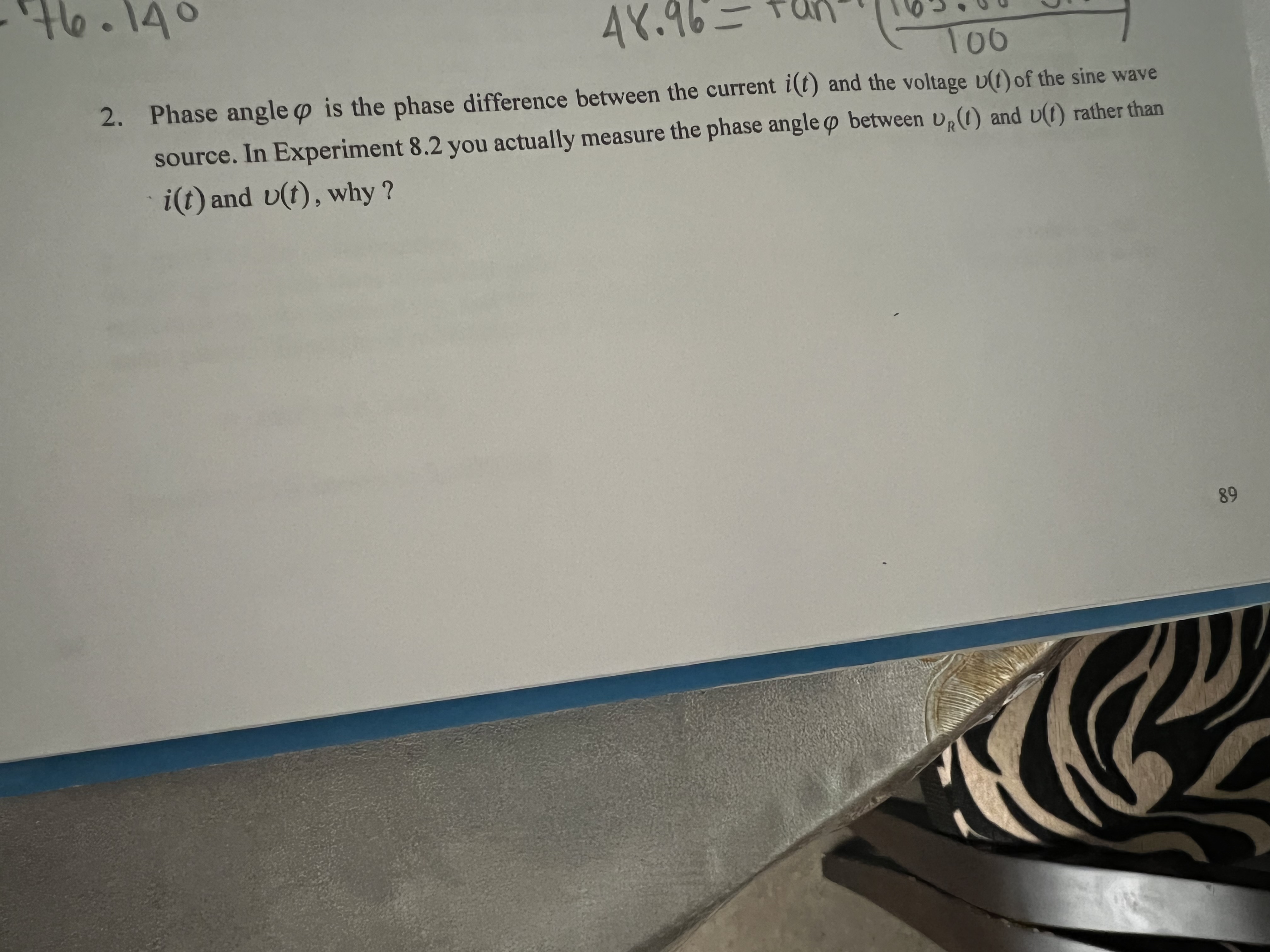
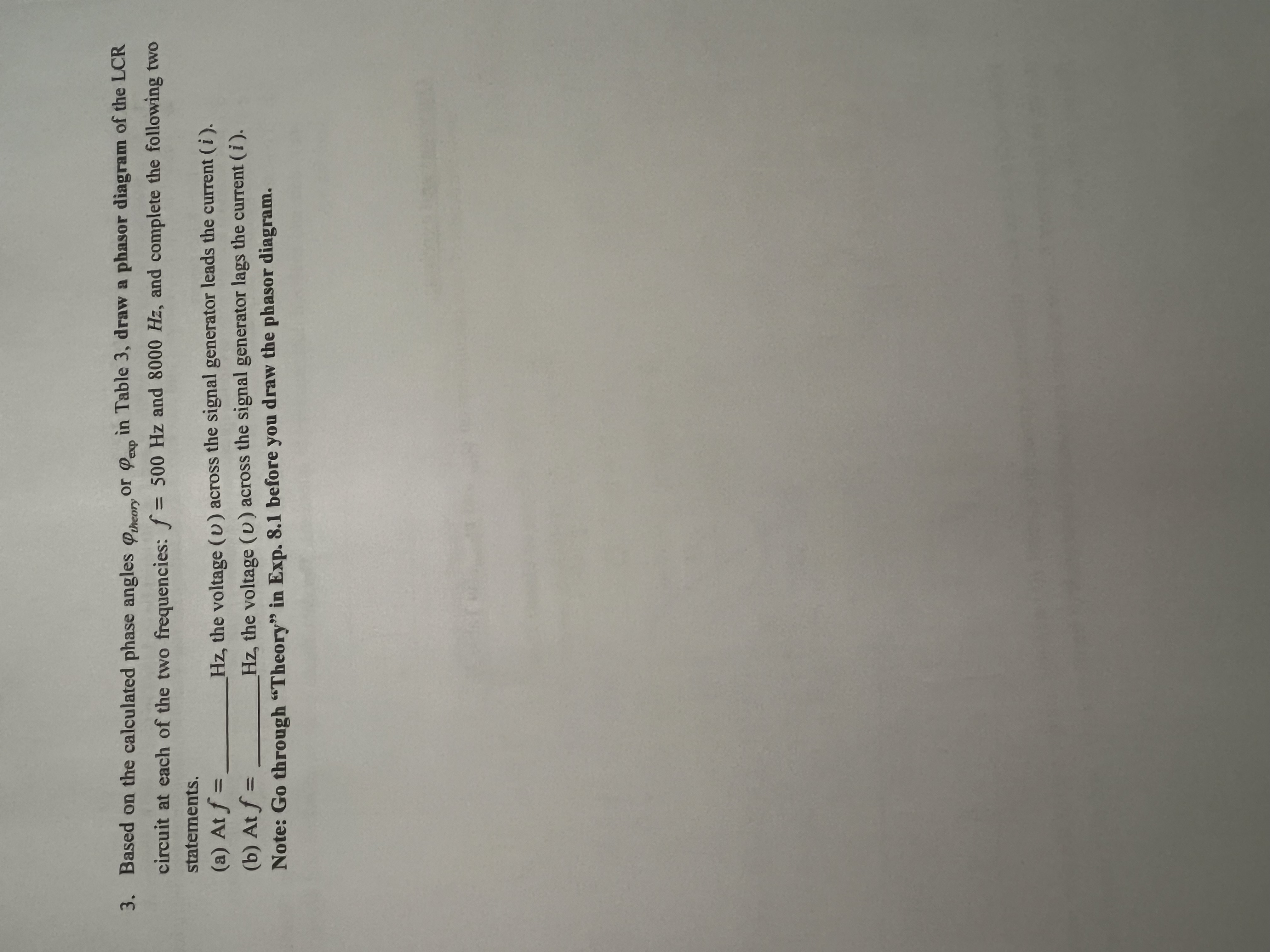
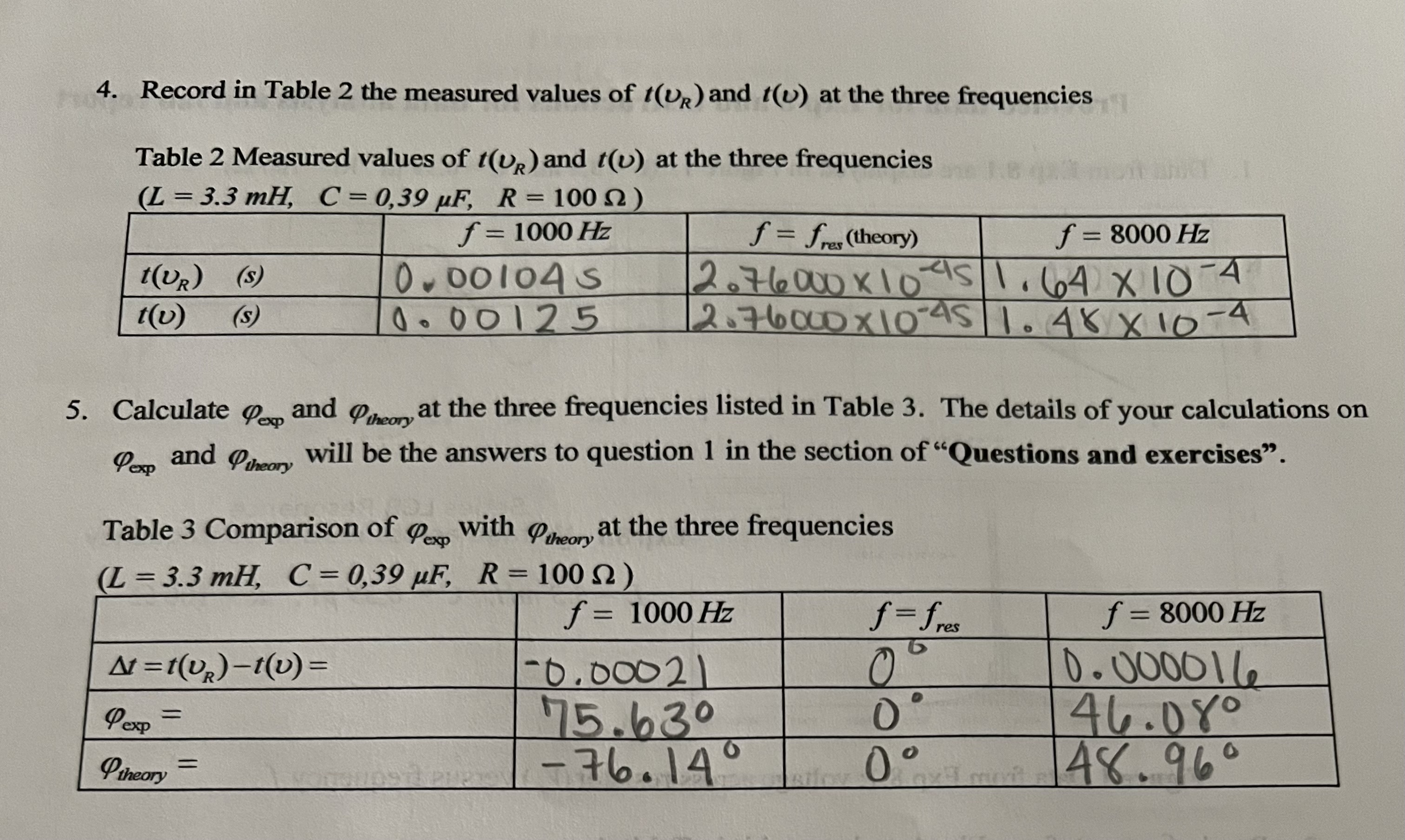
76 . 140 48.96 - 2. Phase angle o is the phase difference between the current i(t) and the voltage U(() of the sine wave source. In Experiment 8.2 you actually measure the phase angle @ between UR(() and U(t) rather than i(t ) and U(t) , why ?3. Based on the calculated phase angles theory or Pes in Table 3, draw a phasor diagram of the LCR circuit at each of the two frequencies: f = 500 Hz and 8000 Hz, and complete the following two statements. (a) At f = Hz, the voltage ( U ) across the signal generator leads the current (i). (b) At f = Hz, the voltage ( U ) across the signal generator lags the current (i). Note: Go through "Theory" in Exp. 8.1 before you draw the phasor diagram.4. Record in Table 2 the measured values of ((UR) and t(v) at the three frequencies Table 2 Measured values of t(Up) and t(v) at the three frequencies (L =3.3 mH, C = 0,39 UF, R = 100 02) f = 1000 Hz f = fres (theory) f = 8000 Hz t(UR) (S) 0 . 00104 5 2.76 000 x 10 45 1 . 64 X 10 4 t(v) (S 1 . 0 0 1 25 2. 76 0 0 x 10-45 1 . 48 X 10-4 5. Calculate Q and Queonat the three frequencies listed in Table 3. The details of your calculations on Pop and Qtheory will be the answers to question 1 in the section of "Questions and exercises". Table 3 Comparison of Q with theon at the three frequencies (L = 3.3 mH, C = 0,39 UF, R = 100 0) f = 1000 Hz f = fres f = 8000 Hz At = 1(Up) -1(0) = -0. DO0 21 0. 0000 16 Pexp 75. 630 0 46. 080 Ptheory = -76.140 48. 960
Step by Step Solution
There are 3 Steps involved in it

Get step-by-step solutions from verified subject matter experts
 Study Help