



Question: 7.6. Let X={a, b, c, d, e, f); Y=(1, 2, 3, 4);Z=(s, t);and let A = 0.0/a + 0.0/b + 1 .0/c + 1 .0/d
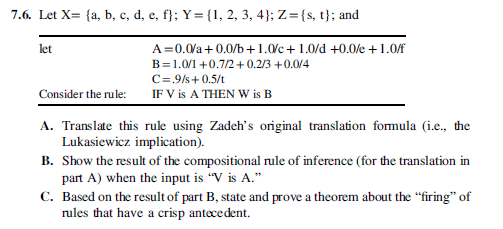
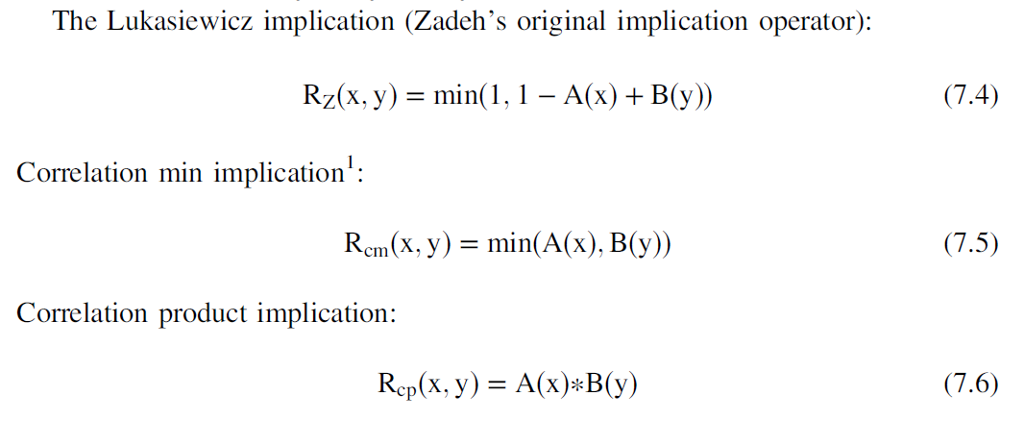
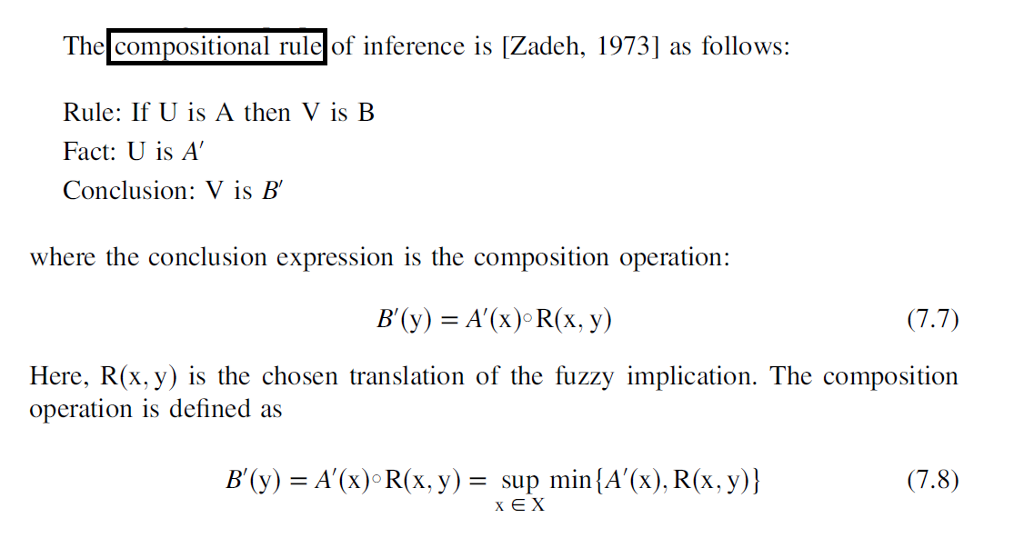
7.6. Let X={a, b, c, d, e, f); Y=(1, 2, 3, 4);Z=(s, t);and let A = 0.0/a + 0.0/b + 1 .0/c + 1 .0/d +0.0 e + 1 .0/f B = 10/1 + 0.72 + 0.23 + 0.0/4 C 9/s+0.5/t IF Vis A THEN W is B Consider the rule: A. Translate this rule using Zadeh's original translation fomula (i.e., the B. Lukasiewicz implication). Show the result of the compositional rule of inference (for the translation in part A) when the input is "V is A." C. Based on the result of part B, state and prove a theorem about the firing" of rules that have a crisp antecedent. 7.6. Let X={a, b, c, d, e, f); Y=(1, 2, 3, 4);Z=(s, t);and let A = 0.0/a + 0.0/b + 1 .0/c + 1 .0/d +0.0 e + 1 .0/f B = 10/1 + 0.72 + 0.23 + 0.0/4 C 9/s+0.5/t IF Vis A THEN W is B Consider the rule: A. Translate this rule using Zadeh's original translation fomula (i.e., the B. Lukasiewicz implication). Show the result of the compositional rule of inference (for the translation in part A) when the input is "V is A." C. Based on the result of part B, state and prove a theorem about the firing" of rules that have a crisp antecedent
Step by Step Solution
There are 3 Steps involved in it

Get step-by-step solutions from verified subject matter experts