



Question: 7-7. (Bond relationship) Mason, Inc. has two bond issues outstanding, called Series A and Series B both paying the same annual interest of $55. Series
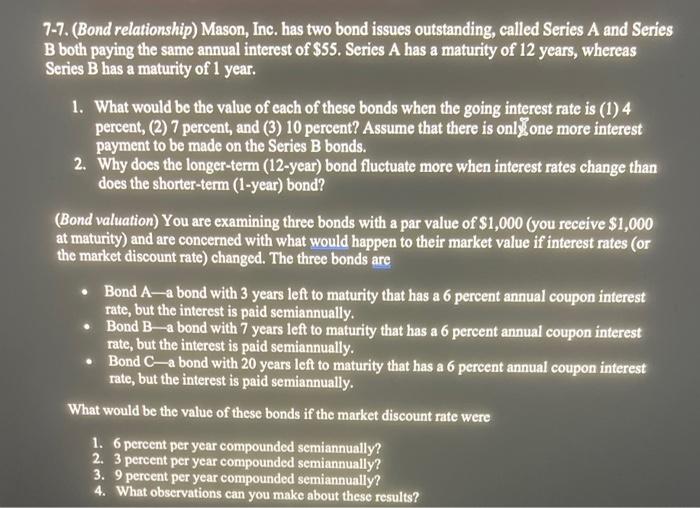
7-7. (Bond relationship) Mason, Inc. has two bond issues outstanding, called Series A and Series B both paying the same annual interest of $55. Series A has a maturity of 12 years, whereas Series B has a maturity of 1 year. 1. What would be the value of each of these bonds when the going interest rate is (1) 4 percent, (2) 7 percent, and (3) 10 percent? Assume that there is onl/ one more interest payment to be made on the Series B bonds. 2. Why does the longer-term (12-year) bond fluctuate more when interest rates change than does the shorter-term (1-year) bond? (Bond valuation) You are examining three bonds with a par value of $1,000 (you receive $1,000 at maturity) and are concerned with what would happen to their market value if interest rates (or the market discount rate) changed. The three bonds are - Bond A-a bond with 3 years left to maturity that has a 6 percent annual coupon interest rate, but the interest is paid semiannually. - Bond B-a bond with 7 years left to maturity that has a 6 percent annual coupon interest rate, but the interest is paid semiannually. - Bond C-a bond with 20 years left to maturity that has a 6 percent annual coupon interest rate, but the interest is paid semiannually. What would be the value of these bonds if the market discount rate were 1. 6 percent per year compounded semiannually? 2. 3 pereent per year compounded semiannually? 3. 9 percent per year compounded semiannually? 4. What observations can you make about these results
Step by Step Solution
There are 3 Steps involved in it

Get step-by-step solutions from verified subject matter experts