







Question: 8 . 1 2 LAB: Red - black tree Nth largest operation Step 1 : Inspect the BSTNode.h and BinarySearchTree.h files Inspect the BSTNode class
LAB: Redblack tree Nth largest operation
Step : Inspect the BSTNode.h and BinarySearchTree.h files
Inspect the BSTNode class declaration for a binary search tree node in BSTNode.h Access BSTNode.h by clicking on the orange arrow next to main.cpp at the top of the coding window. The BSTNode class has private member variables for the key, parent pointer, left child pointer, and right child pointer. Accessor functions exist for each.
Inspect the BinarySearchTree class declaration for a binary search tree node in BinarySearchTree.h The GetNthKey function is the only pure virtual function that exists.
Step : Inspect other files related to the inheritance hierarchy
Classes RBTNode and RedBlackTree inherit from BSTNode and BinarySearchTree, respectively. Each class is implemented in a read only header file.
Classes ExtendedRBTNode and ExtendedRedBlackTree are declared, but implementations are incomplete. Both classes must be implemented in this lab.
Six class names are shown in boxes. White boxes representing read only, completed class implementations. Four white boxes exist: BinarySearchTree, RedBlackTree, BSTNode, and RBTNode. Yellow boxes represent incomplete class implementations. Two yellow boxes exist: ExtendedRedBlackTree and ExtendedRBTNode. Arrows between boxes indicate inheritance. ExtendedRedBlackTree inherits from RedBlackTree, RedBlackTree inherits from BinarySearchTree, ExtendedRBTNode inherits from RBTNode, and RBTNode inherits from BSTNode.
Step : Understand the purpose of the subtreeKeyCount variable
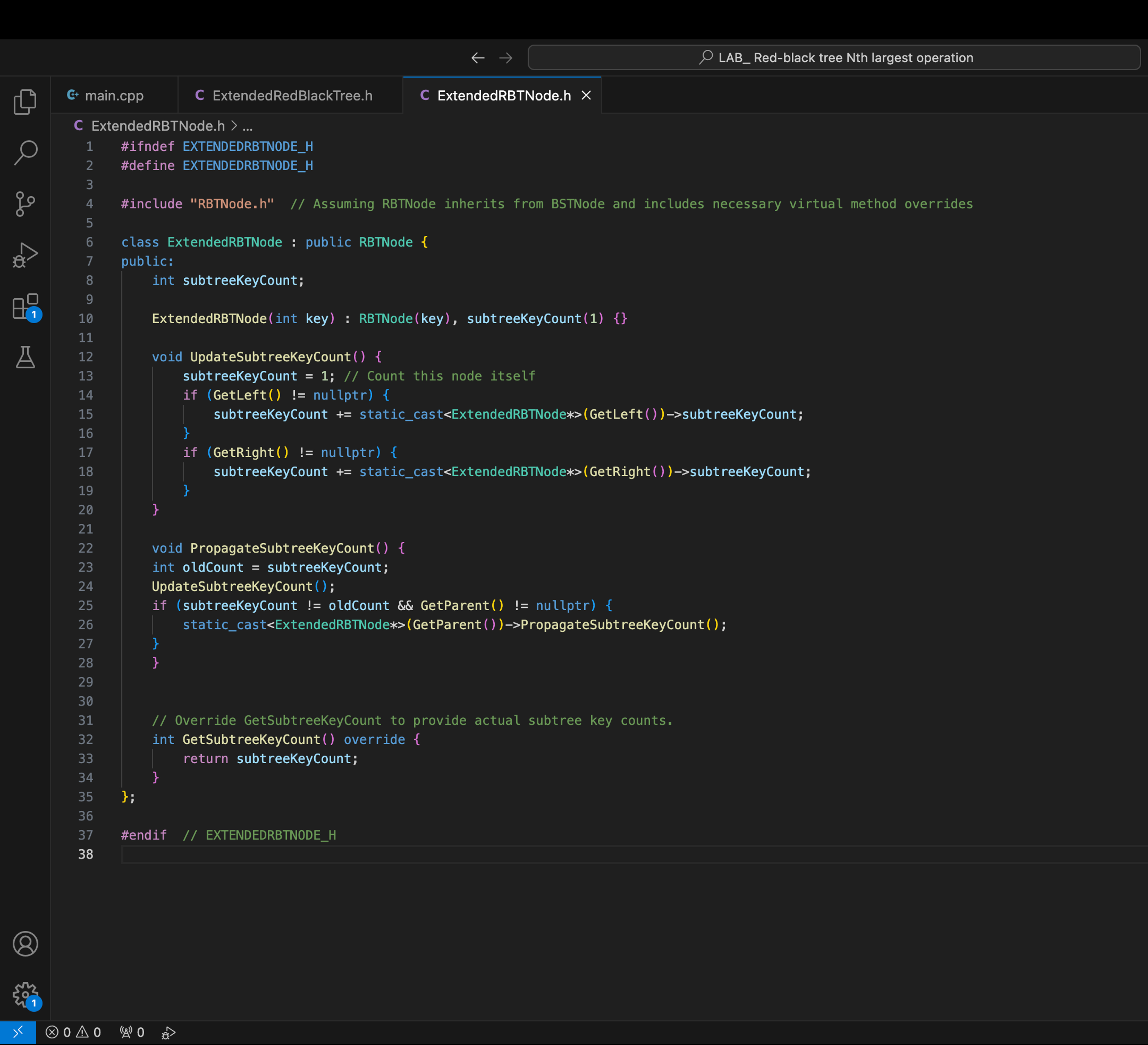
The ExtendedRBTNode class inherits from RBTNode and adds one integer member variable, subtreeKeyCount. Each node's subtree key count is the number of keys in the subtree rooted at that node. Ex:
Sample redblack tree with subtree key counts shown outside each node. Root node is black, has key and subtreeKeyCount Root's left child is black, has key and subtreeKeyCount Root's right child is red, has key and subtreeKeyCount Node s right child is red, has key and subtreeKeyCount Node s left child is black, has key and subtreeKeyCount Node s right is black, has key and subtreeKeyCount Node s right child is red, has key and subtreeKeyCount
ExtendedRBTNode's constructor and GetSubtreeKeyCount member functions are already implemented and should not be changed. Additional member functions are needed to ensure that subtreeKeyCount remains accurate.
Step : Implement ExtendedRedBlackTree and ExtendedRBTNode
Each node in an ExtendedRedBlackTree must have a correct subtreeKeyCount after an insertion or removal operation. Determine which member functions in RedBlackTree and RBTNode must be overridden in ExtendedRedBlackTree and ExtendedRBTNode to keep each node's subtreeKeyCount correct. New functions can be added along with overridden functions, if desired.
Hint: Consider an UpdateSubtreeKeyCount member function for the ExtendedRBTNode class. The function requires each child node's subtreeKeyCount to be correct, and updates the node's subtreeKeyCount appropriately. Overridden functions in both ExtendedRBTNode and ExtendedRedBlackTree can call a node's UpdateSubtreeKeyCount function as needed.
Once determinations are made, complete the implementation of both the ExtendedRedBlackTree and ExtendedRBTNode classes. Do not implement ExtendedRedBlackTree's GetNthKey in this step. GetNthKey requires correct subtree counts at each node.
Step : Run tests in develop mode and submit mode
TreeTestCommand is an abstract base class defined in TreeCommands.h A TreeTestCommand object is an executable command that operates on a binary search tree. Classes inheriting from TreeTestCommand are also declared in TreeCommands.h:
TreeInsertCommand inserts keys into the tree
TreeRemoveCommand removes keys from the tree
TreeVerifyKeysCommand verifies the tree's keys using an inorder traversal
TreeVerifySubtreeCountsCommand verifies that each node in the tree has the expected subtree key count
TreeGetNthCommand verifies that GetNthKey returns an expected value
Code in main.cpp contains three automated test cases. Each test executes a vector of TreeTestCommand objects in sequence. The third test includes TreeGetNthCommands and will not pass until the completion of Step The first two tests should pass after completion of step
Before proceeding to Step run code in develop mode and ensure that the first two tests in main.cpp pass. Then submit code and ensure that the first two unit tests pass.
Step : Implement ExtendedRedBlackTree's GetNthKey member function worst case Olog n
GetNthKey must return the tree's nthlargest key. The parameter n starts at for the smallest key in the tree. Ex: Suppose a tree has keys:
Then GetNthKey returns GetNthKey returns GetNthKey returns and GetNthKey returns
Determine an algorithm that uses the subtree key counts so that GetNthKey operates in worst case Olog n time.
Here my current code and the result after testing my code.
IN C please
Step by Step Solution
There are 3 Steps involved in it
1 Expert Approved Answer
Step: 1 Unlock

Question Has Been Solved by an Expert!
Get step-by-step solutions from verified subject matter experts
Step: 2 Unlock
Step: 3 Unlock
 Study Help