







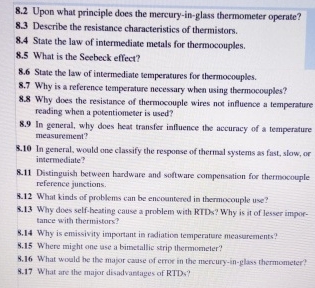
Question: 8 . 2 Upon what principle does the mercury - in - glass thermometer operate? 8 . 3 Describe the resistance characteristics of thermistors. 8
Upon what principle does the mercuryinglass thermometer operate?
Describe the resistance characteristics of thermistors.
State the law of intermediate metals for thermocouples.
What is the Seebeck effect?
State the law of intermediate temperatures for thermocouples.
Why is a reference temperature necessary when using thermocouples?
Why does the resistance of thermocouple wires not influence a temperature
reading when a potentiometer is used?
In general, why does beat transfer influence the accuracy of a temperature
measurement?
In general, would one classify the response of thermal systems as fast, slow, or
intermediate?
Distinguish between hardware and software compensation for thermocouple
reference junctions.
R What kinds of problems can be encountered in thermocouple use?
Why does selfhearing cause a problem with RIDs? Why is it of lesser impor
tance with thermistors?
Why is emissivity important in radiation temperature measurements?
Where might one use a bimetallic strip thermometer?
What would he the major cause of error in the mercuryinglass thermometer?
What are the major disadvantages of RTDs
Step by Step Solution
There are 3 Steps involved in it
1 Expert Approved Answer
Step: 1 Unlock

Question Has Been Solved by an Expert!
Get step-by-step solutions from verified subject matter experts
Step: 2 Unlock
Step: 3 Unlock
 Study Help