







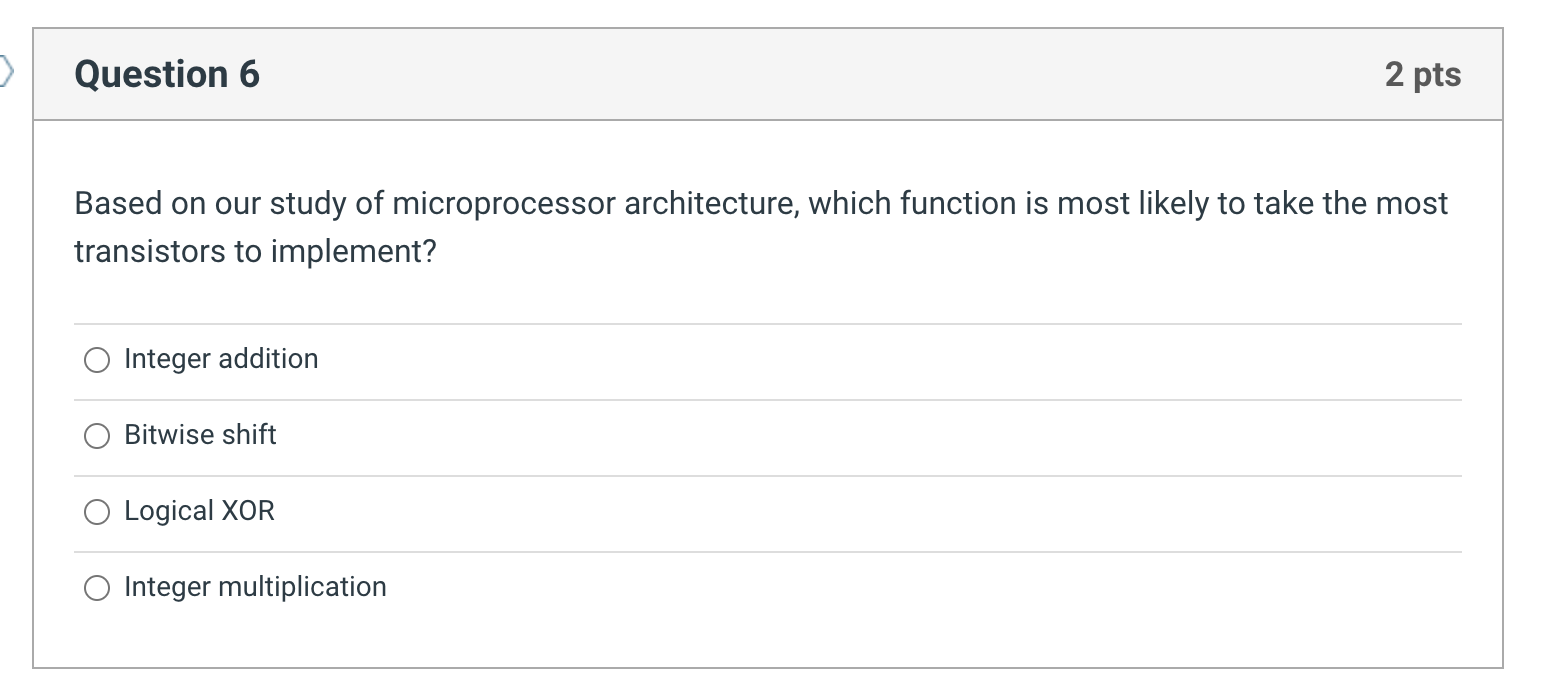
Question: 8. 9. 10. Based on our study of microprocessor architecture, which function is most likely to take the most transistors to implement? Integer addition Bitwise
 8.
8.
9.
 10.
10.
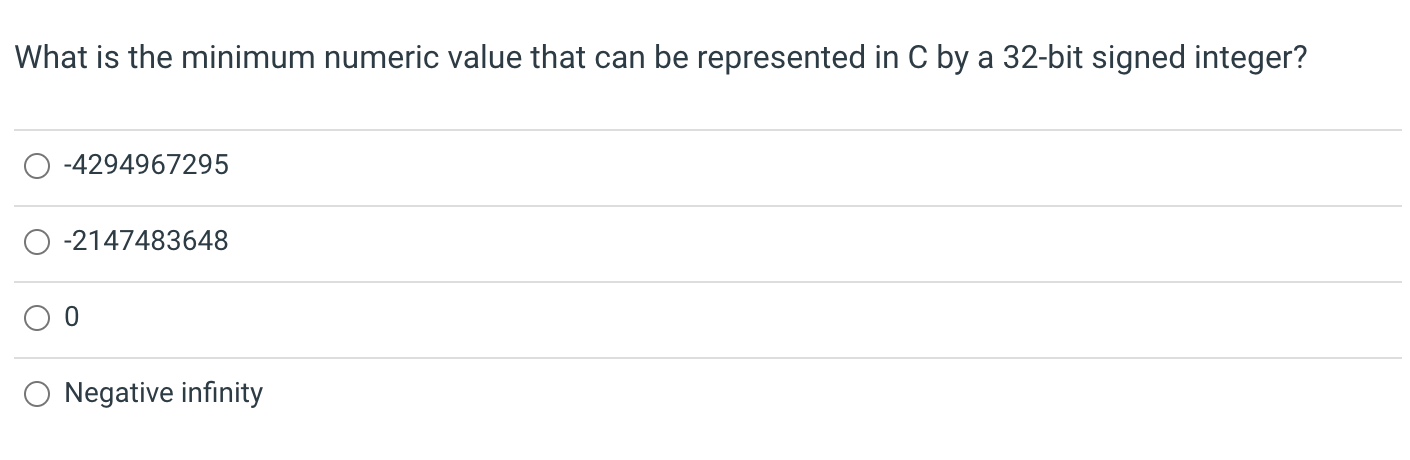
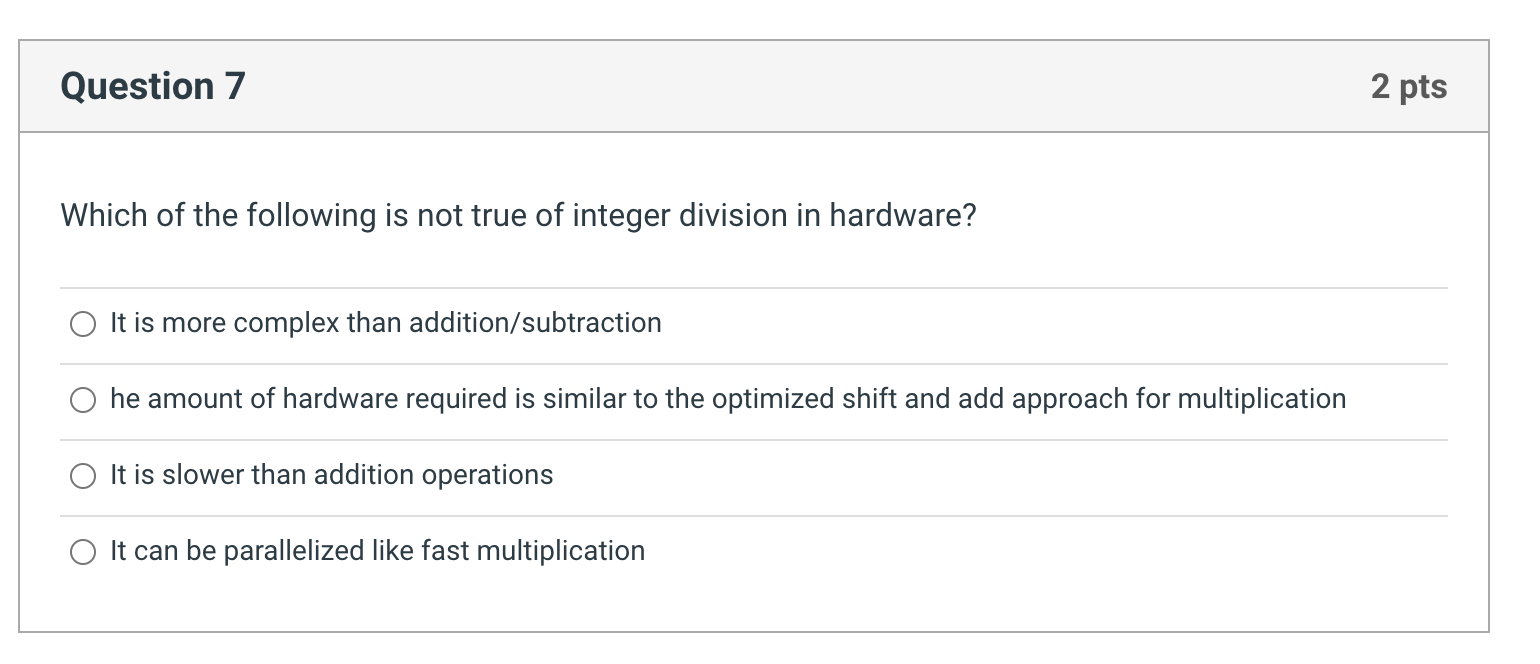
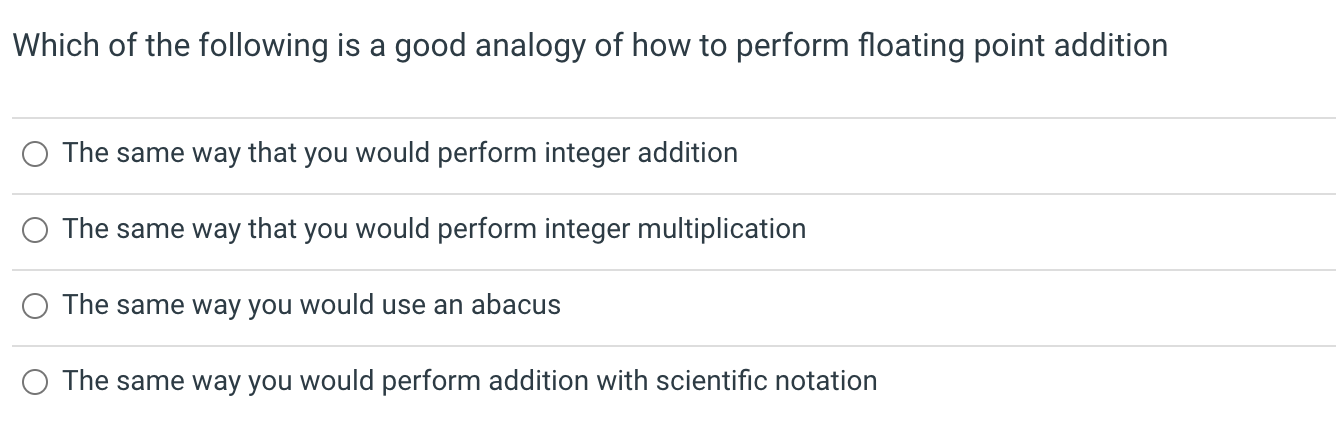
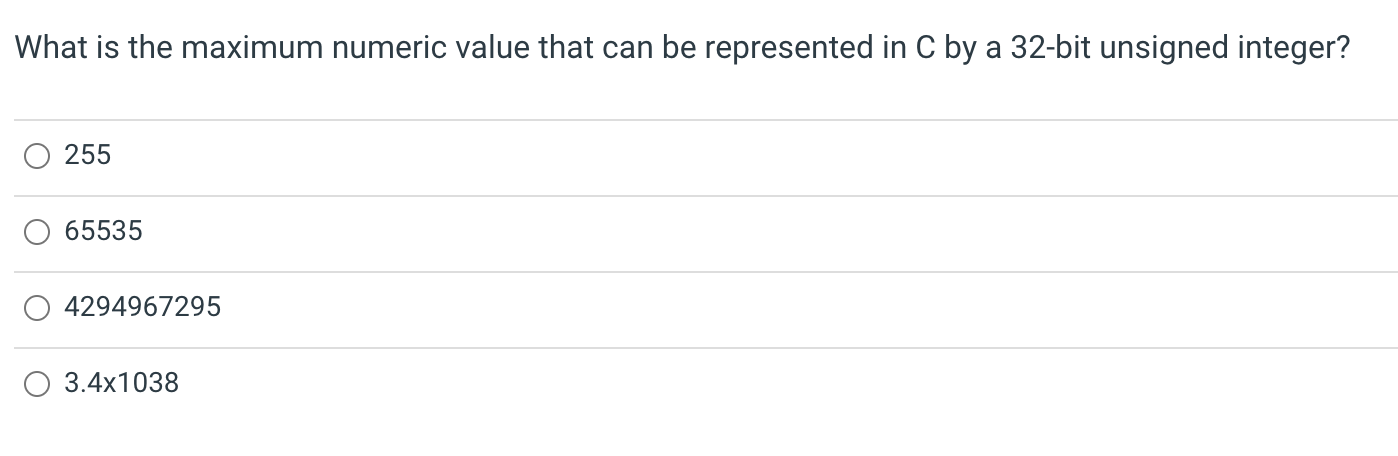
Based on our study of microprocessor architecture, which function is most likely to take the most transistors to implement? Integer addition Bitwise shift Logical XOR Integer multiplication Which of the following is not true of integer division in hardware? It is more complex than addition/subtraction he amount of hardware required is similar to the optimized shift and add approach for multiplication It is slower than addition operations It can be parallelized like fast multiplication Which of the following is a good analogy of how to perform floating point addition The same way that you would perform integer addition The same way that you would perform integer multiplication The same way you would use an abacus The same way you would perform addition with scientific notation What is the maximum numeric value that can be represented in C by a 32-bit unsigned integer? \begin{tabular}{l} 255 \\ \hline 65535 \\ \hline 4294967295 \\ \hline 3.41038 \end{tabular} What is the minimum numeric value that can be represented in C by a 32 -bit signed integer? \begin{tabular}{l} 4294967295 \\ \hline2147483648 \\ \hline 0 \end{tabular} Negative infinity
Step by Step Solution
There are 3 Steps involved in it

Get step-by-step solutions from verified subject matter experts
 Study Help