







Question: 8 9:1.10 | 11 | 12 | 13 | 14 | 1 Assignment Case Study 1 (Marks 21 ) Case Study. SNC-LAVALIN GROUP INC Bribery
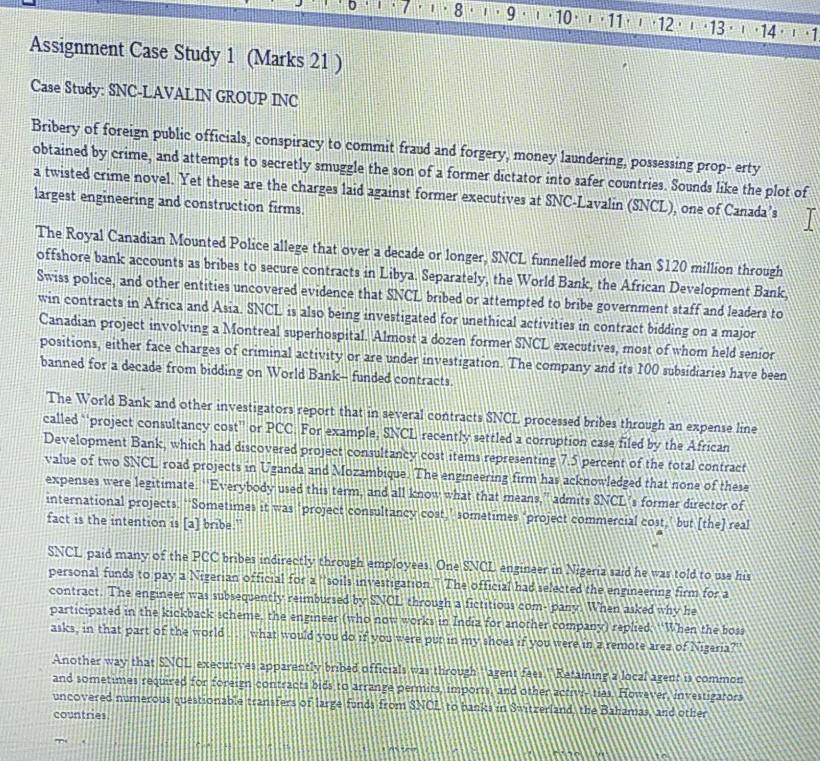
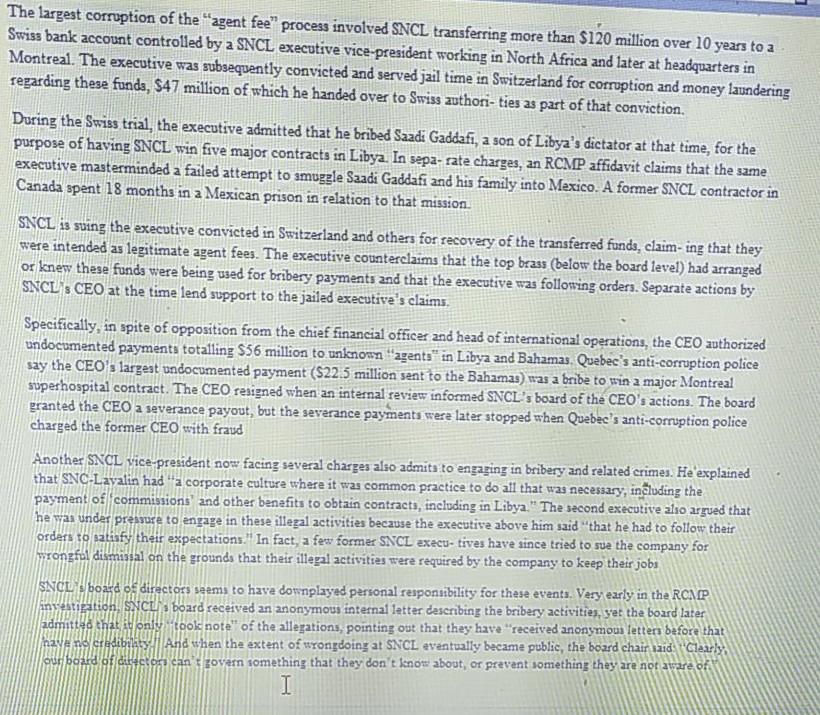
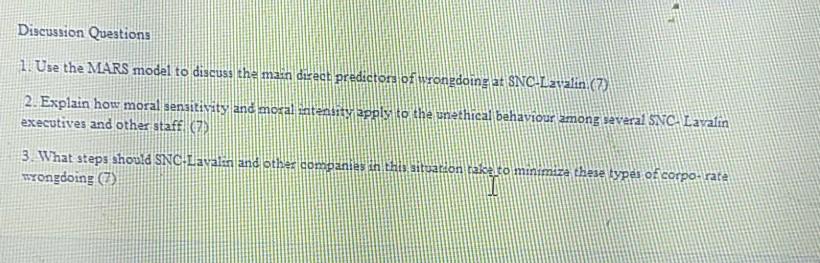
8 9:1.10 | 11 | 12 | 13 | 14 | 1 Assignment Case Study 1 (Marks 21 ) Case Study. SNC-LAVALIN GROUP INC Bribery of foreign public officials, conspiracy to commit fraud and forgery, money laundering, possessing prop-erty obtained by crime, and attempts to secretly smuggle the son of a former dictator into safer countries Sounds like the plot of a twisted crime novel. Yet these are the charges laid against former executives at SNC-Lavalin (SNCL), one of Canada's I largest engineering and construction firms The Royal Canadian Mounted Police allege that over a decade or longer. SNCL funnelled more than $120 million through offshore bank accounts as bribes to secure contracts in Libya. Separately, the World Bank, the African Development Bank, Swiss police, and other entities uncovered evidence that SNCL bribed or attempted to bribe government staff and leaders to win contracts in Africa and Asia. SNCL is also being investigated for unethical activities in contract bidding on a major Canadian project involving a Montreal superhospital. Almost a dozen former SNCL executives, most of whom held senior positions, either face charges of criminal activity or are under investigation. The company and its 100 subsidiaries have been banned for a decade from bidding on World Bank, funded contracts, The World Bank and other investigators report that in several contracts SNCL processed bribes through an expense line called project consultancy cost" or PCC For example, SNCL recently settled a corruption case filed by the African Development Bank, which had discovered project consultancy cost items representing 75 percent of the total contract value of two SNCL road projects in Uganda and Mozambique. The engineering firm has acknowledged that none of these expenses were legitimate. Everybody used this term, and all snow what that means, admits SNCLs formar director of international projects. Sometimes it was project consultancy cost, sometimes project commercial cost, but [the] real fact is the intention is (a) bribe. SNCL paid many of the PCC bribes indirectly through employees One SVCL anginaer in Nigeria said he was told to use his personal funds to pay . Nizerian official for 2 soils investigation. The Official had selected the engineering firm for a contract. The engineer was subsequently reimbursed by SOL through a fictitious com- pany. When asked why he participated in the kickback scheme the engineer (ho nos works in India or another company) replied. When the bose asks, in that part of the world that would you do if you were put in my shoes if you were in a remote area of Nigeria Another way that SNOL executivan appareatiy bribed officiali a through agenta Retaining local agent common and sometimes requered for beraien contact bids to strenge permis import and other activer til forever, investigadors uncovered numerous questionable transfer of large Fonds from SNOL to bank in Saitzerland, the Bahamas, and other countries The largest corruption of the "agent fee" process involved SNCL transferring more than $120 million over 10 years to a Swiss bank account controlled by a SNCL executive vice-president working in North Africa and later at headquarters in Montreal. The executive was subsequently convicted and served jail time in Switzerland for corruption and money laundering regarding these funda, 547 million of which he handed over to Swiss authori- ties as part of that conviction. During the Swiss trial, the executive admitted that he bribed Saadi Gaddafi, a son of Libya's dictator at that time, for the purpose of having SNCL win five major contracts in Libya. In sepa- rate charges, an RCMP affidavit claims that the same executive masterminded a failed attempt to smuggle Saadi Gaddafi and his family into Mexico. A former SNCL contractor in Canada spent 18 months in a Mexican prison in relation to that mission. SNCL is suing the executive convicted in Switzerland and others for recovery of the transferred funds, claim-ing that they were intended as legitimate agent fees. The executive counterclaims that the top brass (below the board level) had arranged or knew these funds were being used for bribery payments and that the executive was following orders. Separate actions by SNCL's CEO at the time lend support to the jailed executive's claims. Specifically, in spite of opposition from the chief financial officer and head of international operations, the CEO authorized undocumented payments totalling $56 million to unknown agents in Libya and Bahamas Quebec's anti-corruption police say the CEO's largest undocumented payment (522.5 million sent to the Bahamas) was a bribe to win a major Montreal superhospital contract. The CEO resigned when an internal review informed SNCL's board of the CEO's actions. The board granted the CEO a severance payout, but the severance payments were later stopped when Quebec's anti-corruption police charged the former CEO with fraud Another SNCL vice-president now facing several charges also admits to engaring in bribery and related crimes. He explained that SNC-Layalin had "a corporate culture where it was common practice to do all that was necessary, inluding the payment of commissions and other benefits to obtain contracts, including in Libya." The second executive also argued that he was under pressure to engage in these illegal activities because the executive above him said that he had to follow their orders to satisfy their expectations." In fact, a few former SNCL execu- tives have since tried to sue the company for wrongful dismissal on the grounds that their illegal activities were required by the company to keep their jobs SNCL board of directors seems to have downplayed personal responsibility for these events. Very early in the RCMP investigation. Suces board received an anonymous internal letter describing the bribery activities, get the board later admitted that it only took note" of the allegations, pointing out that they have "received anonymous letters before that have no credibility And when the extent of wrongdoing at SNCL eventually became public, the board chair iaid Clearly, our board of dirts: 072 can't govern something that they don't know about, or prevent something they are not aware of I Discussion Questions 1. Use the MARS model to discuss the main direct predicton of wongdoing at SNC-Lavalin. (7) 2. Explain how moral sensitivity and moral catality apply to the unethical behaviour among several INC. Lavalin executives and other staff 3. What steps should SNC-Lavalen and other companies in this situadon taice to minimize these types of corpo- rare wyongdoing )
Step by Step Solution
There are 3 Steps involved in it
1 Expert Approved Answer
Step: 1 Unlock

Question Has Been Solved by an Expert!
Get step-by-step solutions from verified subject matter experts
Step: 2 Unlock
Step: 3 Unlock
 Study Help