







Question: 8. Decision tree with multiple decision points Aa Aa E Free Spirit Industries Inc. is planning to add a new product line to make iToys.
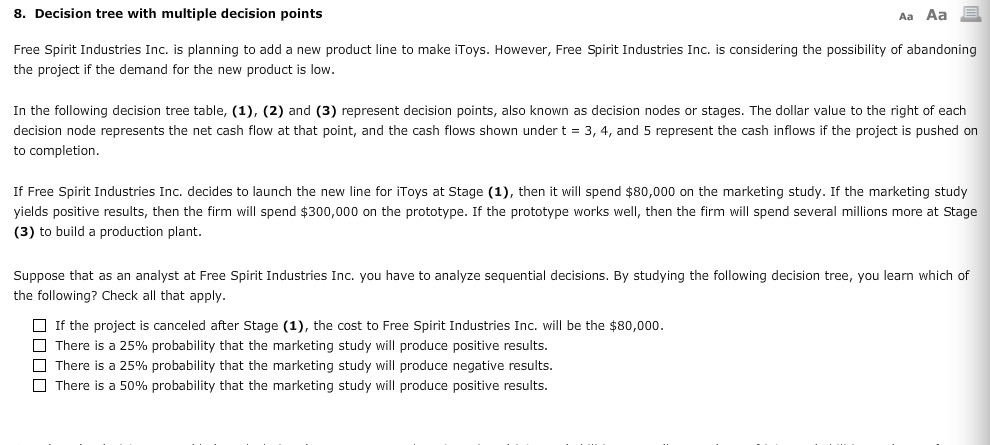
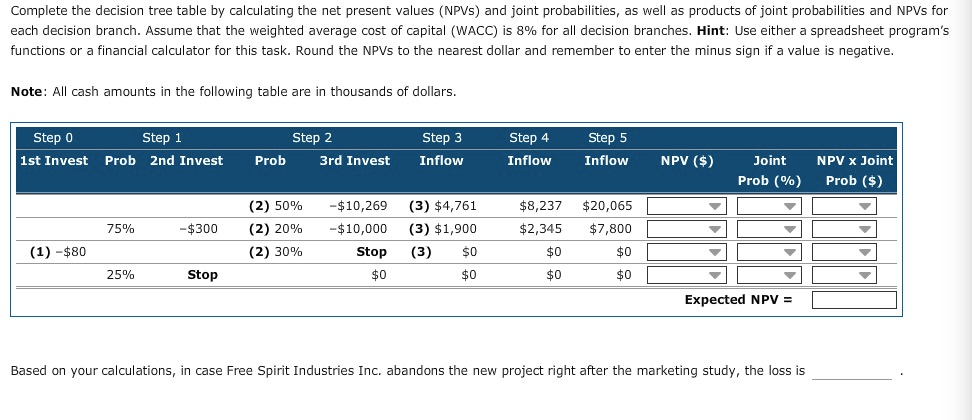
8. Decision tree with multiple decision points Aa Aa E Free Spirit Industries Inc. is planning to add a new product line to make iToys. However, Free Spirit Industries Inc. is considering the possibility of abandoning the project if the demand for the new product is low. In the following decision tree table, (1), (2) and (3) represent decision points, also known as decision nodes or stages. The dollar value to the right of each decision node represents the net cash flow at that point, and the cash flows shown under t = 3, 4, and 5 represent the cash inflows if the project is pushed on to completion. If Free Spirit Industries Inc. decides to launch the new line for iToys at Stage (1), then it will spend $80,000 on the marketing study. If the marketing study yields positive results, then the firm will spend $300,000 on the prototype. If the prototype works well, then the firm will spend several millions more at Stage (3) to build a production plant. Suppose that as an analyst at Free Spirit Industries Inc. you have to analyze sequential decisions. By studying the following decision tree, you learn which of the following? Check all that apply. If the project is canceled after Stage (1), the cost to Free Spirit Industries Inc. will be the $80,000. There is a 25% probability that the marketing study will produce positive results. There is a 25% probability that the marketing study will produce negative results. There is a 50% probability that the marketing study will produce positive results. Complete the decision tree table by calculating the net present values (NPVS) and joint probabilities, as well as products of joint probabilities and NPVs for each decision branch. Assume that the weighted average cost of capital (WACC) is 8% for all decision branches. Hint: Use either a spreadsheet program's functions or a financial calculator for this task. Round the NPVs to the nearest dollar and remember to enter the minus sign if a value is negative. Note: All cash amounts in the following table are in thousands of dollars. Step 0 Step 1 1st Invest Prob 2nd Invest Step 2 3rd Invest Step 3 Inflow Step 4 Inflow Step 5 I nflow Prob NPV ($) Joint Prob (%) NPV x Joint Prob ($) 75% -$300 (2) 50% (2) 20% (2) 30% -$10,269 $10,000 Stop $0 (3) $4,761 (3) $1,900 (3) $0 $0 $8,237 $2,345 $0 $0 $20,065 $7,800 $0 $0 (1) -$80 25% Stop Expected NPV = Based on your calculations, in case Free Spirit Industries Inc. abandons the new project right after the marketing study, the loss is 8. Decision tree with multiple decision points Aa Aa E Free Spirit Industries Inc. is planning to add a new product line to make iToys. However, Free Spirit Industries Inc. is considering the possibility of abandoning the project if the demand for the new product is low. In the following decision tree table, (1), (2) and (3) represent decision points, also known as decision nodes or stages. The dollar value to the right of each decision node represents the net cash flow at that point, and the cash flows shown under t = 3, 4, and 5 represent the cash inflows if the project is pushed on to completion. If Free Spirit Industries Inc. decides to launch the new line for iToys at Stage (1), then it will spend $80,000 on the marketing study. If the marketing study yields positive results, then the firm will spend $300,000 on the prototype. If the prototype works well, then the firm will spend several millions more at Stage (3) to build a production plant. Suppose that as an analyst at Free Spirit Industries Inc. you have to analyze sequential decisions. By studying the following decision tree, you learn which of the following? Check all that apply. If the project is canceled after Stage (1), the cost to Free Spirit Industries Inc. will be the $80,000. There is a 25% probability that the marketing study will produce positive results. There is a 25% probability that the marketing study will produce negative results. There is a 50% probability that the marketing study will produce positive results. Complete the decision tree table by calculating the net present values (NPVS) and joint probabilities, as well as products of joint probabilities and NPVs for each decision branch. Assume that the weighted average cost of capital (WACC) is 8% for all decision branches. Hint: Use either a spreadsheet program's functions or a financial calculator for this task. Round the NPVs to the nearest dollar and remember to enter the minus sign if a value is negative. Note: All cash amounts in the following table are in thousands of dollars. Step 0 Step 1 1st Invest Prob 2nd Invest Step 2 3rd Invest Step 3 Inflow Step 4 Inflow Step 5 I nflow Prob NPV ($) Joint Prob (%) NPV x Joint Prob ($) 75% -$300 (2) 50% (2) 20% (2) 30% -$10,269 $10,000 Stop $0 (3) $4,761 (3) $1,900 (3) $0 $0 $8,237 $2,345 $0 $0 $20,065 $7,800 $0 $0 (1) -$80 25% Stop Expected NPV = Based on your calculations, in case Free Spirit Industries Inc. abandons the new project right after the marketing study, the loss is
Step by Step Solution
There are 3 Steps involved in it

Get step-by-step solutions from verified subject matter experts
 Study Help