







Question: 8. DHCP standards define multiple methods to allocate IP addresses. What are they? c. Dynamic only d. Dynamic, Automatic, and Manual a. Dynamic and Automatic
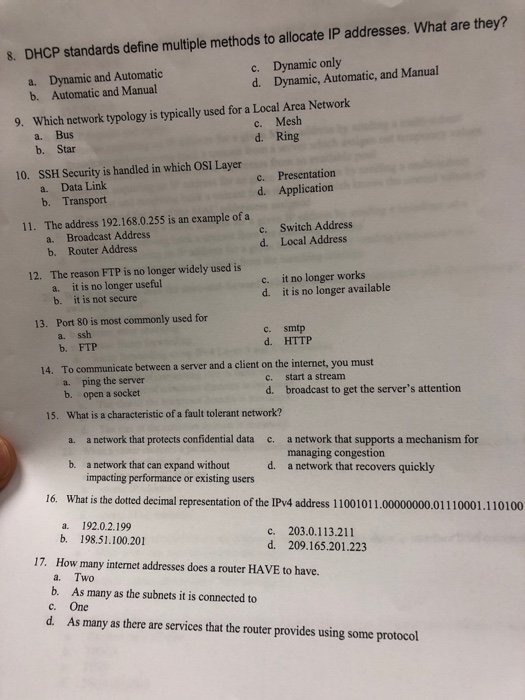
8. DHCP standards define multiple methods to allocate IP addresses. What are they? c. Dynamic only d. Dynamic, Automatic, and Manual a. Dynamic and Automatic b. Automatic and Manual Which network typology is typically used for a Local Area Network a. Bus b. Star 9. c. Mesh d. Ring SSH Security is handled in which OSI Layer a. Data Link b. Transport 10. c. Presentation d. Application 11. The address 192.168.0.255 is an example of a a. Broadcast Address b. Router Address c. Switch Address d. Local Address The reason FTP is no longer widely used is a. 12. it is no longer useful it is not secure c. d. it no longer works it is no longer available b. 13. Port 80 is most commonly used for a. ssh b. FTP c. smtp d. HTTP To communicate between a server and a client on the internet, you must a ping the server b. open a socket 14. c. start a stream d. broadcast to get the server's attention 15. What is a characteristic of a fault tolerant network? a network that protects confidential data a. c. a network that supports a mechanism for managing congestion a network that recovers quickly b. a network that can expand without impacting performance or existing users d. 16. What is the dotted decimal representation of the IPv4 address 11001011.00000000.01110001.110100 a. 192.0.2.199 c. 203.0.113.211 d. 209.165.201.223 b. 198.51.100.201 17. How many internet addresses does a router HAVE to have. a. Two b. As many as the subnets it is connected to c. One d. As many as there are services that the router provides using some protocol
Step by Step Solution
There are 3 Steps involved in it

Get step-by-step solutions from verified subject matter experts
 Study Help