Question: 8. In this problem, we will add constraints onto the parameterized basic production problem that we worked on in the last two classes. Provide additional
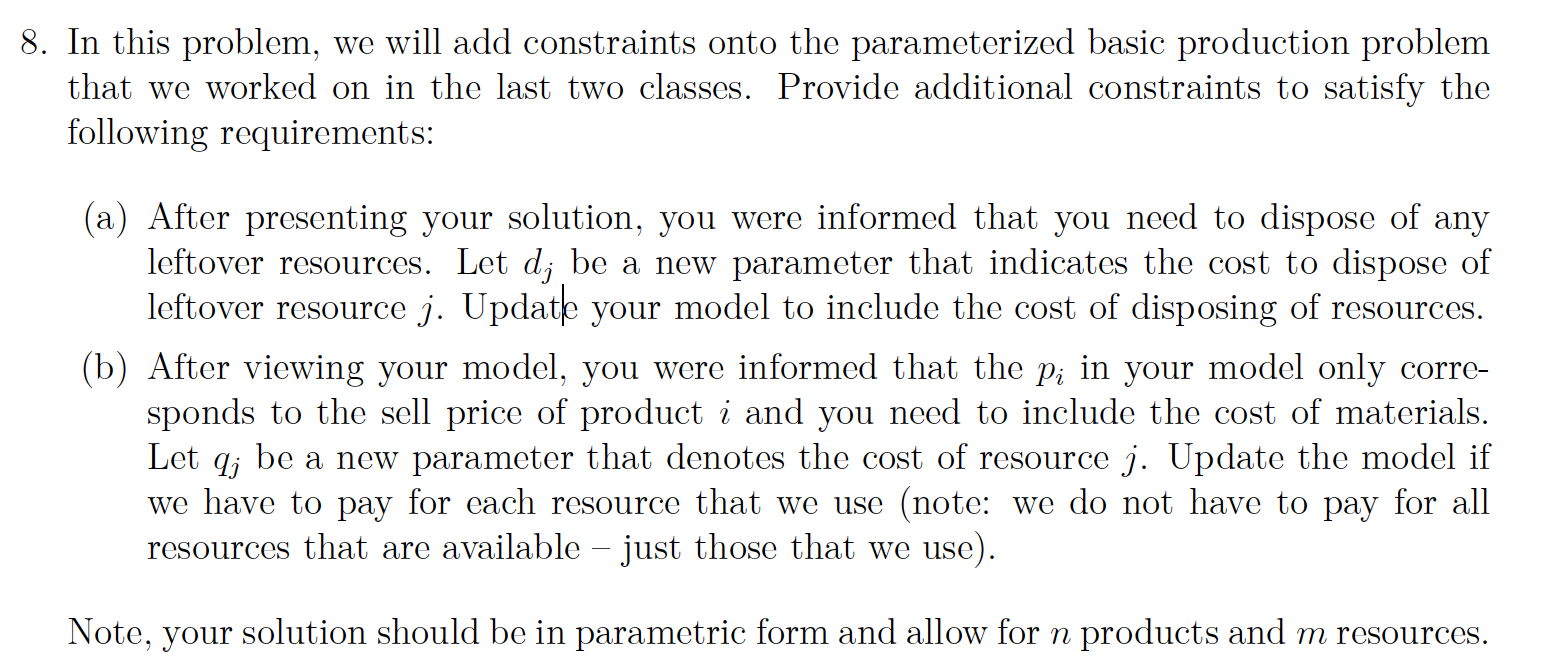
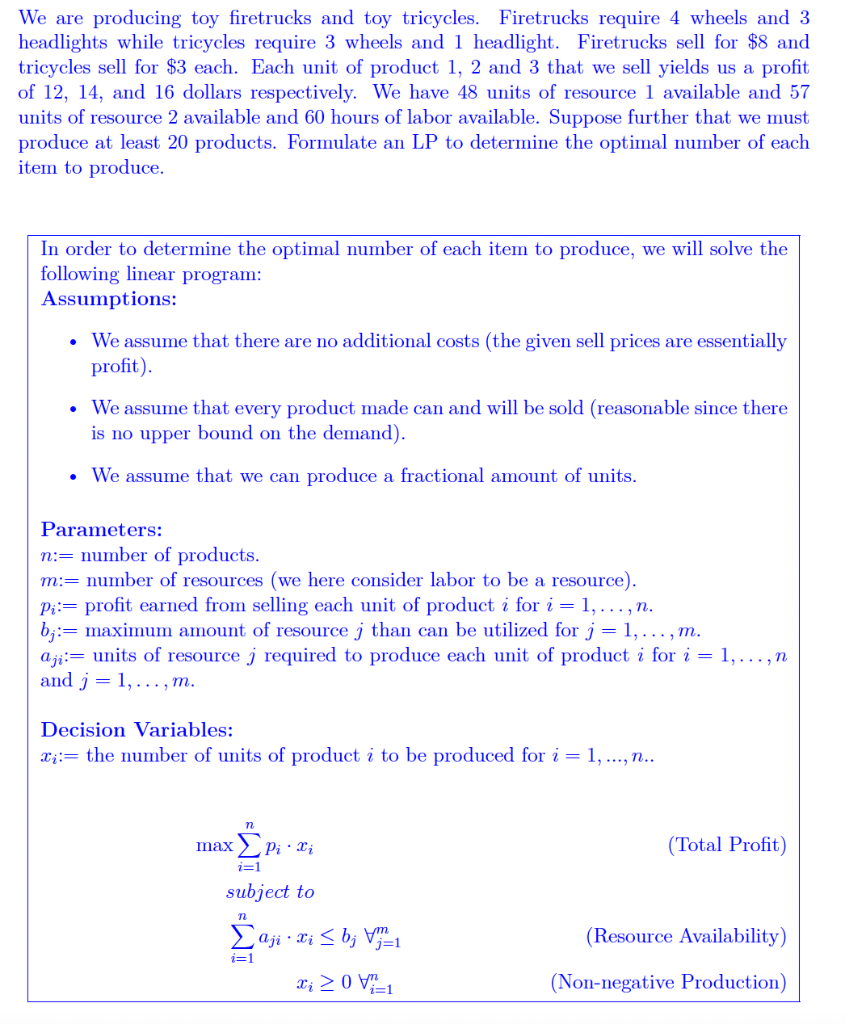
8. In this problem, we will add constraints onto the parameterized basic production problem that we worked on in the last two classes. Provide additional constraints to satisfy the following requirements: (a) After presenting your solution, you were informed that you need to dispose of any leftover resources. Let d; be a new parameter that indicates the cost to dispose of leftover resource j. Update your model to include the cost of disposing of resources. (b) After viewing your model, you were informed that the pi in your model only corre- sponds to the sell price of product i and you need to include the cost of materials. Let qj be a new parameter that denotes the cost of resource j. Update the model if we have to pay for each resource that we use (note: we do not have to pay for all resources that are available - just those that we use). Note, your solution should be in parametric form and allow for n products and m resources. We are producing toy firetrucks and toy tricycles. Firetrucks require 4 wheels and 3 headlights while tricycles require 3 wheels and 1 headlight. Firetrucks sell for $8 and tricycles sell for $3 each. Each unit of product 1, 2 and 3 that we sell yields us a profit of 12, 14, and 16 dollars respectively. We have 48 units of resource 1 available and 57 units of resource 2 available and 60 hours of labor available. Suppose further that we must produce at least 20 products. Formulate an LP to determine the optimal number of each item to produce. In order to determine the optimal number of each item to produce, we will solve the following linear program: Assumptions: We assume that there are no additional costs (the given sell prices are essentially profit). We assume that every product made can and will be sold (reasonable since there is no upper bound on the demand). We assume that we can produce a fractional amount of units. Parameters: n:= number of products. m:= number of resources (we here consider labor to be a resource). Pi:= profit earned from selling each unit of product i for i = 1,..., n. bj:= maximum amount of resource j than can be utilized for j = 1,..., m. Aji:= units of resource j required to produce each unit of product i for i = 1, ..., n and j = 1,...,m. Decision Variables: Xi:= the number of units of product i to be produced for i = 1, ..., N.. n max i=1 (Total Profit) subject to aji Li 5 b; V=1 (Resource Availability) i=1 Xi>OVAL (Non-negative Production) 8. In this problem, we will add constraints onto the parameterized basic production problem that we worked on in the last two classes. Provide additional constraints to satisfy the following requirements: (a) After presenting your solution, you were informed that you need to dispose of any leftover resources. Let d; be a new parameter that indicates the cost to dispose of leftover resource j. Update your model to include the cost of disposing of resources. (b) After viewing your model, you were informed that the pi in your model only corre- sponds to the sell price of product i and you need to include the cost of materials. Let qj be a new parameter that denotes the cost of resource j. Update the model if we have to pay for each resource that we use (note: we do not have to pay for all resources that are available - just those that we use). Note, your solution should be in parametric form and allow for n products and m resources. We are producing toy firetrucks and toy tricycles. Firetrucks require 4 wheels and 3 headlights while tricycles require 3 wheels and 1 headlight. Firetrucks sell for $8 and tricycles sell for $3 each. Each unit of product 1, 2 and 3 that we sell yields us a profit of 12, 14, and 16 dollars respectively. We have 48 units of resource 1 available and 57 units of resource 2 available and 60 hours of labor available. Suppose further that we must produce at least 20 products. Formulate an LP to determine the optimal number of each item to produce. In order to determine the optimal number of each item to produce, we will solve the following linear program: Assumptions: We assume that there are no additional costs (the given sell prices are essentially profit). We assume that every product made can and will be sold (reasonable since there is no upper bound on the demand). We assume that we can produce a fractional amount of units. Parameters: n:= number of products. m:= number of resources (we here consider labor to be a resource). Pi:= profit earned from selling each unit of product i for i = 1,..., n. bj:= maximum amount of resource j than can be utilized for j = 1,..., m. Aji:= units of resource j required to produce each unit of product i for i = 1, ..., n and j = 1,...,m. Decision Variables: Xi:= the number of units of product i to be produced for i = 1, ..., N.. n max i=1 (Total Profit) subject to aji Li 5 b; V=1 (Resource Availability) i=1 Xi>OVAL (Non-negative Production)









 Study Help