







Question: 8. Limiting Values in Physics - Challenge Problem In physics, the definitions of instantaneous velocity and instantaneous acceleration are based on the mathematical concept of
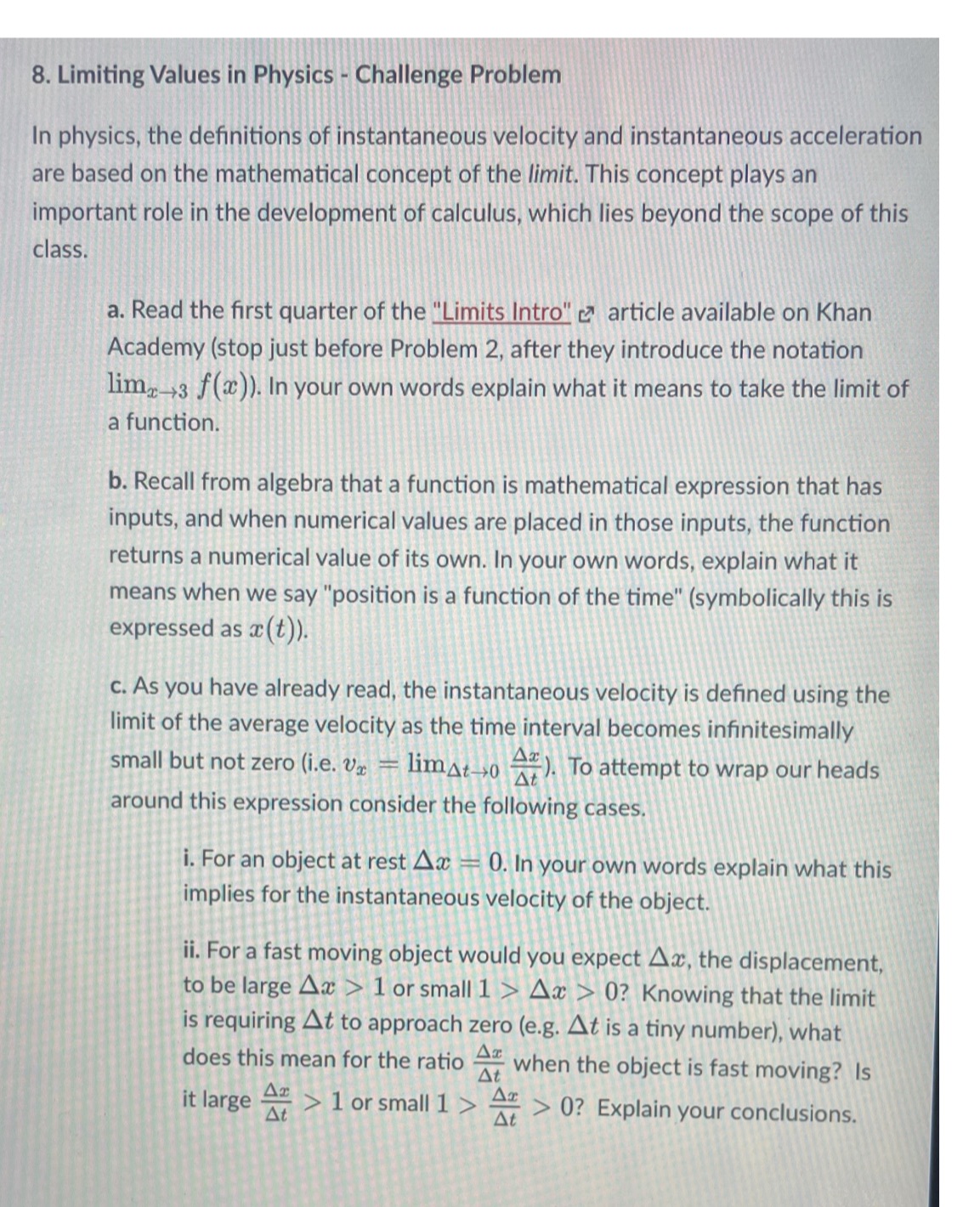
8. Limiting Values in Physics - Challenge Problem In physics, the definitions of instantaneous velocity and instantaneous acceleration are based on the mathematical concept of the limit. This concept plays an important role in the development of calculus, which lies beyond the scope of this class. a. Read the first quarter of the "Limits Intro" @ article available on Khan Academy (stop just before Problem 2, after they introduce the notation limz-3 f()). In your own words explain what it means to take the limit of a function. b. Recall from algebra that a function is mathematical expression that has inputs, and when numerical values are placed in those inputs, the function returns a numerical value of its own. In your own words, explain what it means when we say "position is a function of the time" (symbolically this is expressed as a (t)). c. As you have already read, the instantaneous velocity is defined using the limit of the average velocity as the time interval becomes infinitesimally small but not zero (i.e. Vx limAt ,0 "). To attempt to wrap our heads around this expression consider the following cases. i. For an object at rest Ax # 0. In your own words explain what this implies for the instantaneous velocity of the object. ii. For a fast moving object would you expect Ax, the displacement, to be large Ax > 1 or small 1 > Ax > 0? Knowing that the limit is requiring At to approach zero (e.g. At is a tiny number), what does this mean for the ratio when the object is fast moving? Is it large z > 1 or small 1 > > 0? Explain your conclusions
Step by Step Solution
There are 3 Steps involved in it

Get step-by-step solutions from verified subject matter experts
 Study Help