







Question: (8%) Problem 2: Common static electricity involves charges in the range between nanocoulombs and microcoulombs. 50% Part (a) How many electrons are needed to
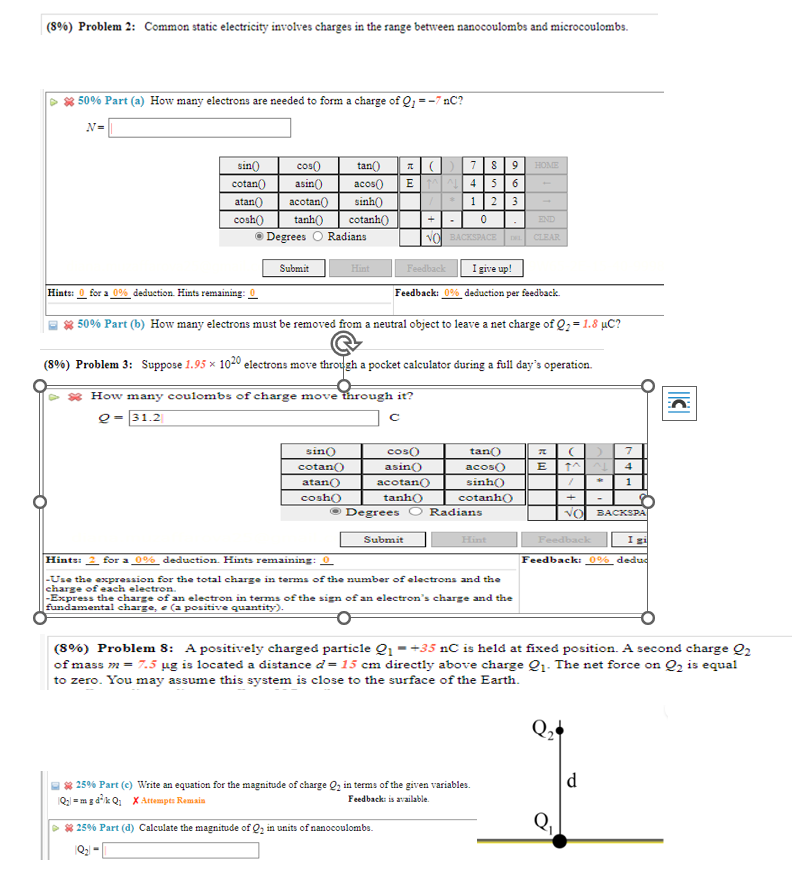
(8%) Problem 2: Common static electricity involves charges in the range between nanocoulombs and microcoulombs. 50% Part (a) How many electrons are needed to form a charge of Q = -7 nC? N= sin Cos tan() 7 cotan asin() acos atan acotan sinh ( ) 78 9 ETAL 4 5 6 1 2 3 HOME cosh tanh) Degrees Radians cotanh 0 END VO BACKSPACE DEL CLEAR Submit Hint Feedback I give up! Hints: for a 0% deduction. Hints remaining: 0 Feedback: 0% deduction per feedback. 50% Part (b) How many electrons must be removed from a neutral object to leave a net charge of Q = 1.8 C? (8%) Problem 3: Suppose 1.95 1020 electrons move through a pocket calculator during a full day's operation. How many coulombs of charge move through it? Q-31.2 C sin cotan() cos() asin() tan() acos > 7 E 4 atan cosh acotan tanh sinh() / 1 cotanh + Degrees O Radians VO - BACKSPA I gi Submit Hints: 2 for a 0% deduction. Hints remaining: 0 Hint -Use the expression for the total charge in terms of the number of electrons and the charge of each electron. -Express the charge of an electron in terms of the sign of an electron's charge and the fundamental charge, (a positive quantity). Feedback Feedback: 0% dedu C (8%) Problem 8: A positively charged particle Q +35 nC is held at fixed position. A second charge Q of mass m = 7.5 g is located a distance d= 15 cm directly above charge Q. The net force on Q2 is equal to zero. You may assume this system is close to the surface of the Earth. 25% Part (c) Write an equation for the magnitude of charge Q2 in terms of the given variables. Q=mg dk Q XAttempts Remain Feedback: is available. 25% Part (d) Calculate the magnitude of Q in units of nanocoulombs. Q2 Q d
Step by Step Solution
There are 3 Steps involved in it

Get step-by-step solutions from verified subject matter experts
 Study Help