





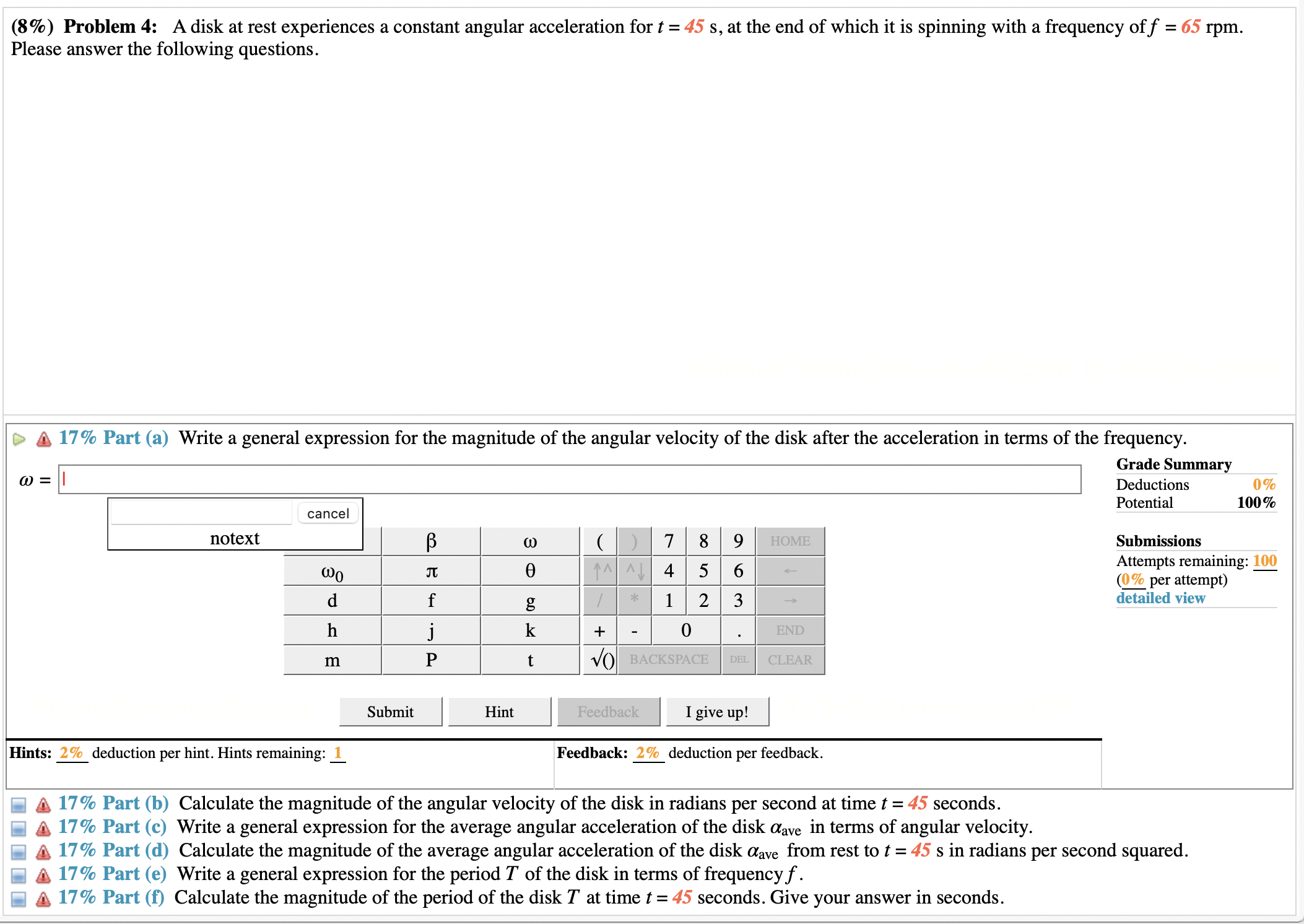
Question: (8%) Problem 4: A disk at rest experiences a constant angular acceleration for t = 45 s, at the end of which it is spinning
(8%) Problem 4: A disk at rest experiences a(8%) Problem 4: A disk at rest experiences a(8%) Problem 4: A disk at rest experiences a
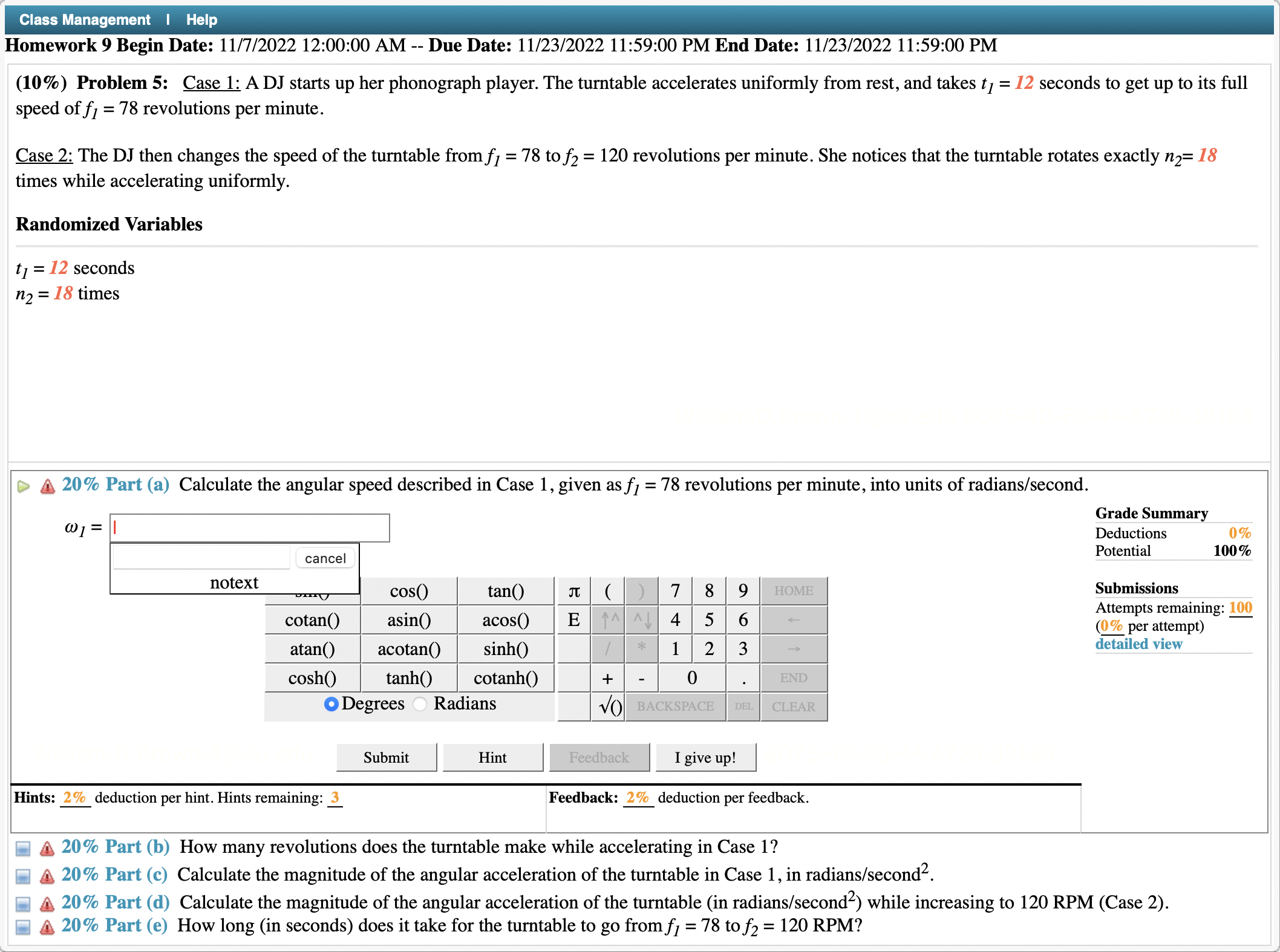
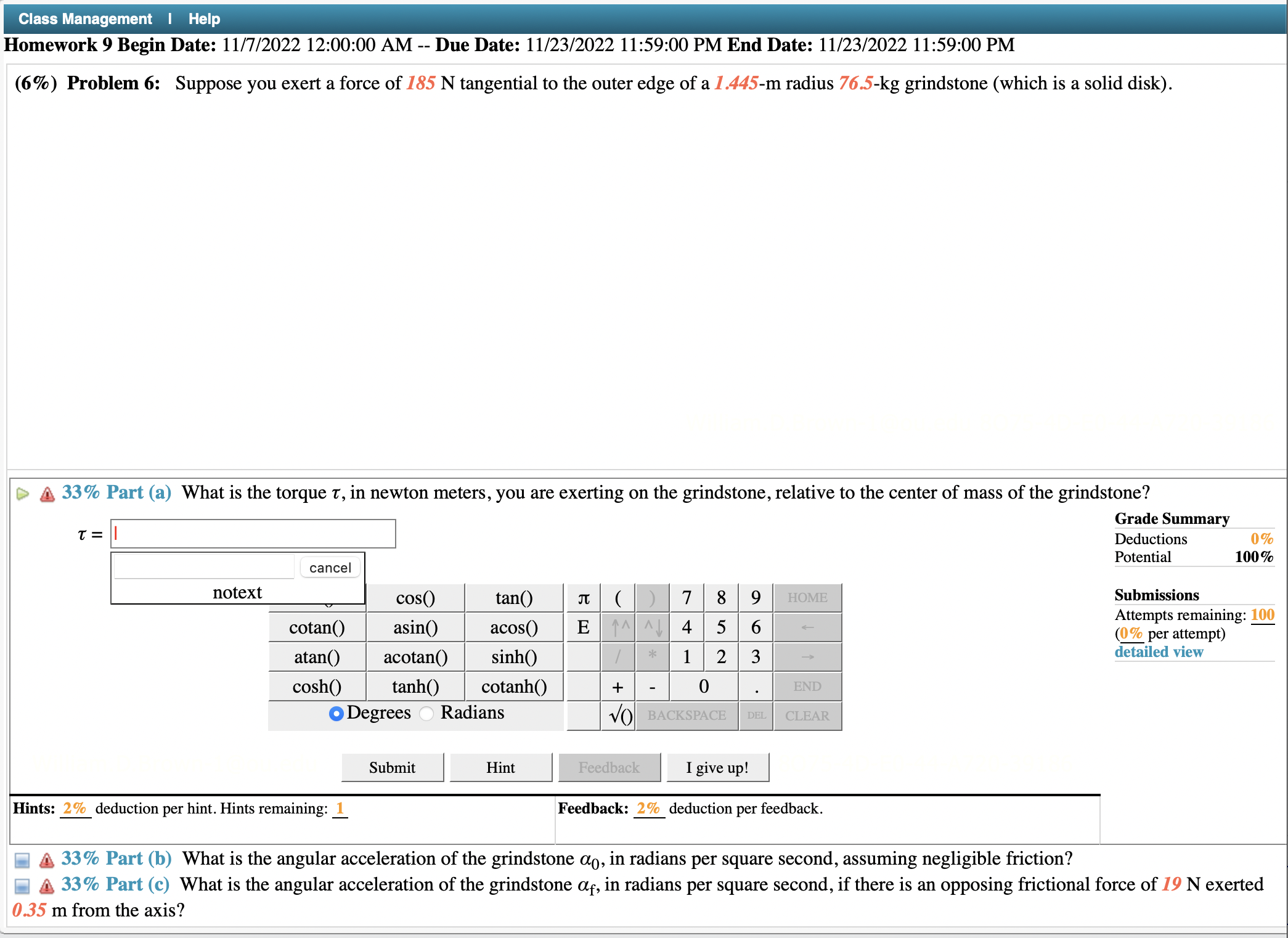
(8%) Problem 4: A disk at rest experiences a constant angular acceleration for t = 45 s, at the end of which it is spinning with a frequency of f = 65 rpm. Please answer the following questions. A 17% Part (3) Write a general expression for the magnitude of the angular velocity of the disk after the acceleration in terms of the frequency. Grade Summary a)=| Deductions Potential 100% ca n cel B as ( 7 8 9 Submissions Attempts remaining: _ (1)0 ' I 6 4 5 6 (_ per attempt) d f l g 1 2 3 detailed View h j | k + . 0 _ m P t /() Submit | Him | | 1 give up! Hints: deduction per hint. Hints remaining: _ Feedback: deduction per feedback. A 17% Part (b) Calculate the magnitude of the angular velocity of the disk in radians per second at time t = 45 seconds. A 17% Part (c) Write a general expression for the average angular acceleration of the disk am in terms of angular velocity. Q 17% Part ((1) Calculate the magnitude of the average angular acceleration of the disk (lava from rest to t = 45 s in radians per second squared. A 17% Part (e) Write a general expression for the period T of the disk in terms of frequency f . A 17% Part (f) Calculate the magnitude of the period of the disk T at time t: 45 seconds. Give your answer in seconds. ' Homework 9 Begin Date: 11/7/2022 12:00:00 AM -- Due Date: 11/23/2022 11:59:00 PM End Date: 11/23/2022 11:59:00 PM (10%) Problem 5: Case 1: A DJ starts up her phonograph player: The turntable accelerates uniformly from rest, and takes t1 = 12 seconds to get up to its full speed of f1 = 78 revolutions per minute. Case 2: The DJ then changes the speed of the turntable from f1 = 78 to f2 = 120 revolutions per minute. She notices that the turntable rotates exactly n2: 18 times While accelerating uniformly. Randomized Variables t1 = 12 seconds n2 = 18 times A 20% Part (3) Calculate the angular speed described in Case 17 given as f1 = 78 revolutions per minute, into units of radians/second. Grade Summary 0)] = I Deductions ' ca n cel Potential 100% notext I 0050 I $21110 I 3': ( 7 8 9 iTthmiSISions . . _ V CHIP 5 [611121111ng1 cotan() asm() I acos() I E 4 5 6 (; per attempt) atan() acotan() I sinhO I 1 2 3 detailed view cosh() tanhO | cotanh() | + - | 0 0 Degrees Radians W/O Submit Hint - I give up! Hints: -, deduction per hint. Hints remaining: _ Feedback: , - deduction per feedback. '- A 20% Part (b) How many revolutions does the turntable make while accelerating in Case 1? - A 20% Part (c) Calculate the magnitude of the angular acceleration of the turntable in Case 1, in radians/second? - A 20% Part (d) Calculate the magnitude of the angular acceleration of the turntable (in radians/secondz) while increasing to 120 RPM (Case 2). - A 20% Part (e) How long (in seconds) does it take for the turntable to go from f1 = 78 to f2 = 120 RPM? Class Management I Help Homework 9 Begin Date: 11/7/2022 12:00:00 AM -- Due Date: 11/23/2022 11:59:00 PM End Date: 11/23/2022 11:59:00 PM (6%) Problem 6: Suppose you exert a force of 185 N tangential to the outer edge of a 1.445-m radius 76.5-kg grindstone (which is a solid disk). A 33% Part (a) What is the torque t, in newton meters, you are exerting on the grindstone, relative to the center of mass of the grindstone? Grade Summary T= Deductions 0% Potential 100% cancel notext Submissions cos() tan() 7 8 9 HOME Attempts remaining: 100 cotan() asin() acoso E 4 5 6 0% per attempt) detailed view atan() acotan() sinh() 2 3 cosh tanh() cotanh() + END Degrees O Radians VO BACKSPACE DEL CLEAR Submit Hint Feedback I give up! Hints: 2% deduction per hint. Hints remaining: 1 Feedback: 2% deduction per feedback 33% Part (b) What is the angular acceleration of the grindstone do, in radians per square second, assuming negligible friction? A 33% Part (c) What is the angular acceleration of the grindstone af, in radians per square second, if there is an opposing frictional force of 19 N exerted 0.35 m from the axis
Step by Step Solution

There are 3 Steps involved in it

1 Expert Approved Answer
Step: 1 Unlock blur-text-image

Question Has Been Solved by an Expert!

Get step-by-step solutions from verified subject matter experts

Step: 2 Unlock
Step: 3 Unlock

Students Have Also Explored These Related Mathematics Questions!