Question: 8 - Quantity and Inventory Read the chapter below and Write a short summary to describe forecasting methods and explain why is it important for
8 - Quantity and Inventory Read the chapter below and Write a short summary to describe forecasting methods and explain why is it important for the supply chain management.
NOTE: Content must be a minimum of 250 words.
Feel free to use any other sources of information such as online libraries or web searches.
You do not have to depend on the course textbook
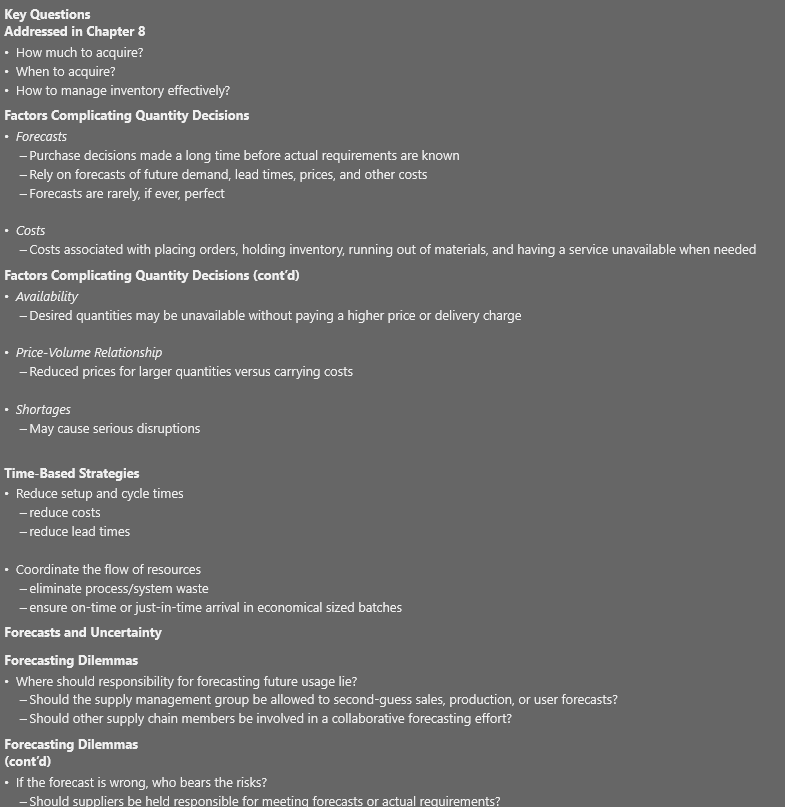
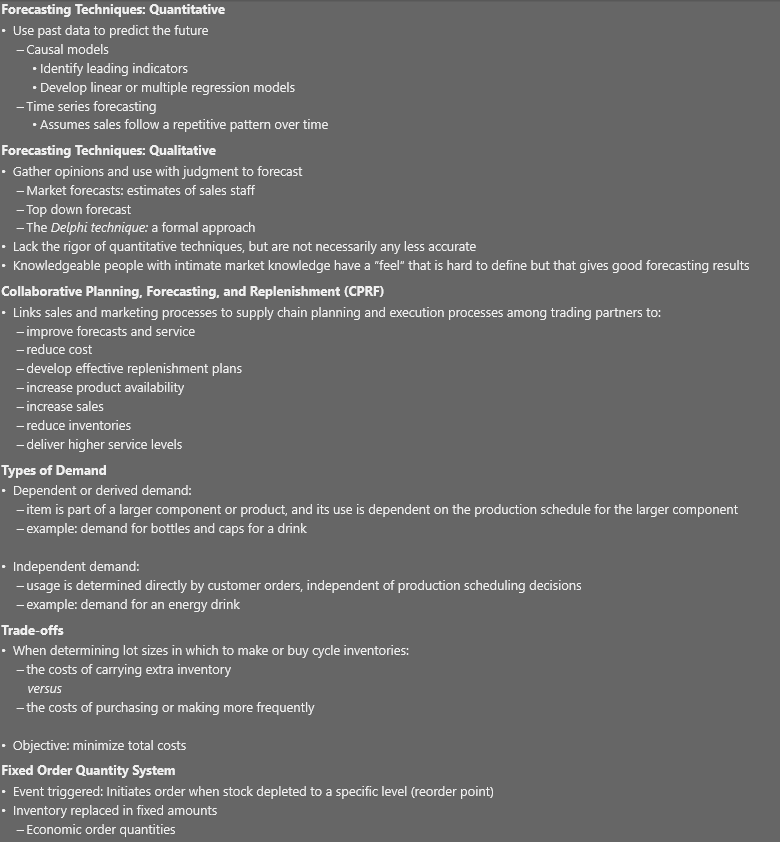
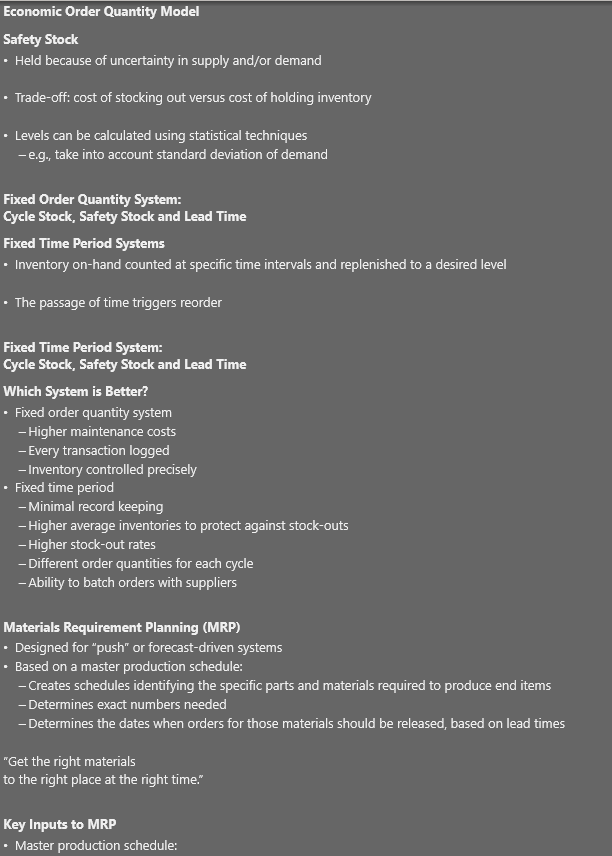
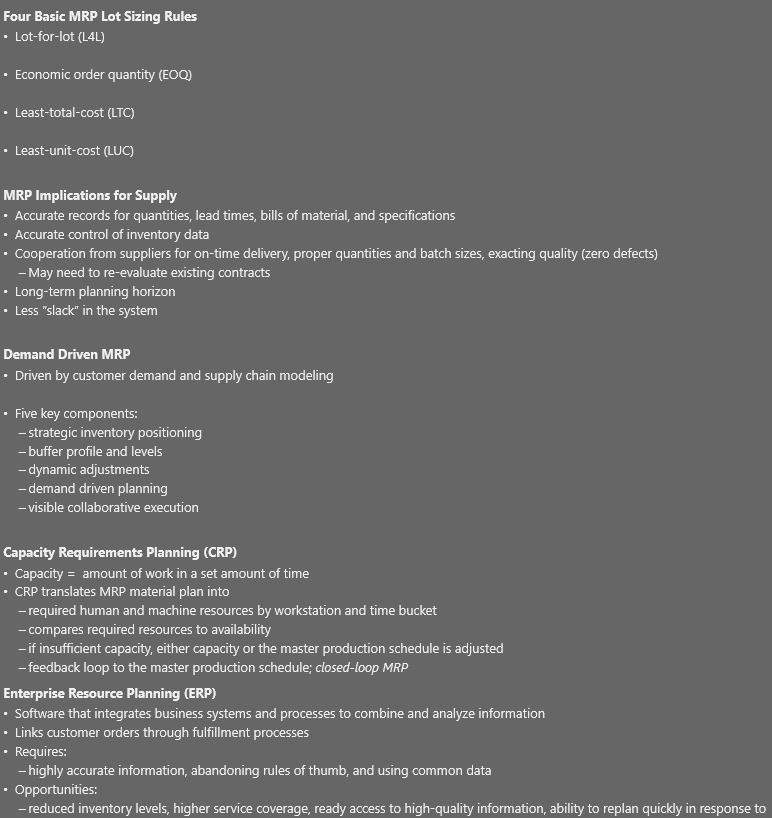
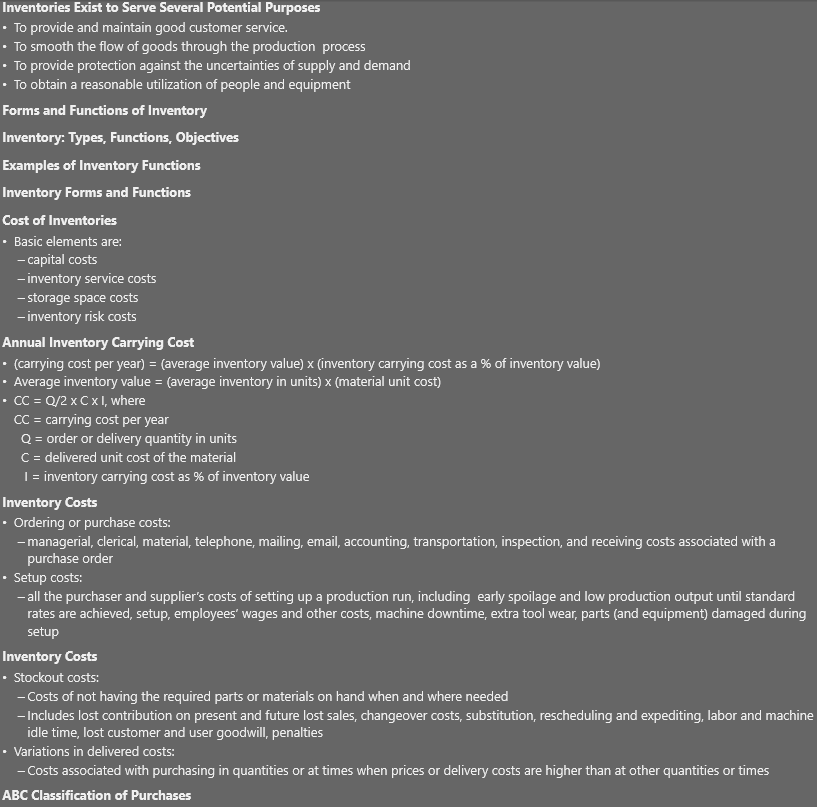
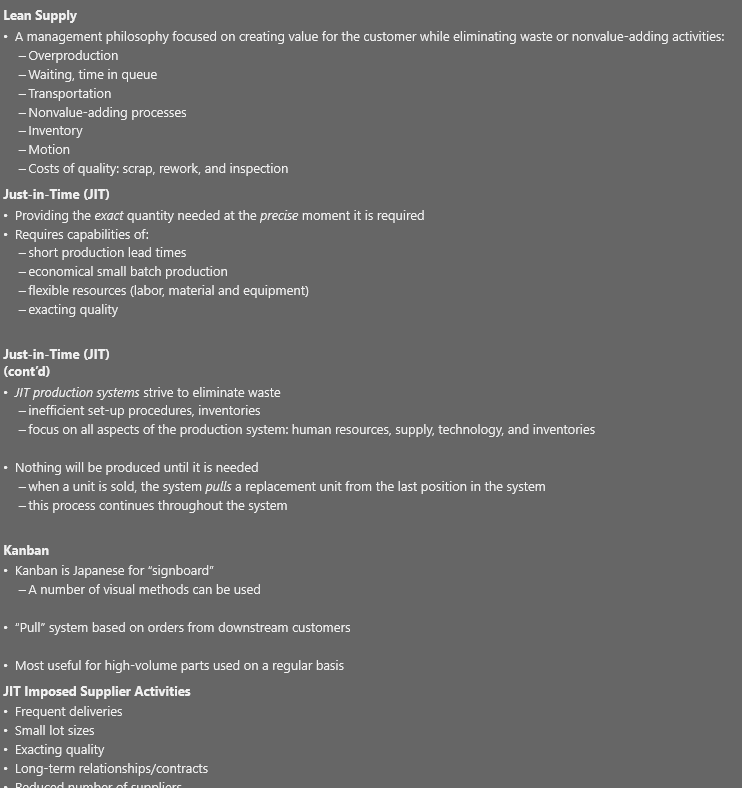
Key Questions Addressed in Chapter 8 - How much to acquire? - When to acquire? - How to manage inventory effectively? Factors Complicating Quantity Decisions - Forecasts - Purchase decisions made a long time before actual requirements are known - Rely on forecasts of future demand, lead times, prices, and other costs - Forecasts are rarely, if ever, perfect - Costs - Costs associated with placing orders, holding inventory, running out of materials, and having a service unavailable when needed Factors Complicating Quantity Decisions (cont'd) - Availability - Desired quantities may be unavailable without paying a higher price or delivery charge - Price-Volume Relationship - Reduced prices for larger quantities versus carrying costs - Shortages - May cause serious disruptions Time-Based Strategies - Reduce setup and cycle times - reduce costs - reduce lead times - Coordinate the flow of resources - eliminate process/system waste - ensure on-time or just-in-time arrival in economical sized batches Forecasts and Uncertainty Forecasting Dilemmas -Where should responsibility for forecasting future usage lie? - Should the supply management group be allowed to second-guess sales, production, or user forecasts? - Should other supply chain members be involved in a collaborative forecasting effort? Forecasting Dilemmas (cont'd) - If the forecast is wrong, who bears the risks? - Should suppliers be held responsible for meeting forecasts or actual requirements? - Assumes sales follow a repetitive pattern over time Forecasting Techniques: Qualitative - Gather opinions and use with judgment to forecast - Market forecasts: estimates of sales staff - Top down forecast - The Delphi technique: a formal approach - Lack the rigor of quantitative techniques, but are not necessarily any less accurate - Knowledgeable people with intimate market knowledge have a "feel" that is hard to define but that gives good forecasting results Collaborative Planning, Forecasting, and Replenishment (CPRF) - Links sales and marketing processes to supply chain planning and execution processes among trading partners to: - improve forecasts and service - reduce cost - develop effective replenishment plans - increase product availability - increase sales - reduce inventories - deliver higher service levels Types of Demand - Dependent or derived demand: - item is part of a larger component or product, and its use is dependent on the production schedule for the larger component - example: demand for bottles and caps for a drink - Independent demand: - usage is determined directly by customer orders, independent of production scheduling decisions - example: demand for an energy drink Trade-offs - When determining lot sizes in which to make or buy cycle inventories: - the costs of carrying extra inventory versus - the costs of purchasing or making more frequently - Objective: minimize total costs Fixed Order Quantity System - Event triggered: Initiates order when stock depleted to a specific level (reorder point) - Inventory replaced in fixed amounts Economic Order Quantity Model Safety Stock - Held because of uncertainty in supply and/or demand - Trade-off: cost of stocking out versus cost of holding inventory - Levels can be calculated using statistical techniques - e.g. take into account standard deviation of demand Fixed Order Quantity System: Cycle Stock, Safety Stock and Lead Time Fixed Time Period Systems - Inventory on-hand counted at specific time intervals and replenished to a desired level - The passage of time triggers reorder Fixed Time Period System: Cycle Stock, Safety Stock and Lead Time Which System is Better? - Fixed order quantity system - Higher maintenance costs - Every transaction logged - Inventory controlled precisely - Fixed time period - Minimal record keeping - Higher average inventories to protect against stock-outs - Higher stock-out rates - Different order quantities for each cycle - Ability to batch orders with suppliers Materials Requirement Planning (MRP) - Designed for "push" or forecast-driven systems - Based on a master production schedule: - Creates schedules identifying the specific parts and materials required to produce end items - Determines exact numbers needed - Determines the dates when orders for those materials should be released, based on lead times "Get the right materials to the right place at the right time." Four Basic MRP Lot Sizing Rules - Lot-for-lot (L4L) - Economic order quantity (EOQ) - Least-total-cost (LTC) - Least-unit-cost (LUC) MRP Implications for Supply - Accurate records for quantities, lead times, bills of material, and specifications - Accurate control of inventory data - Cooperation from suppliers for on-time delivery, proper quantities and batch sizes, exacting quality (zero defects) - May need to re-evaluate existing contracts - Long-term planning horizon - Less "slack" in the system Demand Driven MRP - Driven by customer demand and supply chain modeling - Five key components: - strategic inventory positioning - buffer profile and levels - dynamic adjustments - demand driven planning - visible collaborative execution Capacity Requirements Planning (CRP) - Capacity = amount of work in a set amount of time - CRP translates MRP material plan into - required human and machine resources by workstation and time bucket - compares required resources to availability - if insufficient capacity, either capacity or the master production schedule is adjusted - feedback loop to the master production schedule; closed-loop MRP Enterprise Resource Planning (ERP) - Software that integrates business systems and processes to combine and analyze information - Links customer orders through fulfillment processes - Requires: - highly accurate information, abandoning rules of thumb, and using common data - Opportunities: - reduced inventory levels, higher service coverage, ready access to high-quality information, ability to replan quickly in response to Inventories Exist to Serve Several Potential Purposes - To provide and maintain good customer service. - To smooth the flow of goods through the production process - To provide protection against the uncertainties of supply and demand - To obtain a reasonable utilization of people and equipment Forms and Functions of Inventory Inventory: Types, Functions, Objectives Examples of Inventory Functions Inventory Forms and Functions Cost of Inventories - Basic elements are: - capital costs - inventory service costs - storage space costs - inventory risk costs Annual Inventory Carrying Cost - (carrying cost per year) = (average inventory value) x (inventory carrying cost as a % of inventory value) - Average inventory value = (average inventory in units) x (material unit cost) - CC=Q/2CI, where CC= carrying cost per year Q= order or delivery quantity in units C= delivered unit cost of the material I= inventory carrying cost as % of inventory value Inventory Costs - Ordering or purchase costs: - managerial, clerical, material, telephone, mailing, email, accounting, transportation, inspection, and receiving costs associated with a purchase order - Setup costs: - all the purchaser and supplier's costs of setting up a production run, including early spoilage and low production output until standard rates are achieved, setup, employees' wages and other costs, machine downtime, extra tool wear, parts (and equipment) damaged during setup Inventory Costs - Stockout costs: - Costs of not having the required parts or materials on hand when and where needed - Includes lost contribution on present and future lost sales, changeover costs, substitution, rescheduling and expediting, labor and machine idle time, lost customer and user goodwill, penalties - Variations in delivered costs: - Costs associated with purchasing in quantities or at times when prices or delivery costs are higher than at other quantities or times ABC Classification of Purchases Lean Supply - A management philosophy focused on creating value for the customer while eliminating waste or nonvalue-adding activities: - Overproduction - Waiting, time in queue -Transportation - Nonvalue-adding processes - Inventory - Motion - Costs of quality: scrap, rework, and inspection Just-in-Time (JIT) - Providing the exact quantity needed at the precise moment it is required - Requires capabilities of: - short production lead times - economical small batch production - flexible resources (labor, material and equipment) - exacting quality Just-in-Time (JIT) (cont'd) - JIT production systems strive to eliminate waste - inefficient set-up procedures, inventories - focus on all aspects of the production system: human resources, supply, technology, and inventories - Nothing will be produced until it is needed - when a unit is sold, the system pulls a replacement unit from the last position in the system -this process continues throughout the system Kanban - Kanban is Japanese for "signboard" - A number of visual methods can be used - "Pull" system based on orders from downstream customers - Most useful for high-volume parts used on a regular basis JIT Imposed Supplier Activities - Frequent deliveries - Small lot sizes - Exacting quality - Long-term relationships/contracts









 Study Help