



Question: 8. Seigniorage in Sidrauski model with log-linear preferences Time: Discrete, infinite horizon Demography: A continuum, mass normalized to 1, of (representative) infinite lived con- sumer/worker
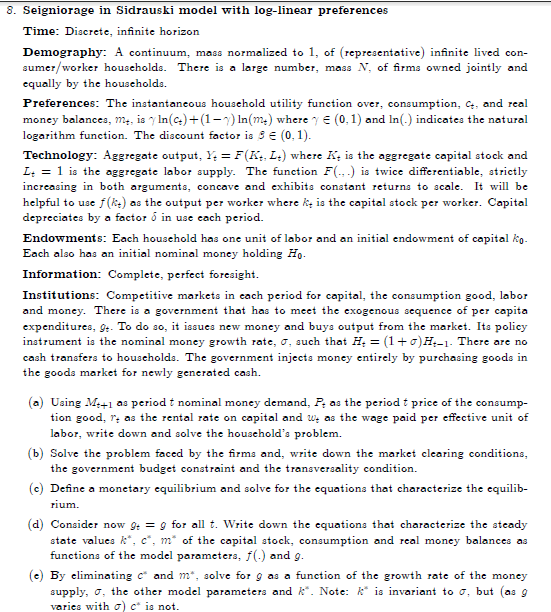
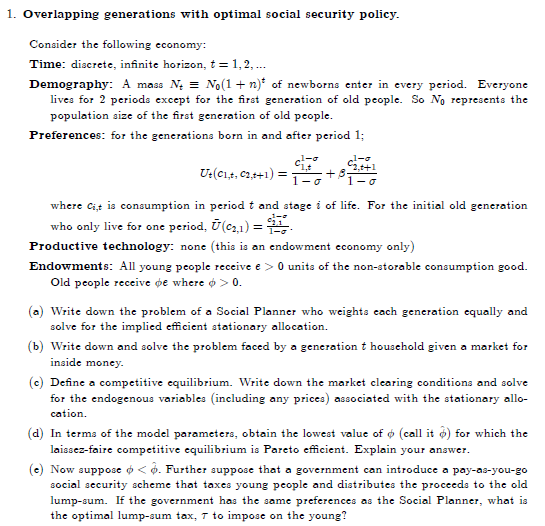
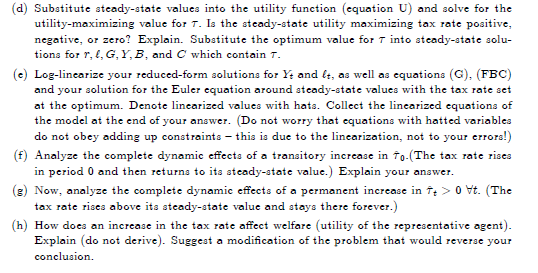
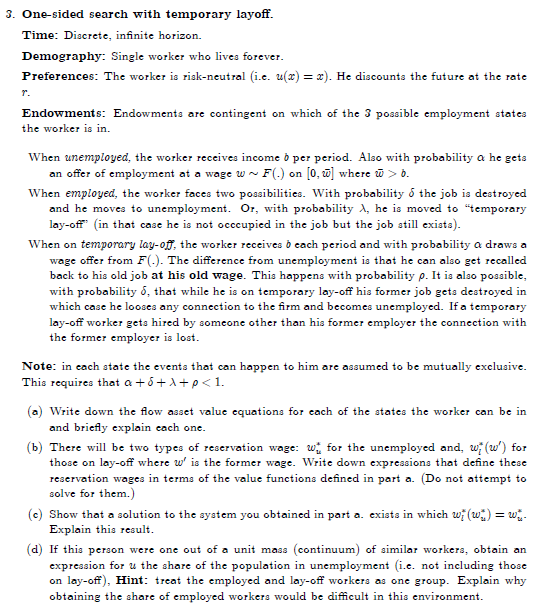
8. Seigniorage in Sidrauski model with log-linear preferences Time: Discrete, infinite horizon Demography: A continuum, mass normalized to 1, of (representative) infinite lived con- sumer/worker households. There is a large number, mass N, of firms owned jointly and equally by the households. Preferences: The instantaneous household utility function over, consumption, C, and real money balances, me, is yIn(c) +(1-7) In(m;) where y = (0, 1) and In(.) indicates the natural logarithm function. The discount factor is $ 6 (0, 1). Technology: Aggregate output, It = F(At, [:) where At is the aggregate capital stock and It = 1 is the aggregate labor supply. The function F(.,.) is twice differentiable, strictly increasing in both arguments, concave and exhibits constant returns to scale. It will be helpful to use f (k:) as the output per worker where k, is the capital stock per worker. Capital depreciates by a factor o in use each period. Endowments: Each household has one unit of labor and an initial endowment of capital ko- Each also has an initial nominal money holding Ho. Information: Complete, perfect foresight. Institutions: Competitive markets in each period for capital, the consumption good, labor and money. There is a government that has to meet the exogenous sequence of per capita expenditures, 9:. To do so, it issues new money and buys output from the market. Its policy instrument is the nominal money growth rate, 7, such that He = (1 +)H-1. There are no cash transfers to households. The government injects money entirely by purchasing goods in the goods market for newly generated cash. (a) Using Me+1 as period t nominal money demand, F, as the period t price of the consump- tion good, ", as the rental rate on capital and w, as the wage paid per effective unit of labor, write down and solve the household's problem. (b) Solve the problem faced by the firms and, write down the market clearing conditions, the government budget constraint and the transversality condition. (c) Define a monetary equilibrium and solve for the equations that characterize the equilib rium. (d) Consider now & = 9 for all t. Write down the equations that characterize the steady state values *", C", m" of the capital stock, consumption and real money balances as functions of the model parameters, f (.) and 9. (e) By eliminating c" and m", solve for 9 as a function of the growth rate of the money supply, 7, the other model parameters and &". Note: & is invariant to 7, but (as 9 varies with o) c* is not.3. One-sided search with temporary layoff. Time: Discrete, infinite horizon. Demography: Single worker who lives forever. Preferences: The worker is risk-neutral (i.e. u(2) = x). He discounts the future at the rate r. Endowments: Endowments are contingent on which of the 3 possible employment states the worker is in. When unemployed, the worker receives income o per period. Also with probability a he gets an offer of employment at a wage w ~ F(.) on 0, w] where w > b. When employed, the worker faces two possibilities. With probability & the job is destroyed and he moves to unemployment. Or, with probability A, he is moved to "temporary lay-off" (in that case he is not occupied in the job but the job still exists). When on temporary lay-off, the worker receives o each period and with probability a draws a wage offer from F(.). The difference from unemployment is that he can also get recalled back to his old job at his old wage. This happens with probability p. It is also possible, with probability o, that while he is on temporary lay-off his former job gets destroyed in which case he looses any connection to the firm and becomes unemployed. If a temporary lay-off worker gets hired by someone other than his former employer the connection with the former employer is lost. Note: in each state the events that can happen to him are assumed to be mutually exclusive. This requires that a to + A+ p
Step by Step Solution
There are 3 Steps involved in it

Get step-by-step solutions from verified subject matter experts