







Question: 8. The budgeted monthly variable and fixed overhead amounts are as follows. Variable overhead is based on the number of units produced. The fixed
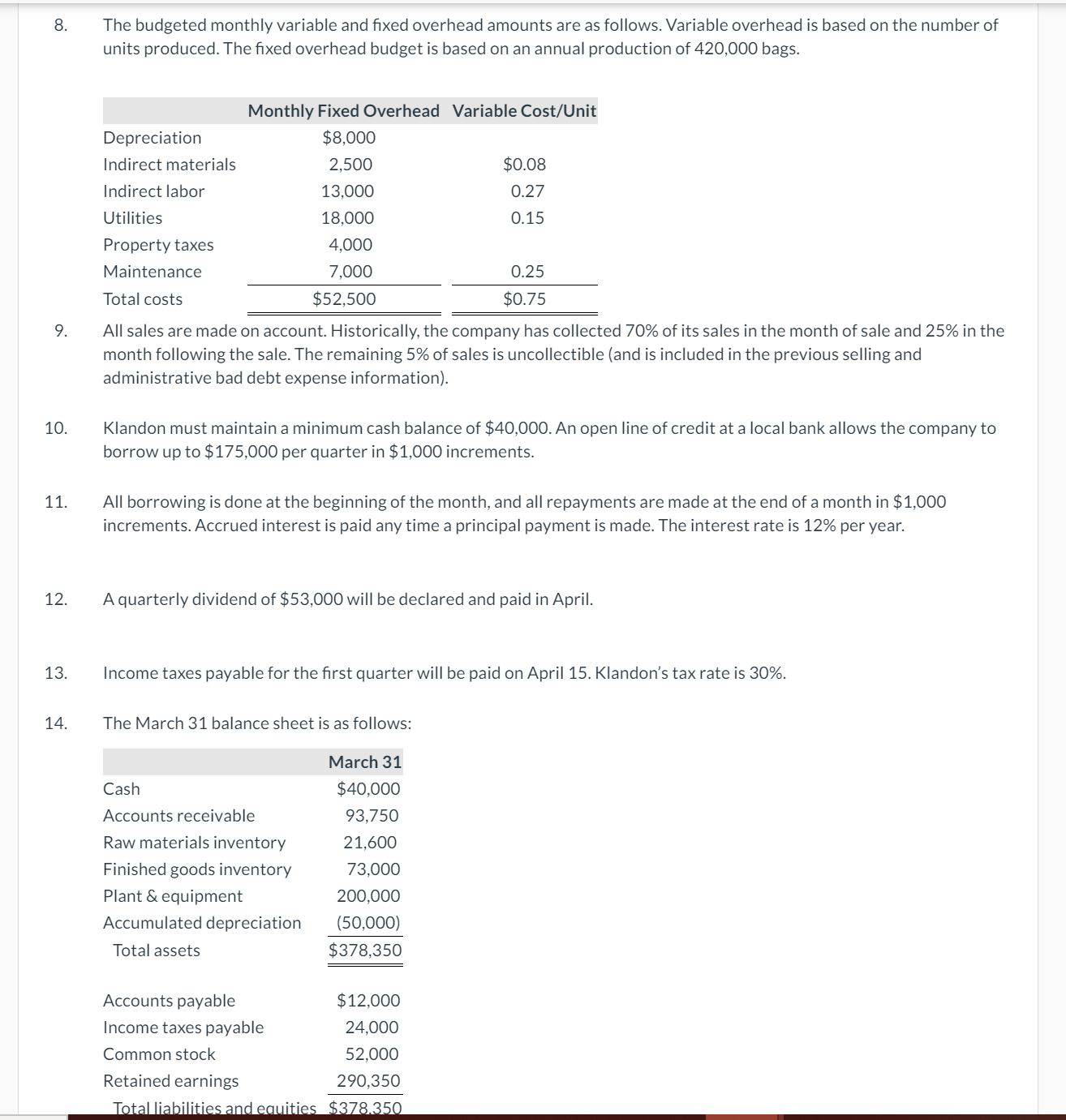
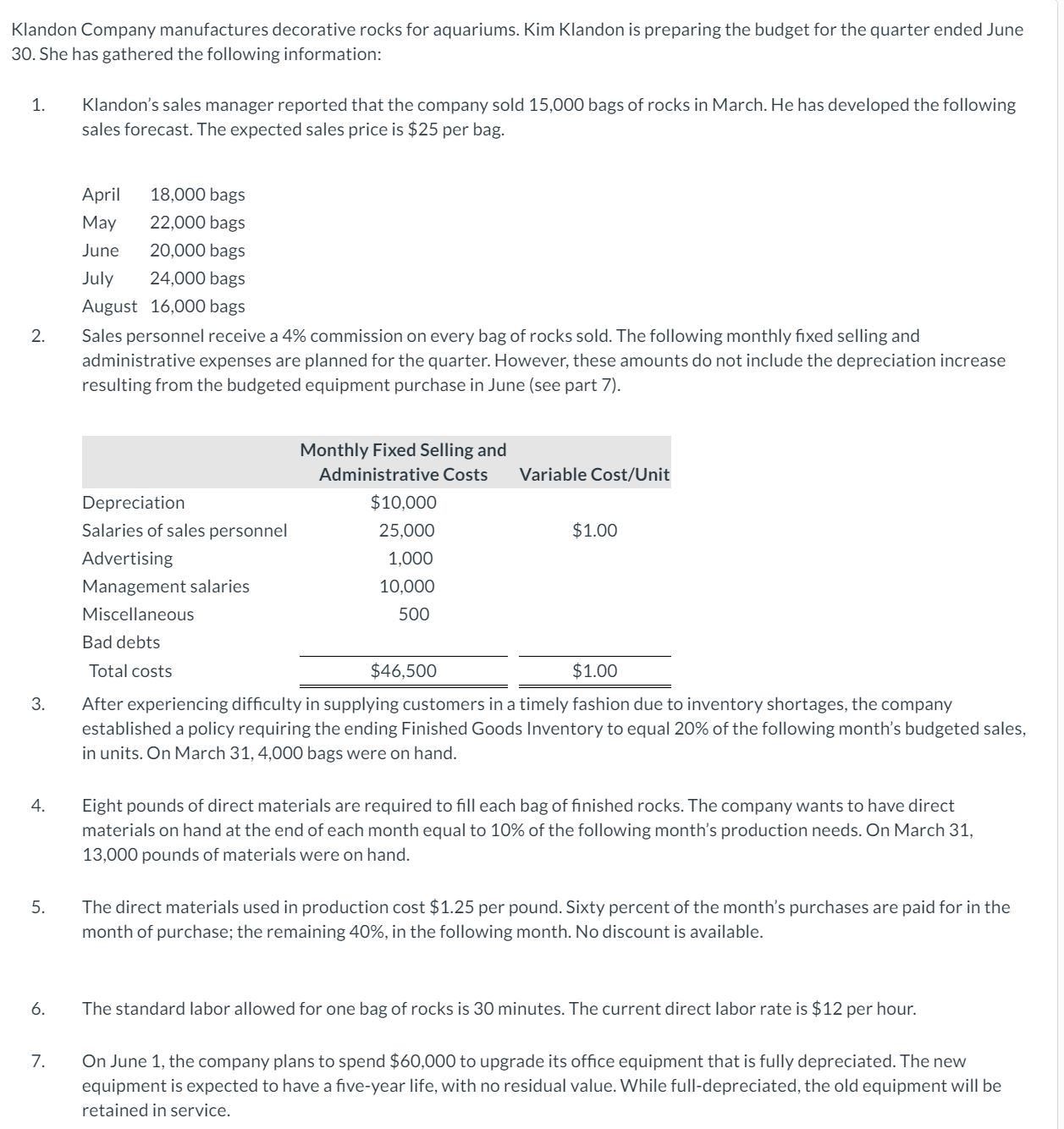
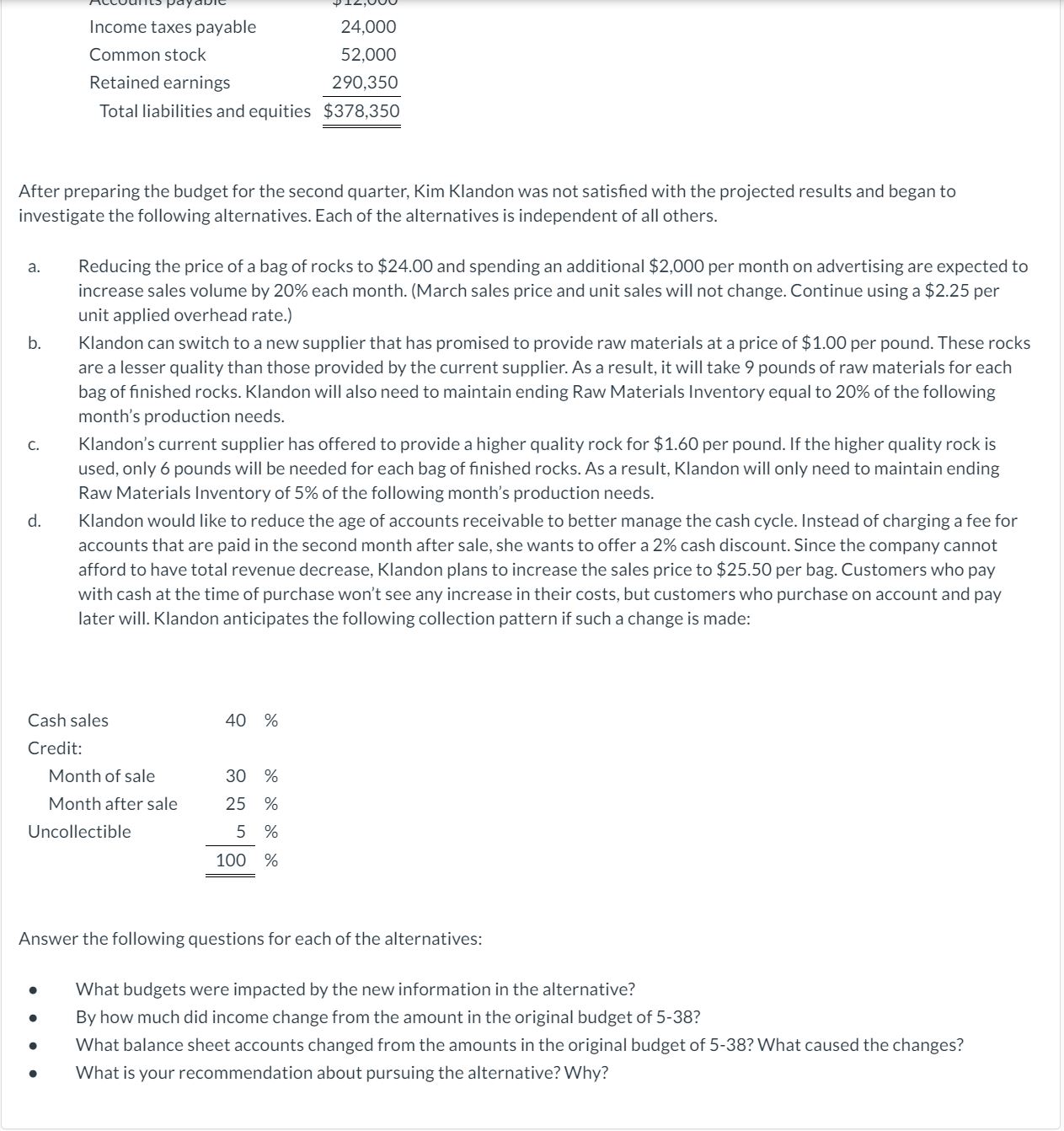
8. The budgeted monthly variable and fixed overhead amounts are as follows. Variable overhead is based on the number of units produced. The fixed overhead budget is based on an annual production of 420,000 bags. Monthly Fixed Overhead Variable Cost/Unit Depreciation $8,000 Indirect materials 2,500 $0.08 Indirect labor 13,000 0.27 Utilities 18,000 0.15 Property taxes 4,000 Maintenance Total costs 7,000 $52,500 9. 10. 11. 0.25 $0.75 All sales are made on account. Historically, the company has collected 70% of its sales in the month of sale and 25% in the month following the sale. The remaining 5% of sales is uncollectible (and is included in the previous selling and administrative bad debt expense information). Klandon must maintain a minimum cash balance of $40,000. An open line of credit at a local bank allows the company to borrow up to $175,000 per quarter in $1,000 increments. All borrowing is done at the beginning of the month, and all repayments are made at the end of a month in $1,000 increments. Accrued interest is paid any time a principal payment is made. The interest rate is 12% per year. 122 12. A quarterly dividend of $53,000 will be declared and paid in April. 13. Income taxes payable for the first quarter will be paid on April 15. Klandon's tax rate is 30%. 14. 14 The March 31 balance sheet is as follows: March 31 Cash $40,000 Accounts receivable 93,750 Raw materials inventory 21,600 Finished goods inventory 73,000 Plant & equipment 200,000 Accumulated depreciation (50,000) Total assets $378,350 Accounts payable $12,000 Income taxes payable 24,000 Common stock 52,000 Retained earnings 290,350 Total liabilities and equities $378.350 Klandon Company manufactures decorative rocks for aquariums. Kim Klandon is preparing the budget for the quarter ended June 30. She has gathered the following information: 1. Klandon's sales manager reported that the company sold 15,000 bags of rocks in March. He has developed the following sales forecast. The expected sales price is $25 per bag. April 18,000 bags 2. May 22,000 bags June 20,000 bags July 24,000 bags August 16,000 bags Sales personnel receive a 4% commission on every bag of rocks sold. The following monthly fixed selling and administrative expenses are planned for the quarter. However, these amounts do not include the depreciation increase resulting from the budgeted equipment purchase in June (see part 7). Depreciation Salaries of sales personnel Advertising Management salaries Miscellaneous Bad debts Total costs Monthly Fixed Selling and Administrative Costs $10,000 25,000 1,000 10,000 500 $46,500 Variable Cost/Unit $1.00 $1.00 3. 4. 5. After experiencing difficulty in supplying customers in a timely fashion due to inventory shortages, the company established a policy requiring the ending Finished Goods Inventory to equal 20% of the following month's budgeted sales, in units. On March 31, 4,000 bags were on hand. Eight pounds of direct materials are required to fill each bag of finished rocks. The company wants to have direct materials on hand at the end of each month equal to 10% of the following month's production needs. On March 31, 13,000 pounds of materials were on hand. The direct materials used in production cost $1.25 per pound. Sixty percent of the month's purchases are paid for in the month of purchase; the remaining 40%, in the following month. No discount is available. 6. The standard labor allowed for one bag of rocks is 30 minutes. The current direct labor rate is $12 per hour. 7. On June 1, the company plans to spend $60,000 to upgrade its office equipment that is fully depreciated. The new equipment is expected to have a five-year life, with no residual value. While full-depreciated, the old equipment will be retained in service. Income taxes payable 24,000 Common stock 52,000 Retained earnings 290,350 Total liabilities and equities $378,350 After preparing the budget for the second quarter, Kim Klandon was not satisfied with the projected results and began to investigate the following alternatives. Each of the alternatives is independent of all others. a. b. C. d. Reducing the price of a bag of rocks to $24.00 and spending an additional $2,000 per month on advertising are expected to increase sales volume by 20% each month. (March sales price and unit sales will not change. Continue using a $2.25 per unit applied overhead rate.) Klandon can switch to a new supplier that has promised to provide raw materials at a price of $1.00 per pound. These rocks are a lesser quality than those provided by the current supplier. As a result, it will take 9 pounds of raw materials for each bag of finished rocks. Klandon will also need to maintain ending Raw Materials Inventory equal to 20% of the following month's production needs. Klandon's current supplier has offered to provide a higher quality rock for $1.60 per pound. If the higher quality rock is used, only 6 pounds will be needed for each bag of finished rocks. As a result, Klandon will only need to maintain ending Raw Materials Inventory of 5% of the following month's production needs. Klandon would like to reduce the age of accounts receivable to better manage the cash cycle. Instead of charging a fee for accounts that are paid in the second month after sale, she wants to offer a 2% cash discount. Since the company cannot afford to have total revenue decrease, Klandon plans to increase the sales price to $25.50 per bag. Customers who pay with cash at the time of purchase won't see any increase in their costs, but customers who purchase on account and pay later will. Klandon anticipates the following collection pattern if such a change is made: Cash sales Credit: 40 % Month of sale 30 % Month after sale 25 % Uncollectible 5 % 100 % Answer the following questions for each of the alternatives: What budgets were impacted by the new information in the alternative? By how much did income change from the amount in the original budget of 5-38? What balance sheet accounts changed from the amounts in the original budget of 5-38? What caused the changes? What is your recommendation about pursuing the alternative? Why?
Step by Step Solution
There are 3 Steps involved in it

Get step-by-step solutions from verified subject matter experts
 Study Help