







Question: 8. Which is the correct order for a recrystallization procedure? a. solvent selection-dissolving-deposition and collection of crystals-filtration-washing-drying b. solvent selection-dissolving-filtration-deposition and collection of crystals-washing-drying c.
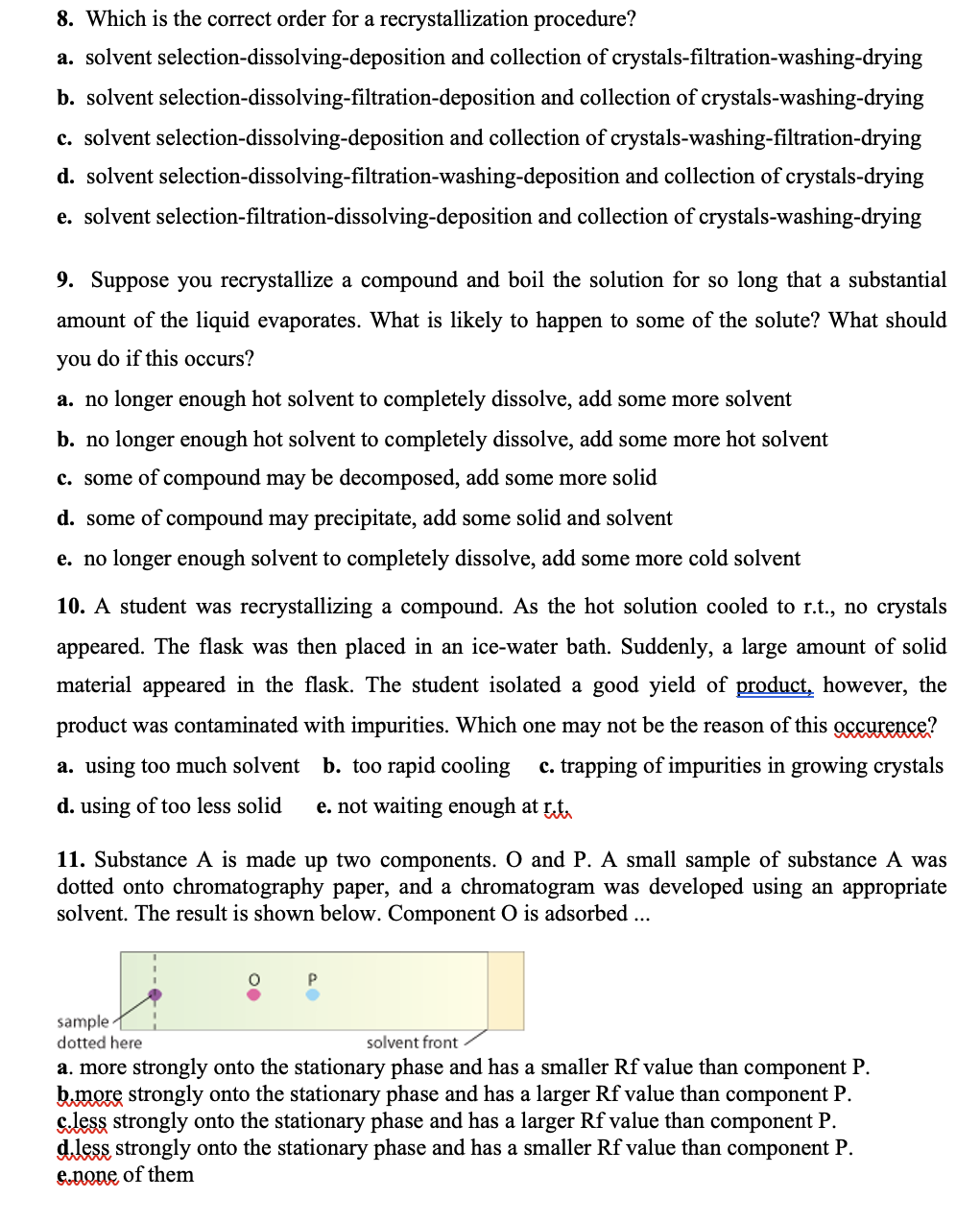
8. Which is the correct order for a recrystallization procedure? a. solvent selection-dissolving-deposition and collection of crystals-filtration-washing-drying b. solvent selection-dissolving-filtration-deposition and collection of crystals-washing-drying c. solvent selection-dissolving-deposition and collection of crystals-washing-filtration-drying d. solvent selection-dissolving-filtration-washing-deposition and collection of crystals-drying e. solvent selection-filtration-dissolving-deposition and collection of crystals-washing-drying 9. Suppose you recrystallize a compound and boil the solution for so long that a substantial amount of the liquid evaporates. What is likely to happen to some of the solute? What should you do if this occurs? a. no longer enough hot solvent to completely dissolve, add some more solvent b. no longer enough hot solvent to completely dissolve, add some more hot solvent c. some of compound may be decomposed, add some more solid d. some of compound may precipitate, add some solid and solvent e. no longer enough solvent to completely dissolve, add some more cold solvent 10. A student was recrystallizing a compound. As the hot solution cooled to r.t., no crystals appeared. The flask was then placed in an ice-water bath. Suddenly, a large amount of solid material appeared in the flask. The student isolated a good yield of product, however, the product was contaminated with impurities. Which one may not be the reason of this occurence? a. using too much solvent b. too rapid cooling c. trapping of impurities in growing crystals d. using of too less solid e. not waiting enough at r.t. 11. Substance A is made up two components. O and P. A small sample of substance A was dotted onto chromatography paper, and a chromatogram was developed using an appropriate solvent. The result is shown below. Component O is adsorbed ... a. more strongly onto the stationary phase and has a smaller Rf value than component P. b.more strongly onto the stationary phase and has a larger Rf value than component P. c.less strongly onto the stationary phase and has a larger Rf value than component P. d.less strongly onto the stationary phase and has a smaller Rf value than component P. e.none of them
Step by Step Solution
There are 3 Steps involved in it

Get step-by-step solutions from verified subject matter experts
 Study Help