





Question: 8) Which statement represents a challenge to Evan and Freeman's defense of the stakeholder theory against the economic model of corporate social responsibility? AL_The law
8) Which statement represents a challenge to Evan

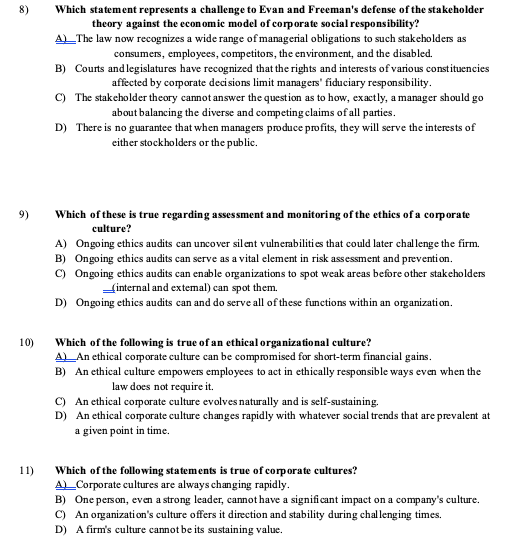
8) Which statement represents a challenge to Evan and Freeman's defense of the stakeholder theory against the economic model of corporate social responsibility? AL_The law now recognizes a wide range of managerial obligations to such stakeholders as consumers, employees, competitors, the environment, and the disabled. B) Courts andlegislatures have recognized that the rights and interests of various constituencies affected by corporate decisions limit managers' fiduciary responsibility. C) The stakeholder theory cannot answer the question as to how, exactly, a manager should go about balancing the diverse and competing claims of all parties. D) There is no guarantee that when managers produce profits, they will serve the interests of either stockholders or the public. 9) Which of these is true regarding assessment and monitoring of the ethics of a corporate culture? A) Ongoing ethics audits can uncover silent vulnerabilities that could later challenge the firm. B) Ongoing ethics audits can serve as a vital element in risk assessment and prevention. C) Ongoing ethics audits can enable organizations to spot weak areas before other stakeholders _internal and extemal) can spot them. D) Ongoing ethics audits can and do serve all of these functions within an organization. 10) Which of the following is true of an ethical organizational culture? AL_An ethical corporate culture can be compromised for short-term financial gains. B) An ethical culture empowers employees to act in ethically responsible ways even when the law does not require it. C) An ethical corporate culture evolves naturally and is self-sustaining. D) An ethical corporate culture changes rapidly with whatever social trends that are prevalent at a given point in time. 11) Which of the following statements is true of corporate cultures? Al_Corporate cultures are always changing rapidly. B) One person, even a strong leader, cannot have a significant impact on a company's culture. C) An organization's culture offers it direction and stability during challenging times. D) A firm's culture cannot be its sustaining value

Step by Step Solution

There are 3 Steps involved in it

1 Expert Approved Answer
Step: 1 Unlock blur-text-image

Question Has Been Solved by an Expert!

Get step-by-step solutions from verified subject matter experts

Step: 2 Unlock
Step: 3 Unlock

Students Have Also Explored These Related General Management Questions!