



Question: 8.10 A bat strikes a 0.145-kg baseball. Just before impact, the ball is traveling horizontally to the right at 40.0 m/s; when it leaves
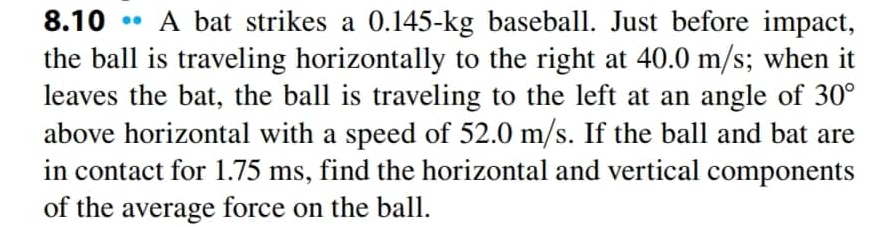
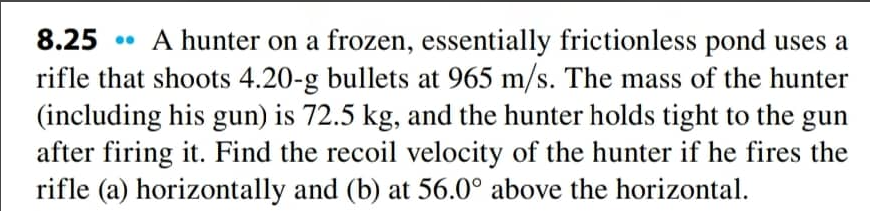
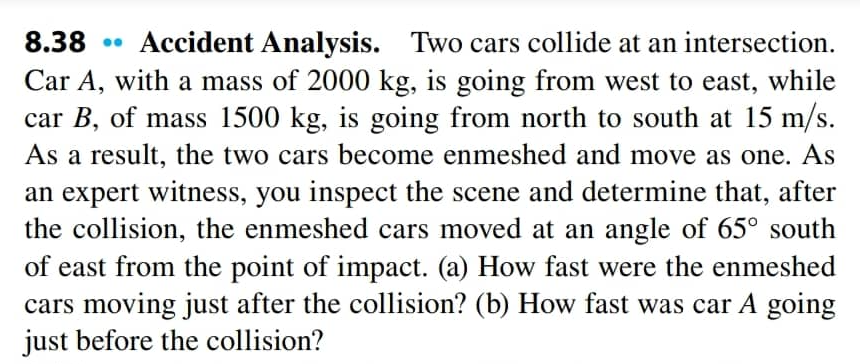
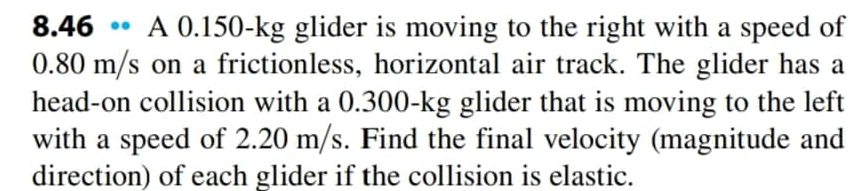
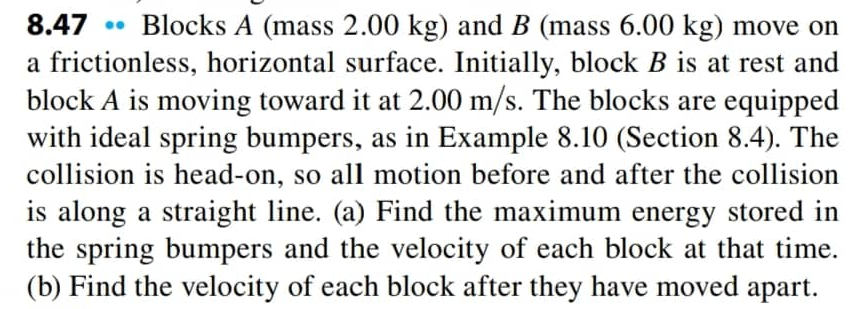
8.10 " A bat strikes a 0.145-kg baseball. Just before impact, the ball is traveling horizontally to the right at 40.0 m/s; when it leaves the bat, the ball is traveling to the left at an angle of 30 above horizontal with a speed of 52.0 m/s. If the ball and bat are in contact for 1.75 1113, find the horizontal and vertical components of the average force on the ball. 8.25 -- A hunter on a frozen, essentially frictionless pond uses a rifle that shoots 4.20-g bullets at 965 m/s. The mass of the hunter (including his gun) is 72.5 kg, and the hunter holds tight to the gun after firing it. Find the recoil velocity of the hunter if he fires the rifle (a) horizontally and (b) at 56.00 above the horizontal. 8.38 .. Accident Analysis. Two cars collide at an intersection. Car A, with a mass of 2000 kg, is going from west to east, while car 3, of mass 1500 kg, is going from north to south at 15 m/s. As a result, the two cars become enmeshed and move as one. As an expert witness, you inspect the scene and determine that, after the collision, the enmeshed cars moved at an angle of 65 south of east from the point of impact. (a) How fast were the enmeshed cars moving just after the collision? (b) How fast was car A going just before the collision? 8.46 " A 0.!50-kg glider is moving to the right with a speed of 0.80 m/s on a frictionless, horizontal air track. The glider has a head-on collision with a 0.300-kg glider that is moving to the left with a speed of 2.20 m/s. Find the final velocity (magnitude and direction) of each glider if the collision is elastic. 8.47 -- Blocks A (mass 2.00 kg) and B (mass 6.00 kg) move on a frictionless, horizontal surface. Initially, block B is at rest and block A is moving toward it at 2.00 m/s. The blocks are equipped with ideal spring bumpers, as in Example 8.10 (Section 3.4). The collision is head-on, so all motion before and after the collision is along a straight line. (a) Find the maximum energy stored in the spring bumpers and the velocity of each block at that time. (ID) Find the velocity of each block after they have moved apart
Step by Step Solution
There are 3 Steps involved in it

Get step-by-step solutions from verified subject matter experts