Question: 8.1.1 8.1.3 8.1.1 Developmental Plan Objectives performance improvement, and personal growth. In addition, developmental plans The overall objective of a developmental plan is to encourage
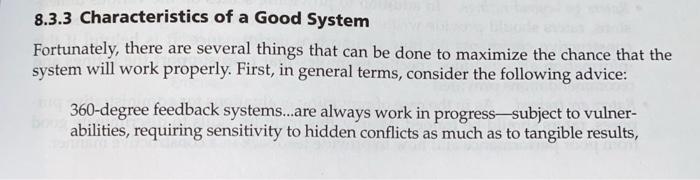
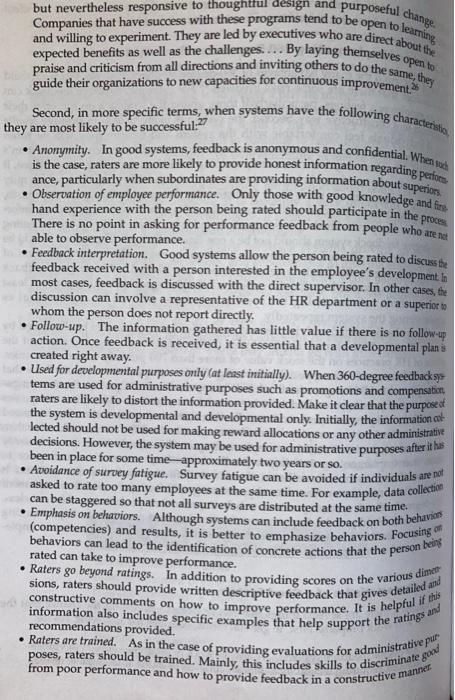
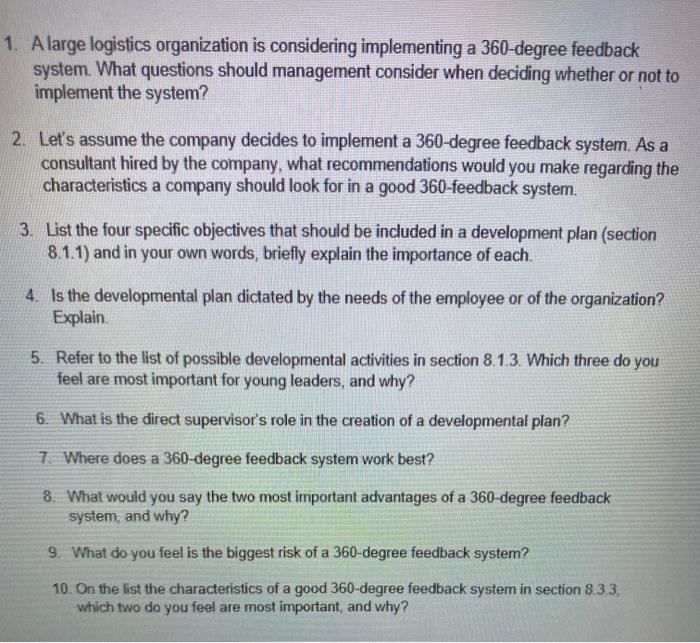
8.1.1 Developmental Plan Objectives performance improvement, and personal growth. In addition, developmental plans The overall objective of a developmental plan is to encourage continuous learning, more Improve performance in current job. A good developmental plan helps employees meet performance standards. Thus, a developmental plan includes suggested courses of action to address each of the performance dimensions that are deficient. This is an important point given that recent surveys have shown that about 25% of federal employees and between 11 and 16% of private sector employees in the United States are not performing up to standards. Sustain performance in current job. A good developmental plan provides tools so that employees can continue to meet and exceed expectations regarding the current job. Thus, the plan includes suggestions about how to continue to meet and exceed expectations for each of the performance dimensions included in the appraisal form. Prepare employees for advancement. A good developmental plan includes advice and courses of action that should be taken so that employees will be able to take advantage of future opportunities and career advancement. Specifically, a good plan indicates which new competencies and behaviors should be learned to help with career advancement. Enrich the employee's work experience. Even if career opportunities within the organization are not readily available, a good plan provides employees with growth opportunities and opportunities to learn new skills. These opportunities provide employees with intrinsic rewards and a more challenging work experi- ence, even if the new skills learned are not a formal part of their jobs. Such opportunities can make jobs more attractive and serve as a powerful employee retention tool. In addition, the new skills can be useful in case of lateral transfers within the organization. Part II. Employee Developm 198 the performance management system: areas employee development 3. Set standards for the next review period 4. Recognize job-related accomplishments 5. Enhance communication and working relationships to the level of supervisory responsibility important compo Consider the employee developmental plan used by Texas A&M University performance management system, the developmental plan is included within the pdForms aspx). Since the developmental plan is a formal component of the universitas College Station, Texas (http://employees.tamu.edu/employees/training/opal appraisal form. The appraisal form used by Texas A&M first lists the six objects 1. Provide employees with feedback to improve or maintain job performance 6. Identify job performance deficiencies (any factor "Does Not Meet Expectations nent of the performance management system. The inclusion of this objective up front sets the tone for the developmental process by helping managers understand that this formance review process. In this way, the developmental plans created for employees and the overall organization. In addition, including the developmental plan at the end of the review and after setting annual performance goals allows the employee to determine whether there are areas he or she needs to develop in order to attain the Why does goal setting work? In other words, based on studies of more than 40,000 your best" or easy goals? There are four basic reasons. First, when an employee commits people in eight countries, why have "stretch" goals led to better performance than "do Based on objective 2, the employee developmental plan is an an important issue. After the sections in the form in which the manager rates employee performance, the following material is included: SECTION B: PROFESSIONAL DEVELOPMENT PLAN Please list professional development activities to be completed and resources needed to support these activities, if applicable (link to examples of suggested employee development http://hr.tamu.eduled/suggest.pdf) Professional Development Needs Resources/Support Needed Time Frame The inclusion of this information after performance ratings allows the manager and employee to focus on developmental areas identified as weaknesses in the per specified goals. 8.1.3 Developmental Activities There are several ways through which employees can reach the objectives stated in this On-the-job training. Each employee is paired with a coworker or supervisor who programs includes how many hours a day or week training will take place and designs a formal on-the-job training course. The design of these mini-training Courses. Some large organizations such as McDonald's, Motorola, Capgemini universities. Other organizations may provide tuition reimbursement. Given the and Ernst & Young offer in-house courses given at their own corporate developmental plans, including learning objectives. proliferation of online courses, employees have a wide variety of options from which to choose. Self-guided reading. Employees can read books and study other resources on their own. Once again, it is important that an objective be set regarding what will be read and within what time frame as well as what measure(s) will be used to assess whether learning has taken place. Mentoring. Many organizations have mentoring programs. In general terms, mentoring is a developmental process that consists of a one-on-one relationship a senior (mentor) and junior (protge) employee. For such programs to arbitrarily assigning who will be mentoring whom. In general, tentos e ful it is best to allow the mentor and protege to choose each other that madels and teach protgs what it takes to succeed in the organization. In specific terms, mentors can help protgs gain targeted skills conference. Another way to acquire required knowledge and skills is Asar an employee's attendance at a conference or trade show. It is useful to ryte that the employee provide a written report or even deliver a presentation fuming from the conference. In this way, it is easier to assess what has Aumed and, in addition, the knowledge gained can be shared with other their employees to obtain additional degrees or certifications. For example, the mga dne. Some organizations provide tuition reimbursement benefits for antization can sponsor an employee's MBA program or an employee's taking a curse with the goal of earning a certification designation (eg Certified Novell Administrator, Professional in Human Resources). In most cases, employees commit antinuing the relationship with their employer for a prespecified amount of time ater completing the degree. If the employee leaves the organization before this time lain. Another way to gain necessary skills is to be assigned to a different job frame, he may have to reimburse the organization for the cost of his education. residents have to rotate across specialty areas for several months (e.8, OB-GYN, on a temporary basis. This is the model followed in the medical profession in which psychiatry, pediatrics). For example, residents may be required to rotate across the Tental activities. Note that the form includes space so that information can be inserted regarding what activities will take place when, what the objectives are, and whether the anizational members, ranous emergency medicine services for a 19-month period. biective has been met or not. Employee Developm201 . plan can be part of the appraisal form, or it can be included in a separate form. The form ncluded in Figure 8.1 shows that employees have several choices in terms of develop- Temporary assignments. A less systematic rotation system includes the opportunity to work on a challenging temporary assignment. This allows employees to gain specific skills within a limited time frame. Membership or leadership role in professional or trade organizations. Some employers sponsor membership in professional or trade organizations. Such an organization dis- tributes publications to its members and holds informal and formal meetings in which employees have an opportunity to learn about best practices and other useful information for their jobs. For example, this could include the Society for Human Resource Management (www.shrm.org) or the Chartered Institute of Personnel and Development (http://www.cipd.co.uk/) for human resources (HR) professionals. Also, presentation, communication, planning, and other skills can be learned while serving in a leadership role in a volunteer organization outside of work. Table 8.1 includes a summarized list of developmental activities that may be avail- and leaming style, which of these activities do you believe would be most beneficial to you? Please rank these activities in terms of your preference. An example of a developmental plan is included in Figure 8.1. The developmental 8.3.3 Characteristics of a Good System Fortunately, there are several things that can be done to maximize the chance that the system will work properly. First, in general terms, consider the following advice: 360-degree feedback systems...are always work in progress-subject to vulner- abilities, requiring sensitivity to hidden conflicts as much as to tangible results, Raters are trained. As in the case of providing evaluations for administrative pur poses, raters should be trained. Mainly, this includes skills to discriminate a from poor performance and how to provide feedback in a constructive manner but nevertheless responsive to thoughtful design and purposeful change. Companies that have success with these programs tend to be open to learning and willing to experiment. They are led by executives who are direct about the expected benefits as well as the challenges.... By laying themselves open to praise and criticism from all directions and inviting others to do the same, they Second, in more specific terms, when systems have the following characteristic Anonymity. In good systems, feedback is anonymous and confidential. When we is the case, raters are more likely to provide honest information regarding perfor Emphasis on behaviors. Although systems can include feedback on both behavior (competencies) and results, it is better to emphasize behaviors. Focusing of behaviors can lead to the identification of concrete actions that the person being Raters go beyond ratings. In addition to providing scores on the various dinert sions, raters should provide written descriptive feedback that gives detailed and information also includes specific examples that help support the ratings constructive comments on how to improve performance. It is helpful if this guide their organizations to new capacities for continuous improvement they are most likely to be successful.27 ance, particularly when subordinates are providing information about superior Observation of employee performance. Only those with good knowledge and so hand experience with the person being rated should participate in the There is no point in asking for performance feedback from people who are o able to observe performance. Feedback interpretation. Good systems allow the person being rated to discuss the feedback received with a person interested in the employee's development in most cases, feedback is discussed with the direct supervisor. In other cases, the discussion can involve a representative of the HR department or a superior to whom the person does not report directly. Follow-up. The information gathered has little value if there is no follow-up action. Once feedback is received, it is essential that a developmental plans created right away. Used for developmental purposes only (at least initially). When 360-degree feedback sy> tems are used for administrative purposes such as promotions and compensation raters are likely to distort the information provided. Make it clear that the purpose of the system is developmental and developmental only. Initially, the information co- lected should not be used for making reward allocations or any other administrative decisions. However, the system may be used for administrative purposes after it has been in place for some time-approximately two years or so. Avoidance of survey fatigue. Survey fatigue can be avoided if individuals are not asked to rate too many employees at the same time. For example, data collection can be staggered so that not all surveys are distributed at the same time. rated can take to improve performance. recommendations provided. 1. A large logistics organization is considering implementing a 360-degree feedback system. What questions should management consider when deciding whether or not to implement the system? 2. Let's assume the company decides to implement a 360-degree feedback system. As a consultant hired by the company, what recommendations would you make regarding the characteristics a company should look for in a good 360-feedback system. 3. List the four specific objectives that should be included in a development plan (section 8.1.1) and in your own words, briefly explain the importance of each. 4. Is the developmental plan dictated by the needs of the employee or of the organization? Explain 5. Refer to the list of possible developmental activities in section 8.1.3. Which three do you feel are most important for young leaders, and why? 6. What is the direct supervisor's role in the creation of a developmental plan? 7 Where does a 360-degree feedback system work best? 8. What would you say the two most important advantages of a 360-degree feedback system, and why? 9. What do you feel is the biggest risk of a 360-degree feedback system? 10. On the list the characteristics of a good 360-degree feedback system in section 8.3.3 which two do you feel are most important, and why









 Study Help