







Question: 8:501 D 1:21:52 Exit 47. The within Article 1, Section 8 of the U.S. Constitution authorizes Congress to pass laws protecting intellectual property. Relative Clause
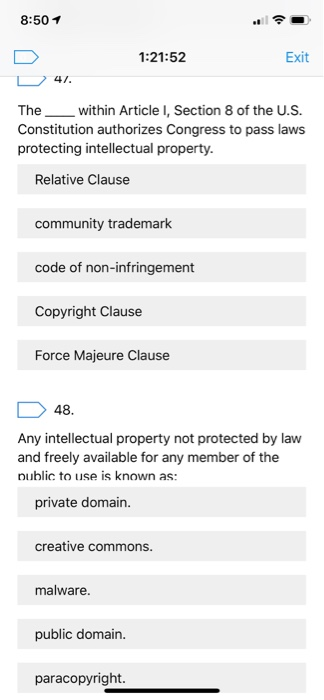
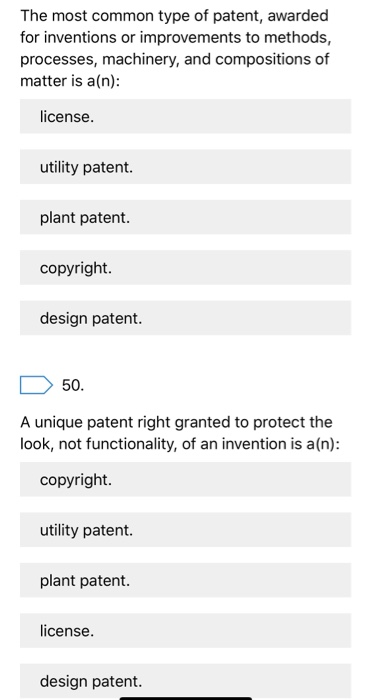
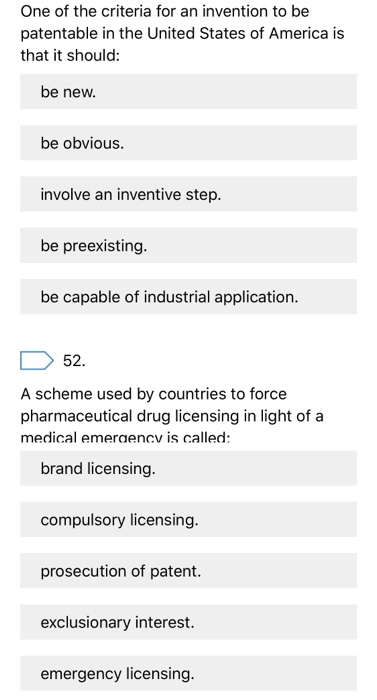
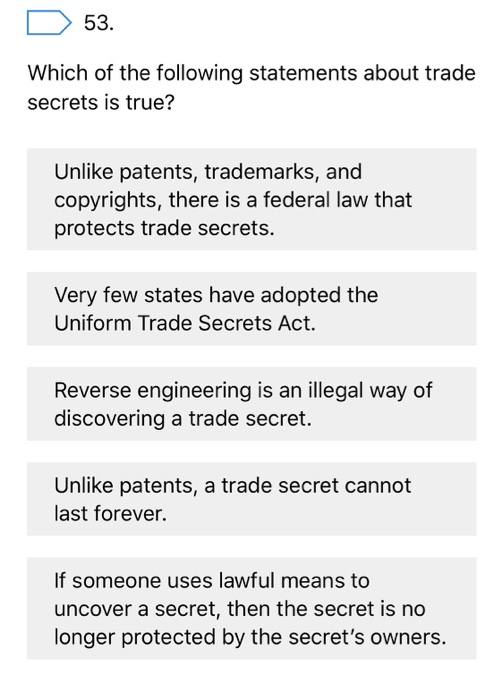
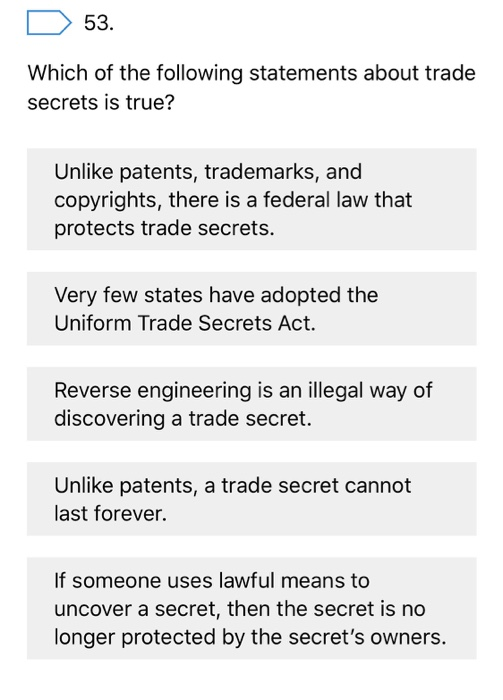
8:501 D 1:21:52 Exit 47. The within Article 1, Section 8 of the U.S. Constitution authorizes Congress to pass laws protecting intellectual property. Relative Clause community trademark code of non-infringement Copyright Clause Force Majeure Clause D48. Any intellectual property not protected by law and freely available for any member of the public to use is known as: private domain. creative commons. malware. public domain. paracopyright. The most common type of patent, awarded for inventions or improvements to methods, processes, machinery, and compositions of matter is a(n): license. utility patent. plant patent. copyright. design patent D 50. A unique patent right granted to protect the look, not functionality, of an invention is a(n): copyright. utility patent. plant patent. license. design patent. One of the criteria for an invention to be patentable in the United States of America is that it should: be new. be obvious. involve an inventive step. be preexisting. be capable of industrial application. D 52. A scheme used by countries to force pharmaceutical drug licensing in light of a medical emergency is called: brand licensing. compulsory licensing. prosecution of patent. exclusionary interest. emergency licensing. D 53. Which of the following statements about trade secrets is true? Unlike patents, trademarks, and copyrights, there is a federal law that protects trade secrets. Very few states have adopted the Uniform Trade Secrets Act. Reverse engineering is an illegal way of discovering a trade secret. Unlike patents, a trade secret cannot last forever. If someone uses lawful means to uncover a secret, then the secret is no longer protected by the secret's owners. D 53. Which of the following statements about trade secrets is true? Unlike patents, trademarks, and copyrights, there is a federal law that protects trade secrets. Very few states have adopted the Uniform Trade Secrets Act. Reverse engineering is an illegal way of discovering a trade secret. Unlike patents, a trade secret cannot last forever. If someone uses lawful means to uncover a secret, then the secret is no longer protected by the secret's owners
Step by Step Solution
There are 3 Steps involved in it
Here are the answers to the questions provided The within Article I Section 8 of the US Constitut... View full answer

Get step-by-step solutions from verified subject matter experts
 Study Help