







Question: 8.8. Given is a DHKE algorithm. The modulus p has 1024 bit and ? is a generator of a subgroup where ord(?) ? 2160. 1.
8.8. Given is a DHKE algorithm. The modulus p has 1024 bit and ? is a generator of a subgroup where ord(?) ? 2160. 1. What is the maximum value that the private keys should have? 2. How long does the computation of the session key take on average if one modular multiplication takes 700 ?s, and one modular squaring 400 ?s? Assume that the public keys have already been computed. 3. One well-known acceleration technique for discrete logarithm Systems uses short primitive elements. We assume now that ? is such a short element (e.g., a 16-bit integer). Assume that modular multiplication with a takes now only 30 ?s. How long does the computation of the public key take now? Why is the time for one modular squaring still the same as above if we apply the square-and-multiply algorithm?
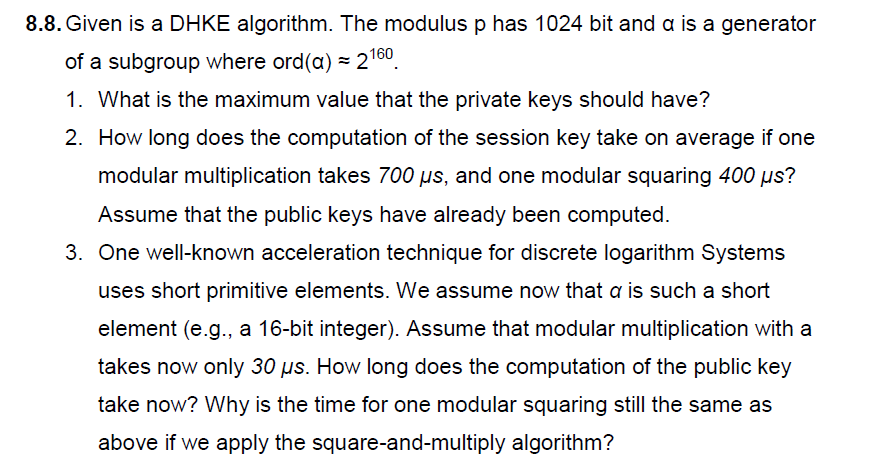
8.8. Given is a DHKE algorithm. The modulus p has 1024 bit and ? is a generator of a subgroup where ord(a) 2160 1. What is the maximum value that the private keys should have? 2. How long does the computation of the session key take on average if one modular multiplication takes 700 us, and one modular squaring 400 us? Assume that the public keys have already been computed. 3. One well-known acceleration technique for discrete logarithm Systems uses short primitive elements. We assume now that ? is such a short element (e.g., a 16-bit integer). Assume that modular multiplication with a takes now only 30 us. How long does the computation of the public key take now? Why is the time for one modular squaring still the same as above if we apply the square-and-multiply algorithm? 8.8. Given is a DHKE algorithm. The modulus p has 1024 bit and ? is a generator of a subgroup where ord(a) 2160 1. What is the maximum value that the private keys should have? 2. How long does the computation of the session key take on average if one modular multiplication takes 700 us, and one modular squaring 400 us? Assume that the public keys have already been computed. 3. One well-known acceleration technique for discrete logarithm Systems uses short primitive elements. We assume now that ? is such a short element (e.g., a 16-bit integer). Assume that modular multiplication with a takes now only 30 us. How long does the computation of the public key take now? Why is the time for one modular squaring still the same as above if we apply the square-and-multiply algorithm
Step by Step Solution
There are 3 Steps involved in it

Get step-by-step solutions from verified subject matter experts
 Study Help