







Question: 9 . 2 Flow in a converging - diverging nozzzle An experiment is conducted where compressed air from a large reservoir is expanded and accelerated
Flow in a convergingdiverging nozzzle
An experiment is conducted where compressed air from a large reservoir is expanded and accelerated through a nozzle figure There is no external work transfer to or from the air, and the expansion can satisfactorily be modeled as a onedimensional isentropic process isentropic meaning that the process is fully reversible, ie without losses to friction, and adiabatic, ie without heat transfer
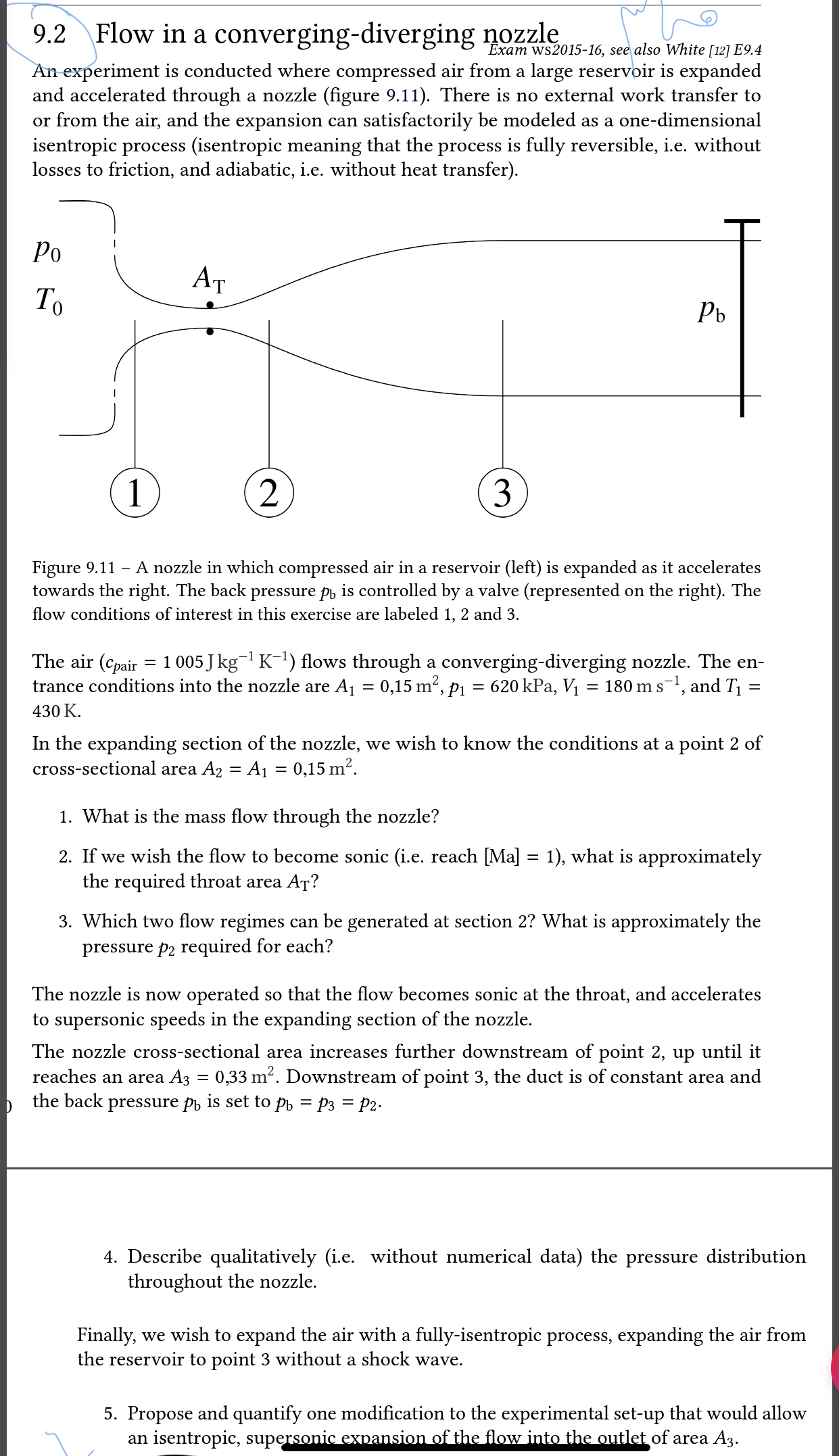
Figure A nozzle in which compressed air in a reservoir left is expanded as it accelerates towards the right. The back pressure is controlled by a valve represented on the right The flow conditions of interest in this exercise are labeled and
The air flows through a convergingdiverging nozzle. The entrance conditions into the nozzle are kPa, and K
In the expanding section of the nozzle, we wish to know the conditions at a point of crosssectional area
What is the mass flow through the nozzle?
If we wish the flow to become sonic ie reach what is approximately the required throat area
Which two flow regimes can be generated at section What is approximately the pressure required for each?
The nozzle is now operated so that the flow becomes sonic at the throat, and accelerates to supersonic speeds in the expanding section of the nozzle.
The nozzle crosssectional area increases further downstream of point up until it reaches an area Downstream of point the duct is of constant area and the back pressure is set to
Describe qualitatively ie without numerical data the pressure distribution throughout the nozzle.
Finally, we wish to expand the air with a fullyisentropic process, expanding the air from the reservoir to point without a shock wave.
Propose and quantify one modification to the experimental setup that would allow an isentropic supersonic expansion of the flow into the outlet of area I want the answer on a paper
Step by Step Solution
There are 3 Steps involved in it
1 Expert Approved Answer
Step: 1 Unlock

Question Has Been Solved by an Expert!
Get step-by-step solutions from verified subject matter experts
Step: 2 Unlock
Step: 3 Unlock
 Study Help