







Question: 9. (20 points) Suppose that there are only two relevant periods for economic decision making, corresponding to the current and the future period. Use the
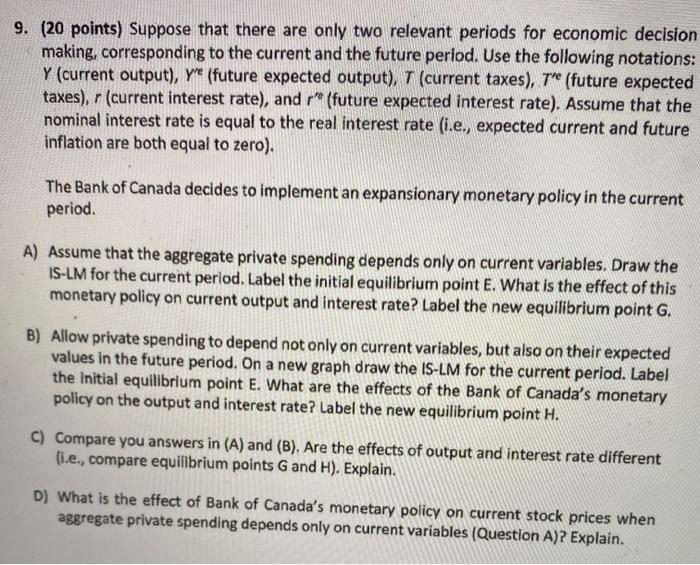
9. (20 points) Suppose that there are only two relevant periods for economic decision making, corresponding to the current and the future period. Use the following notations: Y (current output), ye (future expected output), T (current taxes), 7 (future expected taxes), r (current interest rate), and r" (future expected interest rate). Assume that the nominal interest rate is equal to the real interest rate (i.e., expected current and future inflation are both equal to zero). The Bank of Canada decides to implement an expansionary monetary policy in the current period. A) Assume that the aggregate private spending depends only on current variables. Draw the IS-LM for the current period. Label the initial equilibrium point E. What is the effect of this monetary policy on current output and interest rate? Label the new equilibrium point G. B) Allow private spending to depend not only on current variables, but also on their expected values in the future period. On a new graph draw the IS-LM for the current period. Label the initial equilibrium point E. What are the effects of the Bank of Canada's monetary policy on the output and interest rate? Label the new equilibrium point H. C) Compare you answers in (A) and (B). Are the effects of output and interest rate different (i.e., compare equilibrium points G and H). Explain. D) What is the effect of Bank of Canada's monetary policy on current stock prices when aggregate private spending depends only on current variables (Question A)? Explain. 9. (20 points) Suppose that there are only two relevant periods for economic decision making, corresponding to the current and the future period. Use the following notations: Y (current output), ye (future expected output), T (current taxes), 7 (future expected taxes), r (current interest rate), and r" (future expected interest rate). Assume that the nominal interest rate is equal to the real interest rate (i.e., expected current and future inflation are both equal to zero). The Bank of Canada decides to implement an expansionary monetary policy in the current period. A) Assume that the aggregate private spending depends only on current variables. Draw the IS-LM for the current period. Label the initial equilibrium point E. What is the effect of this monetary policy on current output and interest rate? Label the new equilibrium point G. B) Allow private spending to depend not only on current variables, but also on their expected values in the future period. On a new graph draw the IS-LM for the current period. Label the initial equilibrium point E. What are the effects of the Bank of Canada's monetary policy on the output and interest rate? Label the new equilibrium point H. C) Compare you answers in (A) and (B). Are the effects of output and interest rate different (i.e., compare equilibrium points G and H). Explain. D) What is the effect of Bank of Canada's monetary policy on current stock prices when aggregate private spending depends only on current variables (Question A)? Explain
Step by Step Solution
There are 3 Steps involved in it

Get step-by-step solutions from verified subject matter experts
 Study Help