







Question: 9 : 5 6 . II 5 6 : DATA _ 5 1 4 _ Unit _ 3 _ F 2 4 Task 3 :
:
II :
DATAUnitF
Task :
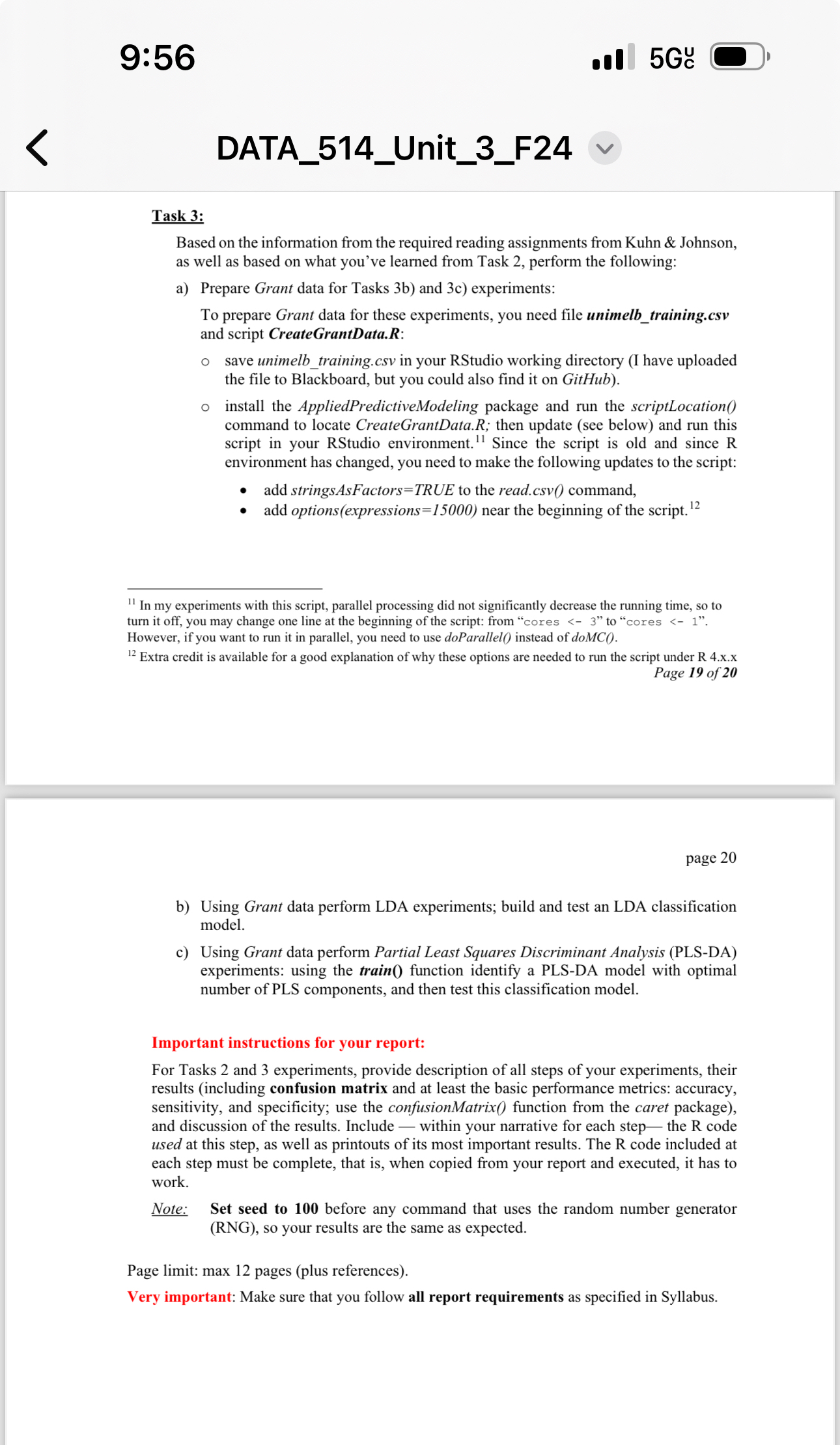
Based on the information from the required reading assignments from Kuhn & Johnson, as well as based on what you've learned from Task perform the following:
a Prepare Grant data for Tasks b and c experiments:
To prepare Grant data for these experiments, you need file unimelbtraining.csv and script CreateGrantData.R:
save unimelbtraining.csv in your RStudio working directory I have uploaded the file to Blackboard, but you could also find it on GitHub
install the AppliedPredictiveModeling package and run the scriptLocation command to locate CreateGrantData.R; then update see below and run this script in your RStudio environment. Since the script is old and since R environment has changed, you need to make the following updates to the script:
add stringsAsFactors TRUE to the read.csv command,
add optionsexpressions near the beginning of the script.
In my experiments with this script, parallel processing did not significantly decrease the running time, so to turn it off, you may change one line at the beginning of the script: from "cores to "cores However, if you want to run it in parallel, you need to use doParallel instead of doMC
Extra credit is available for a good explanation of why these options are needed to run the script under R xx Page of
page
b Using Grant data perform LDA experiments; build and test an LDA classification model.
c Using Grant data perform Partial Least Squares Discriminant Analysis PLSDA experiments: using the function identify a PLSDA model with optimal number of PLS components, and then test this classification model.
Important instructions for your report:
For Tasks and experiments, provide description of all steps of your experiments, their results including confusion matrix and at least the basic performance metrics: accuracy, sensitivity and specificity; use the confusionMatrix function from the caret package and discussion of the results. Include within your narrative for each step the R code used at this step, as well as printouts of its most important results. The R code included at each step must be complete, that is when copied from your report and executed, it has to work.
Note: Set seed to before any command that uses the random number generator RNG so your results are the same as expected.
Page limit: max pages plus references
Very important: Make sure that you follow all report requirements as specified in Syllabus.
Step by Step Solution
There are 3 Steps involved in it
1 Expert Approved Answer
Step: 1 Unlock

Question Has Been Solved by an Expert!
Get step-by-step solutions from verified subject matter experts
Step: 2 Unlock
Step: 3 Unlock
 Study Help