







Question: ( 9 + 8 + 1 . 5 + 2 . 5 + 3 0 = 5 1 points ) 4 0 min. 1 .
points min. State diagram: Complete the missing state transition conditions for transitition arrows.
Complete RTL for the three states. In state CIJ compare I and J you would like to
decrement
IJI or JI and JI
unconditionally and conditionally neither I nor Crucial point: You want to arrive in
INSAIBJ with the right combination of I and whether you arrive from CIJ or INSAI
If is an bit number : the first pair to be compared in INSAIBJ is
A B A B neither And if is a bit number the first pair to be
compared in INSAIBJ is
neithe
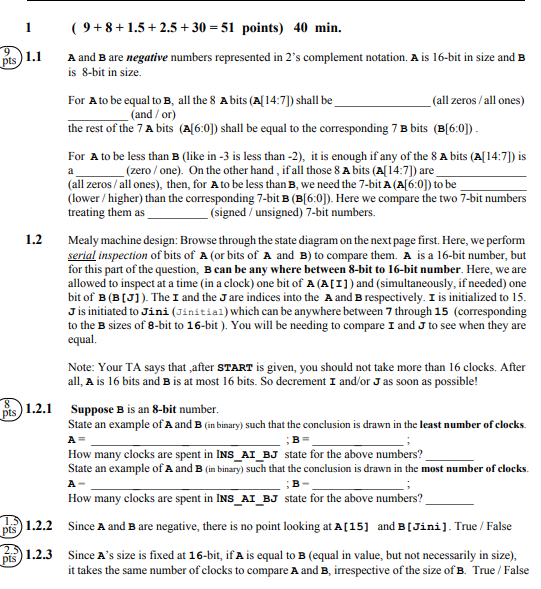
A and are negative numbers represented in s complement notation. is bit in size and
is bit in size.
For to be equal to all the A bits : shall be
all zerosall ones
andor
the rest of the A bits A: shall be equal to the corresponding bits B:
For to be less than like in is less than it is enough if any of the A bits : is
a
zero one On the other hand, if all those A bits : are
all zerosall ones then, for to be less than we need the bit : to be
lower higher than the corresponding bit : Here we compare the two bit numbers
treating them as
signed unsignedbit numbers.
Mealy machine design: Browse through the state diagram on the next page first. Here, we perform
serial inspection of bits of or bits of A and to compare them. is a bit number, but
for this part of the question, B can be any where between bit to bit number. Here, we are
allowed to inspect at a time in a clock one bit of A A I and simultaneously if needed one
bit of The I and the are indices into the A and respectively. I is initialized to
is initiated to Jini Jinitial which can be anywhere between through corresponding
to the sizes of bit to bit You will be needing to compare I and to see when they are
equal.
Note: Your TA says that after START is given, you should not take more than clocks. After
all, is bits and is at most bits. So decrement I andor as soon as possible!
Suppose B is an bit number.
State an example of A and in binary such that the conclusion is drawn in the least number of clocks.
;
How many ciocks are spent in INsABu state for the above numbers?
State an example of A and in binary such that the conclusion is drawn in the most number of clocks.
A
How many clocks are spent in INSAIBJ state for the above numbers?
Pts Since A and are negative, there is no point looking at and Jini True False
pts Since s size is fixed at bit, if is equal to equal in value, but not necessarily in size
it takes the same number of clocks to compare A and irrespective of the size of True False
Step by Step Solution
There are 3 Steps involved in it
1 Expert Approved Answer
Step: 1 Unlock

Question Has Been Solved by an Expert!
Get step-by-step solutions from verified subject matter experts
Step: 2 Unlock
Step: 3 Unlock
 Study Help