







Question: 9. An entity recognizes a contract liability if it transfers a promised good or service before the customer pays the consideration. 10. A contract asset
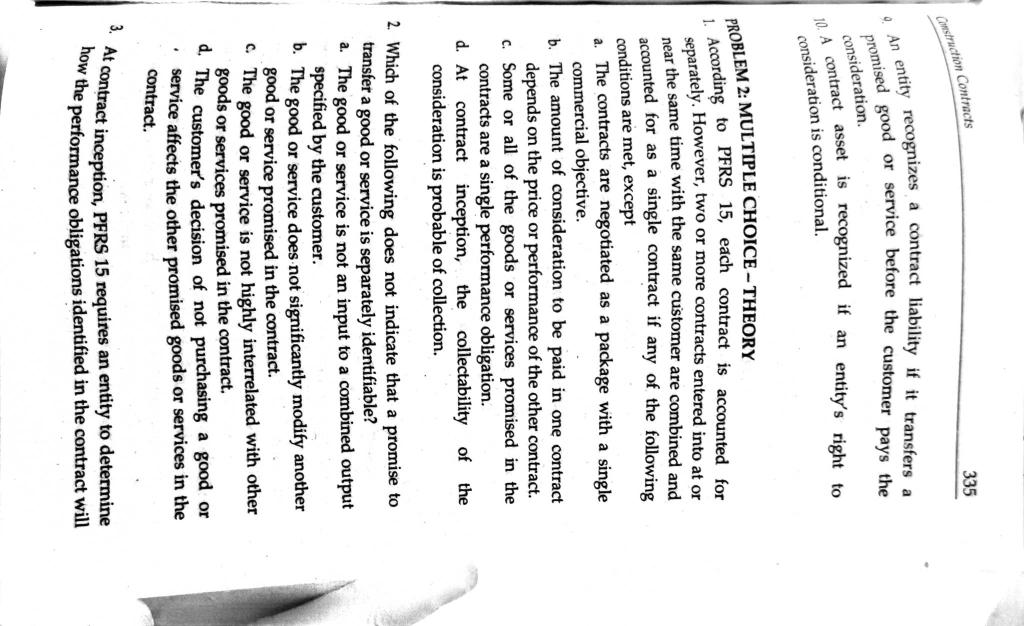
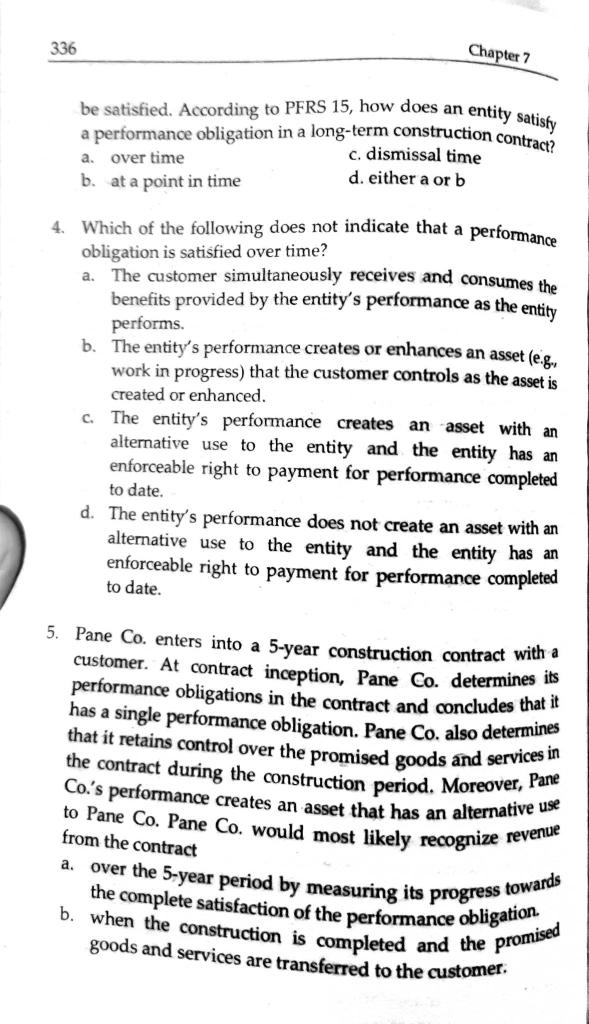
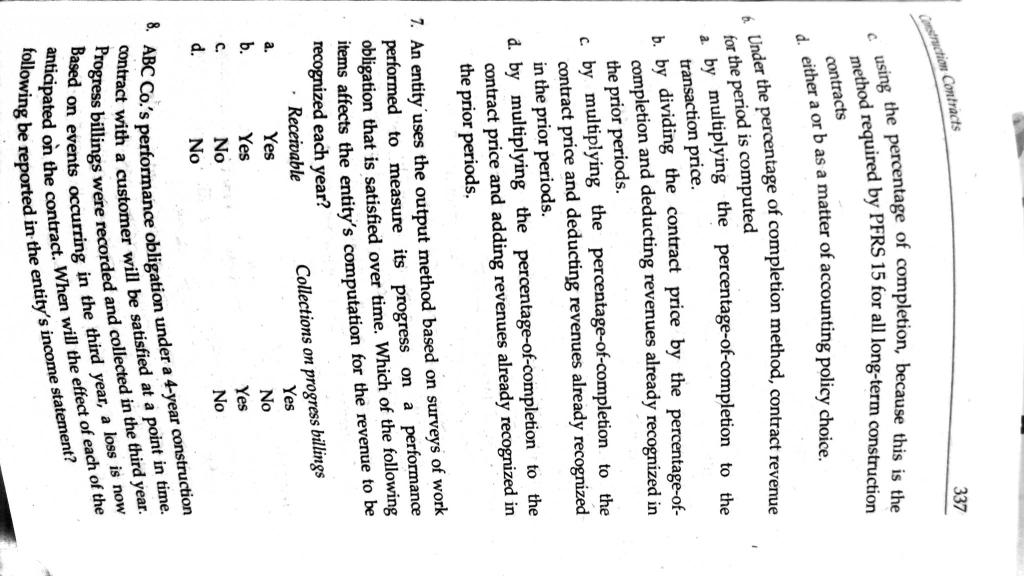
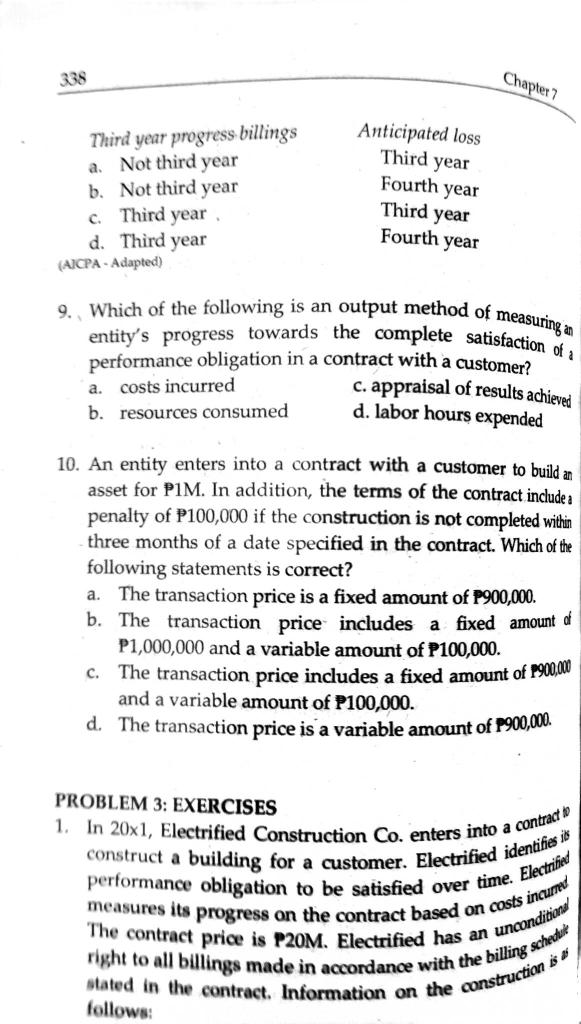
9. An entity recognizes a contract liability if it transfers a promised good or service before the customer pays the consideration. 10. A contract asset is recognized if an entity's right to consideration is conditional. PROBLEM 2: MULTIPLE CHOICE - THEORY 1. According to PFRS 15, each contract is accounted for separately. However, two or more contracts entered into at or near the same time with the same cuistomer are combined and accounted for as a single contract if any of the following conditions are met, except a. The contracts are negotiated as a package with a single commercial objective. b. The amount of consideration to be paid in one contract depends on the price or performance of the other contract. c. Some or all of the goods or services promised in the contracts are a single performance obligation. d. At contract inception, the collectability of the consideration is probable of collection. 2. Which of the following does not indicate that a promise to transfer a good or service is separately identifiable? a. The good or service is not an input to a combined output specified by the customer. b. The good or service does not significantly modify another good or service promised in the contract. c. The good or service is not highly interrelated with other goods or services promised in the contract. d. The customer's decision of not purchasing a good or - service affects the other promised goods or services in the contract. 3. At contract inception, PFRS 15 requires an entity to determine how the performance obligations identified in the contract will be satisfied. According to PFRS 15, how does an entity satisfy a performance obligation in a long-term construction contract? a. over time c. dismissal time b. at a point in time d. either a or b 4. Which of the following does not indicate that a performance obligation is satisfied over time? a. The customer simultaneously receives and consumes the benefits provided by the entity's performance as the entity performs. b. The entity's performance creates or enhances an asset (e.g. work in progress) that the customer controls as the asset is created or enhanced. c. The entity's performance creates an asset with an alternative use to the entity and the entity has an enforceable right to payment for performance completed to date. d. The entity's performance does not create an asset with an alternative use to the entity and the entity has an enforceable right to payment for performance completed to date. 5. Pane Co. enters into a 5-year construction contract with a customer. At contract inception, Pane Co. determines its performance obligations in the contract and concludes that it has a single performance obligation. Pane Co. also determines that it retains control over the promised goods and services in the contract during the construction period. Moreover, Pane Co.'s performance creates an asset that has an alternative use to Pane Co. Pane Co. would most likely recognize revenue from the contract a. over the 5-year period by measuring its progress towards the complete satisfaction of the performance obligation. b. when the construction is completed and the promised goods and services are transferred to the customer. c. using the percentage of completion, because this is the method required by PFRS 15 for all long-term construction contracts d. either a or b as a matter of accounting policy choice. 6. Under the percentage of completion method, contract revenue for the period is computed a. by multiplying the percentage-of-completion to the transaction price. b. by dividing the contract price by the percentage-ofcompletion and deducting revenues already recognized in the prior periods. c. by multiplying the percentage-of-completion to the contract price and deducting revenues already recognized in the prior periods. d. by multiplying the percentage-of-completion to the contract price and adding revenues already recognized in the prior periods. 7. An entity uses the output method based on surveys of work performed to measure its progress on a performance obligation that is satisfied over time. Which of the following items affects the entity's computation for the revenue to be 8. ABC Co.'s performance obligation under a 4-yea w. on contract with a customer will be satisfied at a point in time. Progress billings were recorded and collected in the third year. Based on events occurring in the third year, a loss is now anticipated on the contract. When will the effect of each of the following be reported in the entity's income statement? Third year progress billings Anticipated loss a. Not third year Third year b. Not third year Fourth year c. Third year . Third year d. Third year Fourth year (ACPA-Adapted) 9. Which of the following is an output method of measuring in entity's progress towards the complete satisfaction of a performance obligation in a contract with a customer? a. costs incurred c. appraisal of results achieved b. resources consumed d. labor hours expended 10. An entity enters into a contract with a customer to build an asset for P1M. In addition, the terms of the contract include penalty of P100,000 if the construction is not completed within three months of a date specified in the contract. Which of the following statements is correct? a. The transaction price is a fixed amount of P900,000. b. The transaction price includes a fixed amount d P1,000,000 and a variable amount of P100,000. c. The transaction price includes a fixed amount of P900,000 and a variable amount of P100,000. d. The transaction price is a variable amount of P900,000. PROBLEM 3: EXERCISES 1. In 201, Electrified Construction Co. enters into a contract to construct a building for a customer. Electrified identifif j0 performance obligation to be satisfied over time. Electrifict measures its progress on the contract based on costs incumber The contract price is P20M. Electrified has an uncondition right to all billings made in accordance with the billing gcheve stated in the contract. Information on the construction follows
Step by Step Solution
There are 3 Steps involved in it

Get step-by-step solutions from verified subject matter experts
 Study Help