



Question: 9. Consider the following simple principal/ agent problem. A firm hires an employee to perform a sales function. Let e denote employee's effort level. Suppose
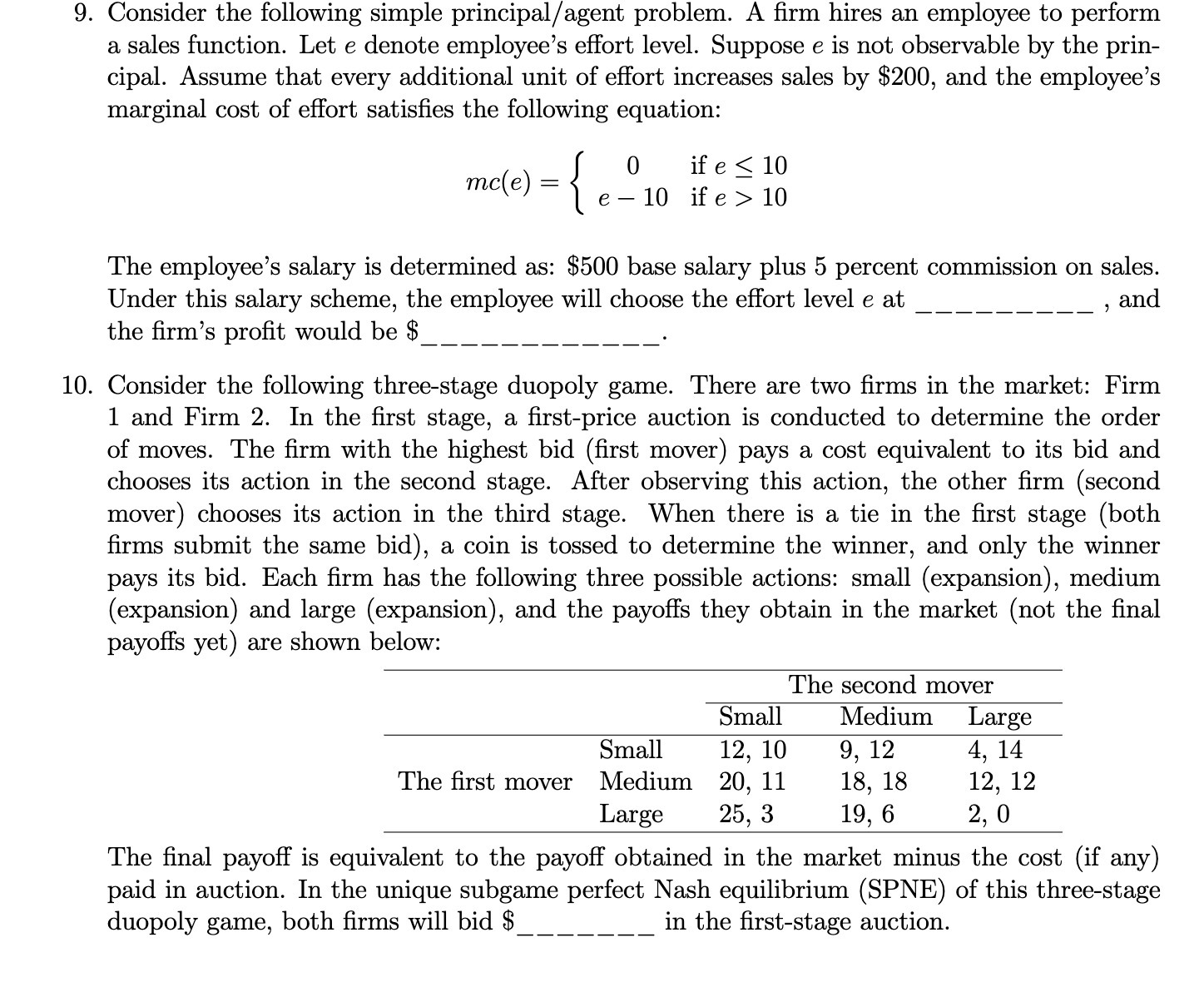
9. Consider the following simple principal/ agent problem. A firm hires an employee to perform a sales function. Let e denote employee's effort level. Suppose e is not observable by the prin- cipal. Assume that every additional unit of effort increases sales by $200, and the employee's marginal cost of effort satisfies the following equation: mc(e) = 0 if e 10 The employee's salary is determined as: $500 base salary plus 5 percent commission on sales. Under this salary scheme, the employee will choose the effort level e at , and the firm's profit would be $ 10. Consider the following three-stage duopoly game. There are two firms in the market: Firm 1 and Firm 2. In the first stage, a first-price auction is conducted to determine the order of moves. The firm with the highest bid (first mover) pays a cost equivalent to its bid and chooses its action in the second stage. After observing this action, the other firm (second mover) chooses its action in the third stage. When there is a tie in the first stage (both firms submit the same bid), a coin is tossed to determine the winner, and only the winner pays its bid. Each firm has the following three possible actions: small (expansion), medium (expansion) and large (expansion), and the payoffs they obtain in the market (not the final payoffs yet) are shown below: The second mover Small Medium Large Small 12, 10 9, 12 4, 14 The first mover Medium 20, 11 18, 18 12, 12 Large 25, 3 19, 6 2, 0 The final payoff is equivalent to the payoff obtained in the market minus the cost (if any) paid in auction. In the unique subgame perfect Nash equilibrium (SPNE) of this three-stage duopoly game, both firms will bid $ in the first-stage auction
Step by Step Solution
There are 3 Steps involved in it

Get step-by-step solutions from verified subject matter experts