



Question: 9. If we increase the significance level for a righttailed test (a) the t critical value increases [bj the pvalue increases [ch the probability of
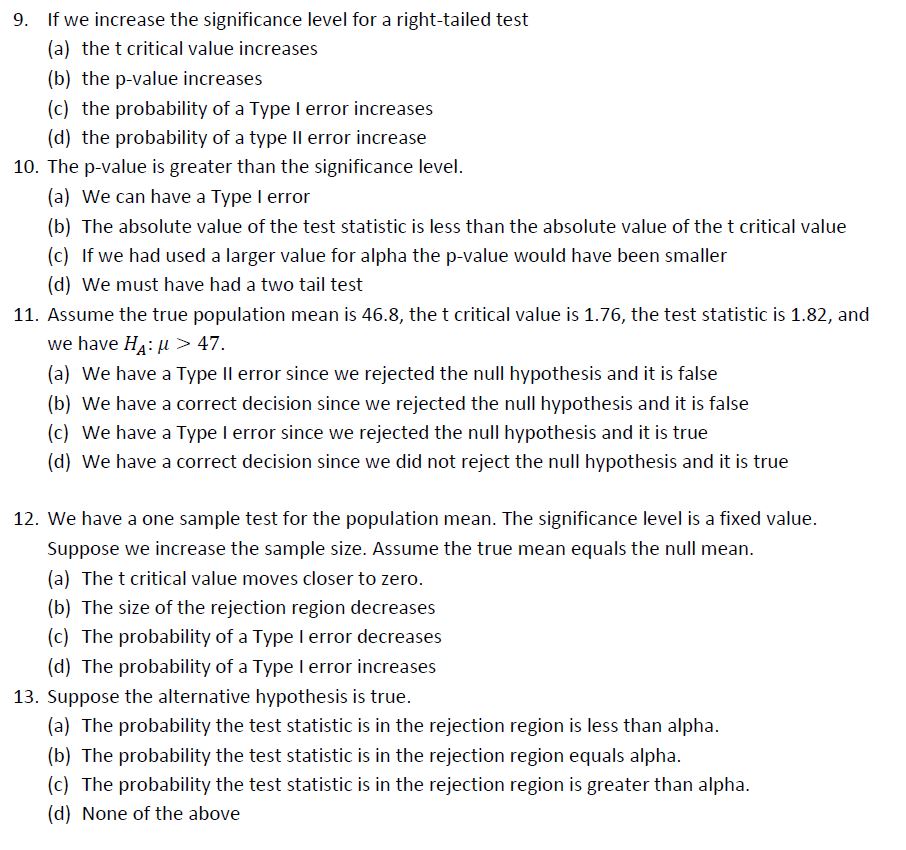
9. If we increase the significance level for a righttailed test (a) the t critical value increases [bj the pvalue increases [ch the probability of a Type I error increases id} the probability of a type II error increase 10. The pvaiue is greater than the significance level. (a) We can have a Type I error {b} The absolute value of the test statistic is less than the absolute value of the t critical value {c} If we had used a larger value for alpha the pvalue would have been smaller {d} We must have had a two tail test 11. Assume the true population mean is 46.8, the t critical value is 1.?6, the test statistic is 1.821 and we have 112,141} 4?. la) We have a Type II error since we rejected the null hypothesis and it is false {b} We have a correct decision since we rejected the null hypothesis and it is false it} idi We have a Type I error since we rejected the null hypothesis and it is true We have a correct decision since we did not reject the null hypothesis and it is true 12. We have a one sample test for the population mean. The significance level is a fixed value. Suppose we increase the sample size. Assume the true mean eoualsthe null mean. la) The t critical value moves closer to zero. lb} The size ofthe rejection region decreases {c} The probability of a Type I error decreases id} The probability of a Type I error increases 13. Suppose the alternative hypothesis is true. la) The probability the test statistic is in the rejection region is less than alpha. lb} The probability the test statistic is in the rejection region equals alpha. is} W) The probability the test statistic is in the rejection region is greater than alpha. None of the above
Step by Step Solution
There are 3 Steps involved in it

Get step-by-step solutions from verified subject matter experts