



Question: [9 marks| Number Representations. As you might suspect, it is possible to represent numbers in other ways besides decimal (base-10) and binary (base-2). One intriguing
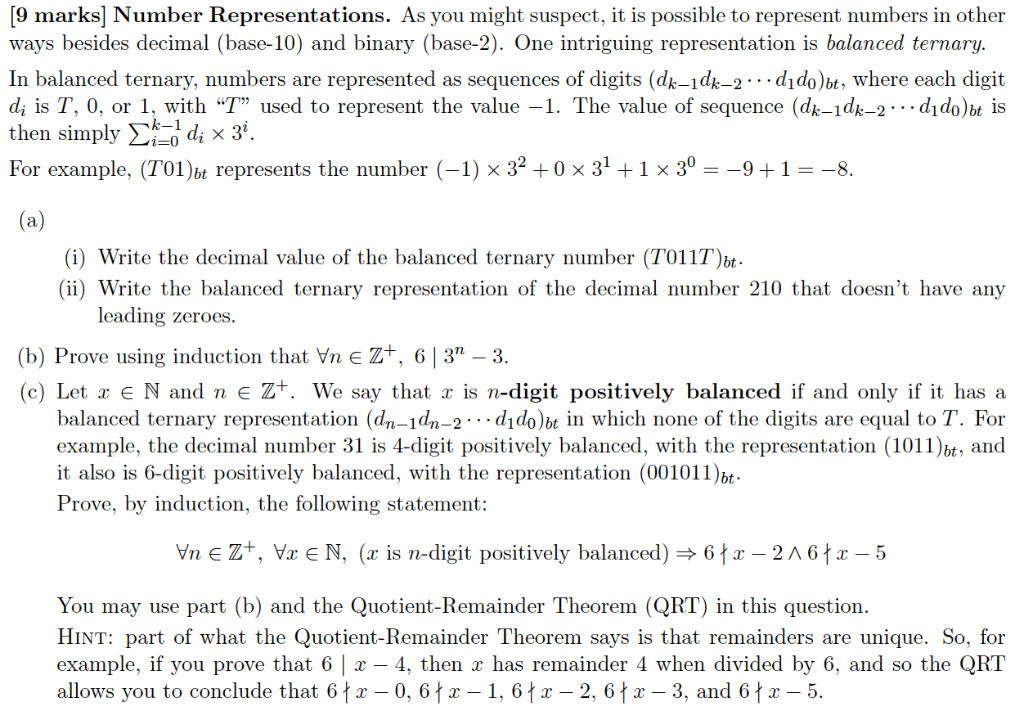
[9 marks| Number Representations. As you might suspect, it is possible to represent numbers in other ways besides decimal (base-10) and binary (base-2). One intriguing representation is balanced ternary In balanced ternary, numbers are represented as sequences of digits (dk-1dk-2.. -dido)bt, where each digit d; is T, 0, or 1, with .." used to represent the value-1. The value of sequence (dk-dk-2 dd0)bt ls then simply 0 dx 31 For example, (T01)bt represents the number (-1) x 32 +0x 31 +1x 30 -91--8. k-1 (i) Write the decimal value of the balanced ternary number (T011T)bt (ii) Write the balanced ternary representation of the decimal number 210 that doesn't have any leading zeroes (b) Prove using induction that yn Z+, 6 | 3n-3 (c) Let a E N and n E Z+. We say that a is n-digit positively balanced if and only if it has a balanced ternary representation (dn_1dn-2d1d0)bt in which none of the digits are equal to T. For example, the decimal number 31 is 4-digit positively balanced, with the representation (1011)bt, and it also is 6-digit positively balanced, with the representation (001011 bt Prove, by induction, the following statement: Vn E Z+, yx E N, (x is n-digit positively balanced) 6 t x-2 6 t x-5 You may use part (b) and the Quotient-Remainder Theorem (QRT) in this question. HiNT: part of what the Quotient-Remainder Theorem says is that remainders are unique. So, for example, if you prove that 6 x - 4, then x has remainder 4 when divided by 6, and so the QRT allows you to conclude that 60, 61 1, 612, 6t-3, and 61 -5
Step by Step Solution
There are 3 Steps involved in it

Get step-by-step solutions from verified subject matter experts